Does Houston Heat Cut Your Home Battery's Output? What Derating Actually Does

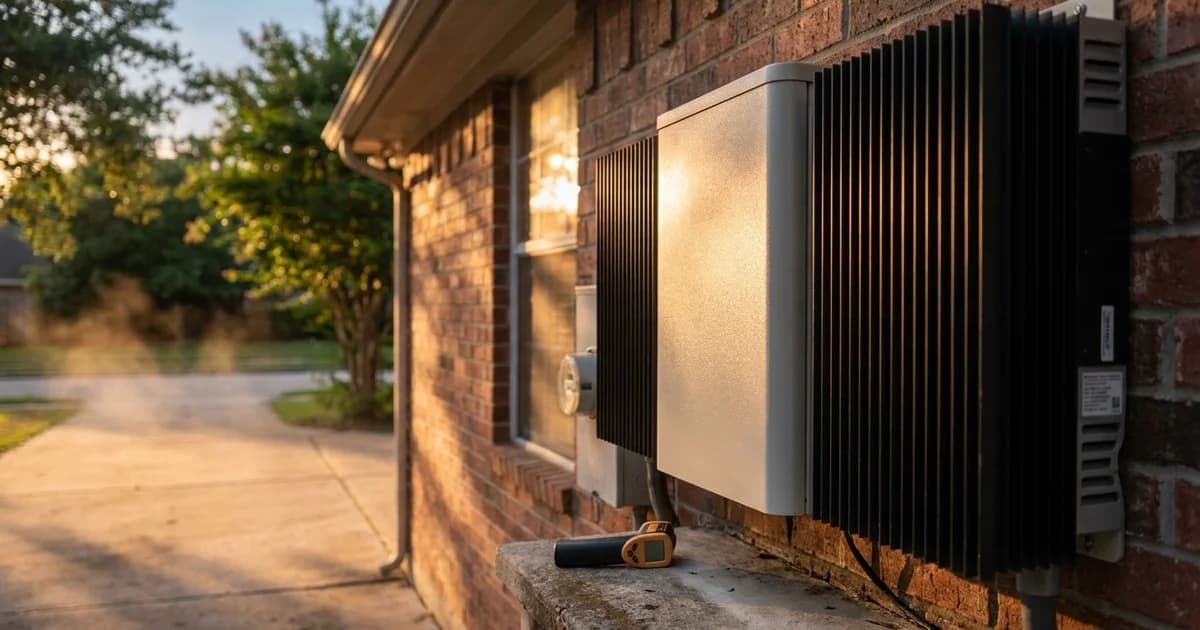
A homeowner opens a battery data sheet, finds an ambient operating range topping out at 131F, does the mental math against a Houston August, and relaxes. Then a second temperature appears further down the same page. It is lower, and nobody explained why there are two.
That second number is where the real answer lives. "Does heat hurt my battery" is two questions wearing one coat: a fast one about power output on a hot afternoon, and a slow one about capacity loss across years. This post pulls them apart using what manufacturers actually publish, and it is honest about what they don't.
Key Takeaways
- Houston heat can reduce a home battery's power output, but through derating, a deliberate firmware power limit, not through a loss of stored energy. Your kilowatt-hours do not evaporate in the heat.
- Every spec sheet carries two temperature numbers. The Enphase IQ Battery 5P lists an ambient operating range up to 131F while discharging, but supports maximum discharge power only between 32F and 122F.
- Tesla states Powerwall 3 performance "may be de-rated at operating temperatures above 40C (104F)" and does not publish how much.
- Derating is a power-electronics protection, not damage. SMA defines it as the controlled reduction of inverter power that keeps semiconductors below their permissible temperature.
- The slow effect is separate. Calendar aging follows Arrhenius behavior, so sustained cell temperature accelerates capacity fade over years, not over one hot afternoon.
- Houston's normal daily high is 94.5F in July and 94.9F in August, which sits inside the full-power discharge window of every major residential battery.
Does Houston heat reduce home battery output?
Yes, above a threshold most Houston days never reach, and the mechanism is a firmware power limit rather than a loss of stored energy. Tesla states that Powerwall 3 performance "may be de-rated at operating temperatures above 40C (104F)" (Tesla, Powerwall 3 Owner's Manual). Enphase supports maximum discharge power up to 122F (Enphase, Temperature Guidelines for IQ Battery Installation, TEB-00300-3.0, February 2026).
Hold onto one distinction and the rest follows from it: energy is not power. Energy is the kilowatt-hours in the pack. Power is the kilowatts the system pushes out at this instant. Heat does not drain the first. It can cap the second, temporarily, then lift the cap when things cool.
Two effects, two clocks. Power derating works in minutes and hours. Calendar aging works in years. Consumer articles blend them into one vague warning, which is why this topic feels murkier than it is. The equipment ratings sit side by side on the full system spec sheet.
Every battery spec sheet has two temperature numbers
The operating range says where the equipment is allowed to run. The full-power range says where it will run at its rated output. Enphase publishes both, and the gap between them is exactly where derating lives.
Take the IQ Battery 5P. Its ambient operating range while discharging is -4F to 131F, and while charging -4F to 122F (Enphase, IQ Battery 5P Data Sheet, DSH-00010-6.0, May 2024). The full-power window is narrower, and Enphase sets it in the accompanying technical brief: maximum-power discharge is supported only between 32F and 122F, and maximum-power charging only between 59F and 113F. Outside those limits, Enphase writes, the battery "will charge and discharge at a reduced power level, known as derated power," and adds that this behavior "is typical for all lithium-ion cell-based batteries."
Notice which window is narrower. Charging tops out at 113F, nine degrees below the discharge window. For a solar-paired system in August, the pinch shows up while the sun fills the pack, not while the house draws from it.
There is a measurement trap here that almost every article misses. Enphase specifies these as internal temperatures, notes the module interior typically runs about 2C above the outside air, and tells installers to carry a 2C design margin. Your porch thermometer is not reading the number the firmware watches.
Enphase is also blunt about the safety question, and the answer is reassuring: exposure to temperatures within -22F to 140F "does not represent a safety risk." Batteries may derate charge and discharge current in that band, "but there is no risk to safe operation."
Inverter thermal derating is the real Houston effect
The part of the system most likely to pull back on a Houston afternoon is not the cells. It's the power electronics, because semiconductor junctions and the heatsink cooling them hit their limits before the cells hit theirs.
SMA publishes the clearest public description of the mechanism. "Derating is the controlled reduction of the inverter power," the company writes. "Temperature derating prevents the sensitive semiconductors in the inverter from overheating. Once the permissible temperature on the monitored components is reached, the inverter shifts its operating point to a reduced power level" (SMA Solar Technology, Technical Information: Temperature Derating, Temp-Derating-TI-en-15, v1.5).
Three details matter to a homeowner. Power comes down in steps, not on a smooth slide. In extreme cases the unit shuts down entirely. And once the monitored components fall below the critical value, the inverter returns to its optimum operating point on its own. No app, no reset, no truck roll. SMA's listed causes include several a Houston install can control: poor heat dissipation from unfavorable installation conditions, operation in direct sunlight or high ambient air, and clogged heat sinks or failed fans.
Picture the thermal chain in order. Ambient air, then enclosure interior, then heatsink, then semiconductor junction. Each link adds a few degrees. The firmware watches the last one, and that last one lags ambient by tens of minutes. This is why derating tends to appear in the late afternoon, after a long solar soak, rather than at the instant the thermometer peaks. It is also why compressor inrush is usually the binding constraint, not the battery.
Now the uncomfortable part, stated plainly. No major residential battery manufacturer publishes a derating curve as a percentage of output at a given ambient temperature. Enphase says power is reduced outside the full-power window and does not say by how much. Tesla says performance may be derated above 104F and does not say by how much. SMA publishes the shape of a derating curve, but as an illustrative example for PV inverters, not as a residential battery specification. Any article telling you "your battery loses 20% at 110F" invented that number.
Derating is not the same as losing efficiency
A warm converter is not a wasteful converter, and Sandia National Laboratories measured it. Riley and Fresquez held DC input power and voltage nearly constant while a temperature chamber swept ambient air from 18.9C to 49.7C across seven steps, then estimated "an approximate absolute inversion efficiency change of about +0.01 %/C to +0.03 %/C for this microinverter" (Riley and Fresquez, Determining the Effect of Temperature on Microinverter Inversion Efficiency, SAND2014-4411C, 2014). The effect was small enough that they judged it reasonable to omit temperature from the AC-module characterization model.
Translate that. Across a 30C swing, conversion efficiency moves by a fraction of a percentage point, which no homeowner would notice on a monitoring screen.
So the correct mental model is a ceiling, not a leak. Below the threshold you get everything the equipment is rated for. Above it, firmware puts a lid on instantaneous kilowatts, then lifts the lid. Nothing bleeds away in between. One honest caveat: Sandia tested a microinverter, not a residential battery inverter, and it was a single device. Strong directional evidence about the mechanism, not a universal constant.
What sustained heat actually costs you, measured in years
The slow effect is real, and it is a different animal. It is measured in years of accumulated cell temperature, not in the temperature of one afternoon.
Werner, Paarmann and Wetzel stored graphite/NCA pouch cells at 40C, 50C and 60C across states of charge from 20% to 100%, monitored self-discharge continuously, and measured remaining capacity and impedance after each storage period. They found accelerated capacity fade and impedance rise with increasing temperature, "following the law of Arrhenius" (Werner, Paarmann and Wetzel, Calendar Aging of Li-Ion Cells, Batteries 2021, 7(2), 28).
Two findings from that paper rarely reach consumer articles. First, no path dependency: earlier storage periods at different temperature levels did not change the present degradation rate. A brutal week contributes its share of aging and nothing more. It does not permanently reset the clock, which is the most reassuring peer-reviewed result available to a Houston owner.
Second, state of charge does heavy lifting at the top of the range. The impact of storage at 100% state of charge was large, while the influence below 80% was small. Heat plus a permanently full pack is worse than heat alone, and that is an operating decision rather than a climate one.
The modelling side corroborates it. NREL fit a life prediction model across nine aging test conditions from 0C to 55C and predicted capacity fade with 1.4% RMS error (Smith et al., Life Prediction Model for Grid-Connected Li-ion Battery Energy Storage System, NREL/PR-5400-68759, 2017). Temperature-driven aging is well characterized, not speculative.
Scope this honestly. Those are laboratory storage temperatures held constant, and no Houston install sits at 60C. The mechanism transfers. The magnitudes do not. For what does move the needle over a decade, see the maintenance rhythm that protects your warranty.
Active thermal management changes the answer
Whether heat costs you anything depends less on Houston than on whether the enclosure can move heat out faster than the sun puts it in.
SMA frames the two approaches cleanly. Passively cooled units dissipate heat to the atmosphere through heat sinks. Actively cooled units add a speed-controlled fan that draws air through the enclosure's cooling ducts and spins faster as temperature rises. The stated advantage: "the inverter can continue to feed in its maximum power as the temperature rises. The inverter is not derated until the cooling system reaches the limits of its capacity."
Residential batteries split along the same line. The IQ Battery 5P data sheet lists passive cooling with "no moving parts or fans," a deliberate reliability choice that carries a thermal cost. Tesla's Powerwall 3 states it is designed to operate in all climates and in direct sunlight across its -20C to 50C range.
The takeaway is narrow but useful. Active cooling raises the ambient temperature at which derating begins. It does not abolish thermal limits, it pushes them further from a Houston August. Where the equipment goes is a separate decision with its own tradeoffs, covered in indoor versus outdoor battery installation.
On Eos commissioning visits around Houston, derating shows up the same way nearly every time: as a temporary power ceiling in the monitoring app during the late-afternoon peak. The customers who notice it are almost always the ones who tried to start a large air conditioning compressor at five in the afternoon on a sun-loaded install.
The Houston reality check
Houston's normal summer highs sit comfortably inside the full-power discharge window of every major residential battery. Under the 1991 to 2020 normals, the normal daily maximum at Bush Intercontinental is 94.5F in July and 94.9F in August, the two hottest months (NWS Houston/Galveston, IAH Extremes, Normals and Annual Summaries). The all-time record there is 109F. That 94.9F afternoon runs roughly 27F below Enphase's 122F full-power discharge ceiling and about 9F below Tesla's stated 104F onset. The normal Houston day is not a derating day.
Then the complication. Ambient is not enclosure temperature, and enclosure is not heatsink temperature. A sun-loaded enclosure on a 95F afternoon is warmer inside than 95F, and Enphase's 2C internal offset is a floor for that gap, not a ceiling.
Here is the design tension worth taking seriously. The week you most need full output is the week the equipment runs hottest. Hurricane Beryl knocked out power to about 2.7 million customers in southeastern Texas in July 2024, and the National Hurricane Center attributed fourteen deaths to "heat-induced hyperthermia caused by widespread electrical outages" (NHC, Tropical Cyclone Report: Hurricane Beryl, AL022024). Days later, 1.3 million Texas customers were still dark (Texas Tribune, 2024).
The answer to that overlap is headroom. A system with margin above your real peak load can give a little back on the worst afternoon and still carry the house, which is also how many hours you actually get in a Texas outage.
The bottom line
Derating is real, documented, and a protection rather than a defect. It steps down, it recovers on its own, and the manufacturers say in writing that it is not a safety issue. It is also not a reason to skip a battery. The alternative to a system that occasionally trims its output ceiling on the hottest afternoon of the year is no power at all on that afternoon, in a house where the heat index climbs all day.
The design response is headroom and honest sizing. Size for the peak you actually run, not for an average, and compare system sizes against your real load rather than your square footage. One last admission: nobody can tell you your exact output at 108F, because nobody publishes that curve. Any installer who quotes a precise derating percentage is guessing, and you should ask where the number came from.
Or call Eos at 833-989-3737 to talk through your setup with an installer.
Frequently asked questions
Does heat reduce how much energy my home battery stores?
No. Heat can limit instantaneous power in kilowatts, not stored energy in kilowatt-hours. Enphase states that outside its full-power windows the battery "will charge and discharge at a reduced power level, known as derated power." The pack still holds its rated capacity, it just delivers it more slowly.
What temperature is too hot for a home battery?
Two different answers. For full power, Enphase supports maximum discharge only up to 122F and Tesla says performance may be derated above 104F. For safety, Enphase states exposure within -22F to 140F "does not represent a safety risk." Too hot for rated output and too hot for safe operation are different numbers.
Will my battery still run the air conditioner on a 100F Houston day?
Usually yes, and the question is headroom rather than heat. An Eos residential system delivers 11.5 kW continuous and 17.1 kW surge from one controller, and 100F sits below every published derating threshold discussed here. Verify your compressor's start event against that surge figure, nameplate by nameplate.
Does derating damage the battery?
No, it exists to prevent damage. SMA describes derating as a controlled reduction that keeps semiconductors below their permissible temperature, with automatic return to the optimum operating point once components cool. Enphase is explicit that batteries may derate current within its stated range with no risk to safe operation.
Does Houston heat void a home battery warranty?
Read your own warranty document, because the answer is product-specific. Enphase's technical brief states that ambient temperature can affect the product's functionality and warranty coverage, and directs readers to the full warranty documents rather than summarizing them. Installation location and long-term thermal exposure are the usual variables.
Sources
- Enphase Energy, Temperature Guidelines for IQ Battery Installation, TEB-00300-3.0, February 2026, retrieved 2026-09-08, https://enphase.com/download/temperature-guidelines-iq-battery-installation
- Enphase Energy, IQ Battery 5P Data Sheet, DSH-00010-6.0, May 2024, retrieved 2026-09-08, https://signaturesolar.com/content/documents/Enphase/Battery/IQ%20Battery-5P-DSH-00010-2.0-EN-US-2023-07-26%20(1).pdf
- Tesla, Powerwall 3 Owner's Manual, Care and Maintenance, retrieved 2026-09-08, https://energylibrary.tesla.com/docs/Public/EnergyStorage/Powerwall/3/OwnerManual/en-us/GUID-4FB9DC70-1855-4E65-B977-9C583ECC8236.html
- SMA Solar Technology AG, Technical Information: Temperature Derating, Temp-Derating-TI-en-15, Version 1.5, retrieved 2026-09-08, https://files.sma.de/downloads/Temp-Derating-TI-en-15.pdf
- Riley, D. and Fresquez, A., Determining the Effect of Temperature on Microinverter Inversion Efficiency, Sandia National Laboratories, SAND2014-4411C, 40th IEEE Photovoltaic Specialist Conference, 2014, retrieved 2026-09-08, https://www.osti.gov/biblio/1146323
- Werner, D., Paarmann, S. and Wetzel, T., Calendar Aging of Li-Ion Cells: Experimental Investigation and Empirical Correlation, Batteries 2021, 7(2), 28, retrieved 2026-09-08, https://doi.org/10.3390/batteries7020028
- Smith, K., Saxon, A., Keyser, M., Lundstrom, B., Cao, Z. and Roc, A., Life Prediction Model for Grid-Connected Li-ion Battery Energy Storage System, National Renewable Energy Laboratory, NREL/PR-5400-68759, 2017, retrieved 2026-09-08, https://www.osti.gov/biblio/1390498
- NOAA National Weather Service, Houston/Galveston, IAH Extremes, Normals and Annual Summaries, 1991 to 2020 normals, retrieved 2026-09-08, https://www.weather.gov/hgx/climate_iah_normals_summary
- NOAA National Hurricane Center, Tropical Cyclone Report: Hurricane Beryl (AL022024), retrieved 2026-09-08, https://www.nhc.noaa.gov/data/tcr/AL022024_Beryl.pdf
- The Texas Tribune, Beryl power outages continue as heat and debris slow recovery, 2024, retrieved 2026-09-08, https://www.texastribune.org/2024/07/11/beryl-power-outage-debris-rain-heat-sargent-texas/
Eduardo Donadi Neto is Founder and CEO of Eos Backup and Battery, which designs and installs home battery backup systems across the Houston metro. Equipment ratings reflect Eos residential specifications as of September 2026. Manufacturer temperature limits cited here apply to the specific products named and are not general to all home batteries. Confirm the figures on your own equipment's data sheet and warranty documents.