Spring Branch and Northwest Houston Battery Backup: Older Homes, Big Trees, Bayou Flooding

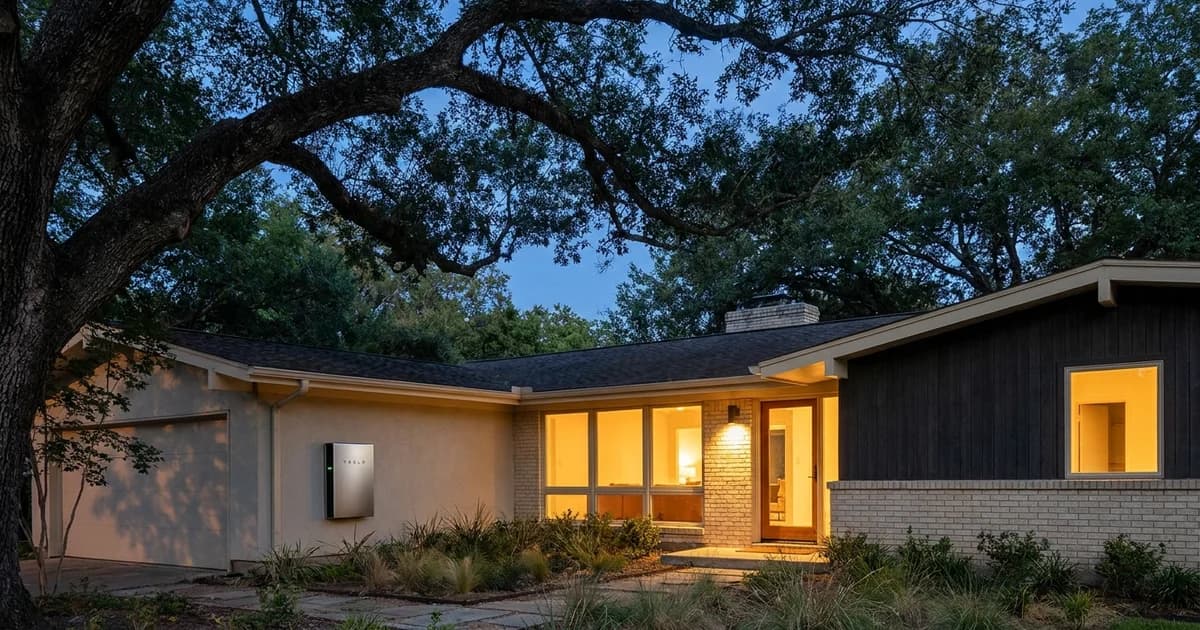
Spring Branch is not one kind of street. A 1950s brick ranch sits next to a new two-story on a subdivided lot, with a pecan tree older than both. Northwest Houston has a way of putting several different backup problems on one block: aging service equipment, trees over the lines, and creeks nearby.
I am not going to tell you your house has a 100-amp panel or sits in a flood zone. I can't know that from a neighborhood name, and a few of the claims you hear about this area have no public data behind them. This guide sticks to what I could verify, and says plainly where I could not.
Key Takeaways
- About 36 percent of housing units in ZIP 77055 and 38 percent in 77080 were built before 1970 (U.S. Census Bureau, ACS 2020-2024 5-year). Age is real, but your own main breaker is the only way to know your service size.
- Houston annexed what is now Spring Branch by 1957, after a post-war housing boom in the early 1950s (Houston Press).
- Trees, not equipment, drive many Houston outages. CenterPoint plans a three-year trimming cycle (KPRC).
- Harris County Flood Control lists Spring Branch Creek maintenance and rehabilitation projects. A battery does not change where water goes.
How old are the homes in Spring Branch, really?
Older than most of Houston's suburbs, though not uniformly. The Houston Press describes unincorporated land in the early 1950s that "was beginning to see a post-war housing boom," and says Houston annexed the remaining area of modern Spring Branch in 1957 (Houston Press, The Changing Face of Houston: Spring Branch Then and Now). The same article notes that older homes in nearby Inner Loop areas are being replaced with much larger ones.
The Census gives a number to go with that story. In the 2020-2024 American Community Survey, ZIP code tabulation area 77055 (which covers much of Spring Branch) counts 18,349 housing units, of which 406 were built in 1949 or earlier, 3,758 in 1950 to 1959 and 2,443 in 1960 to 1969. That adds up to about 36 percent built before 1970. ZIP 77080, next door, comes to about 38 percent (computed from the Census Bureau tables via Census Reporter).
Two cautions. ZIP codes do not match neighborhood lines, so treat these as the area, not your street. And the same data shows a rental market: in 77055, about 54 percent of occupied units are rented, and in 77080 about 51 percent. If you rent, the equipment decision belongs to your landlord, and a portable option is a different conversation.
Is the electrical panel in an older Spring Branch house a problem?
It might be, and it might not. Our Memorial Villages guide already looked for public data on how many Spring Branch homes sit on 100-amp service and found none. I looked again for this post and found nothing new, so I am not repeating the claim.
What I can say is how the rule works. A 100-amp panel limits how much back-fed breaker capacity a battery can add under the electrical code. Our 100-amp panel guide explains when an upgrade is required and three code-legal ways around it, and our panel connection guide covers the critical-load subpanel approach.
The practical step is simple: open the panel door and read the number on the main breaker. If it says 100, you have a question to ask an installer, not a dealbreaker.
Why do trees matter so much for outages here?
Because they are the most common thing between your house and the grid when the weather turns. KPRC reported that Hurricane Ike in 2008 knocked out power to 95 percent of CenterPoint customers, largely because trees and limbs fell on lines, and that CenterPoint spent more than $35 million on tree and vegetation trimming in 2023 (KPRC).
CenterPoint's response is a plan to clear hazardous trees and branches around power lines every three years, and to move a large part of its system underground (KPRC, CenterPoint's $5.75 billion plan). I could not verify which Spring Branch streets are on the near-term schedule, so I won't guess. Plans take years, and a neighborhood with mature canopy will see falling limbs in the meantime.
A battery does not stop a limb from landing on a wire. It does mean that when the wire comes down, your refrigerator, Wi-Fi, lights and medical devices keep running. Per our plan specs, the Essential plan's 8.76 kWh of usable capacity delivers up to 6 hours at minimal load, and larger plans add more.
What about creeks and flooding near Spring Branch?
This one needs the most care. The Harris County Flood Control District lists Spring Branch projects on its Buffalo Bayou page, including F-59 Spring Branch Creek W140-00-00 Major Maintenance, CI-018 Rehabilitation of Spring Branch and CI-017 Spring Branch ISD Subsurface Detention Basin (HCFCD, Buffalo Bayou projects). I could only confirm the project titles. The pages I could load did not show limits, schedules or current status, so I can't tell you what is built, what is pending, or whether your street is affected.
What I can say: whether a particular house floods depends on its elevation and its location relative to the channel, and a map lookup is the only reliable way to check. A battery in a flood-prone spot has its own placement rules, which we cover in home battery flood elevation in Houston. Neighbors in other northwest Harris County areas face similar creek questions, as our guides to Jersey Village and Bear Creek and Aldine and Greens Bayou show.
Do not buy a battery to solve a flooding problem. If your lot floods, the answer is drainage and elevation first. The battery is for the outage that follows.
What loads should a Spring Branch house protect first?
The same ones as anywhere in Houston, with one local twist. In a mid-century ranch with a smaller attic and older ductwork, central air tends to be the load that decides sizing. I don't have a verified average draw for Spring Branch homes, so measure your own: read the nameplate on your AC outdoor unit and your refrigerator.
A reasonable order:
- Refrigerator, freezer, Wi-Fi, lights and phone chargers.
- Any medical equipment.
- Sump pump, if you have one. Our sump pump guide covers the sizing.
- Central air, which usually decides whether you need more than one module.
Every Eos plan uses one controller rated for 11.5 kW continuous and 17.1 kW surge, which sets how many big loads can start together. Our smart panel guide explains how to prioritize circuits so the AC does not starve the fridge.
What did we leave out on purpose?
Some claims come up whenever people talk about this part of Houston. I am leaving them out because I could not support them:
- The share of Spring Branch homes on 100-amp service. No public dataset found.
- Which streets lose power most often. CenterPoint does not publish that by neighborhood in a form I could verify.
- Flood risk for your lot. Depends on your address and elevation.
- Install timelines. Scheduling and utility interconnection vary.
If a neighborhood guide gives you confident numbers on any of those without a source, ask where they came from.
What to do next
Three steps, in order:
- Read your main breaker and write down the number.
- Look up your address on the Harris County flood tools before deciding where equipment goes.
- List the three loads you can't lose and size from there.
For a wider look at storm season, our Houston hurricane season battery guide covers what to prepare and when.
Or call Eos at 833-989-3737 to talk through your setup with an installer.
Frequently asked questions
Are Spring Branch homes mostly old?
A large minority are. About 36 percent of housing units in ZIP 77055 and 38 percent in ZIP 77080 were built before 1970 (U.S. Census Bureau ACS 2020-2024, via Census Reporter). Many have been renovated or replaced, so check your own house.
Do I need a panel upgrade for a home battery in an older house?
Not necessarily. It depends on your main breaker and how the battery connects. See our 100-amp panel guide for the options.
Will trimming trees reduce my outages?
It can, over time. CenterPoint's plan calls for clearing hazardous vegetation around power lines every three years, but I could not verify how that applies to trees on private lots (KPRC). Your own trees on your own property are yours to maintain.
Does a battery protect against flooding?
No. A battery keeps power on after the grid fails. It does not stop water. Placement matters in flood-prone areas, so read our flood elevation guide.