Memorial and the Villages Battery Backup: Big Homes, Mature Pines

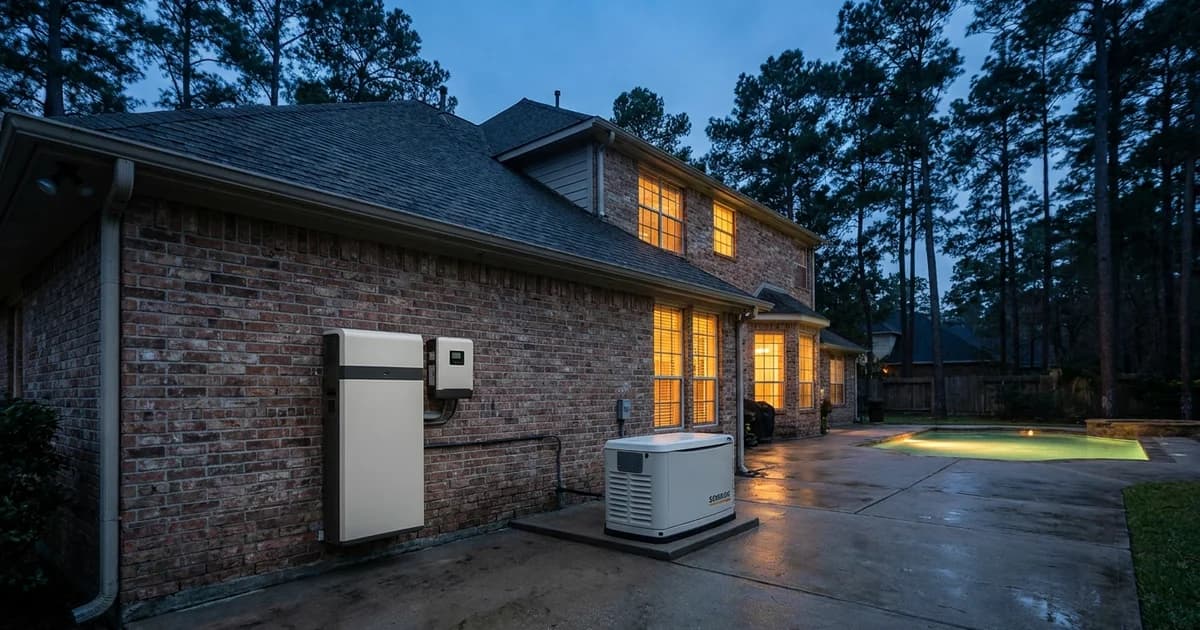
Most Memorial-area homes don't have an outage problem that looks like the one in a brochure. They have a size problem. Four thousand square feet or more, two or three AC zones, a pool, often a standby generator already bolted to a pad, and pine and oak canopy that has been growing over the service drop for fifty years.
That changes what "backup" means. This guide covers what scale does to battery sizing, how a battery fits next to the generator you may already own, and what the paperwork actually looks like in the Memorial Villages. One of those answers turned out to be different from what most contractors tell you.
Key Takeaways
- Under Texas SB 1252, a residential backup system of 100 kWh or less cannot be regulated by a city's installation or inspection rules (TDLR). Every Eos residential plan sits below that line.
- Fallen trees caused most Hurricane Beryl outages in Houston (Texas Tribune). Mature canopy is a real outage factor here.
- One controller delivers 11.5 kW continuous. A big house needs load priorities, not a bigger hope.
What makes a Memorial home different from a typical Houston house?
Scale, and the equipment that comes with it. A large home usually runs several AC systems, a pool pump and heater, an electric range, sometimes a second refrigerator or wine storage, and often a detached garage or guest house on the same service. None of that is exotic. It simply adds up past what a single small battery can carry through a Houston August night.
Our guide to sizing a battery for a 4,000 sqft Texas home walks through the arithmetic. The short version for this part of town: you are not backing up the whole house at full comfort. You are choosing which loads matter and giving them enough stored energy to run long enough.
The Eos hardware has a hard ceiling worth knowing. One smart controller delivers 11.5 kW continuous and 17.1 kW surge, which is what lets it start a central AC compressor. Two AC zones starting together, plus a pool pump, can push past that. A smart panel decides what stays on and what waits.
How many battery modules does a large home need?
It depends on which loads you protect and for how long, not on square footage alone. The Pro plan stores 26.28 kWh usable, and Eos rates it at up to 18 hours at minimal load: fridge, Wi-Fi, lights, medical devices. Premium stores 35.04 kWh usable. Ultimate stores 43.80 kWh usable.
Those hour counts assume minimal load. Run one AC zone in the evening and the numbers drop fast. For most estate-size homes in this area, the realistic choice is between Pro and Premium, with one or two AC zones prioritized and the rest deliberately left off the backed-up panel.
Why do trees matter so much for outages here?
Because falling limbs, not grid failures upstream, are what take down neighborhood feeders in a Gulf storm. In July 2024, Hurricane Beryl left about 2.6 million CenterPoint customers without power, and fallen trees caused the majority of those outages, according to the Texas Tribune's summary of the Public Utility Commission investigation. CenterPoint's own filing put peak interruptions at about 2.26 million customers and restoration costs at $1.2 billion to $1.3 billion (CenterPoint Energy, SEC Form 424B5, 2024). The two counts differ because outlets report different measures, so treat both as the same order of magnitude.
The same Tribune summary notes that 60% of the vegetation CenterPoint removed after Beryl came from trees outside its rights-of-way. That is why a utility trimming program only goes so far. The tree over your drive may not be the utility's to trim.
You also probably can't remove it. Hunters Creek Village, for one, treats any tree with an 18-inch circumference or larger as protected, and a removal permit requires a tree survey and a showing that removal is necessary for reasonable use of the site (City of Hunters Creek Village, Ordinance No. 722). Hunters Creek is one village of six, and other Villages have their own tree rules, so check yours. The practical point: the canopy stays, so plan for outages that come with it.
Our read: In wooded lots, the outage risk is local and repeated, not just a once-a-decade hurricane. That favors a system that recharges from the grid invisibly after every short outage over one that needs refueling.
What is the permit story in the Memorial Villages?
This is the part we expected to write differently. The Memorial Villages are six separate cities: Bunker Hill Village, Hedwig Village, Hilshire Village, Hunters Creek Village, Piney Point Village and Spring Valley Village. They share a fire department but not all share police: the Memorial Villages Police Department serves three of them (City of Bunker Hill Village, Public Safety). For permits, the usual advice is "each one is its own office."
For home batteries up to 100 kWh, that advice is now mostly outdated. Texas SB 1252 took effect on September 1, 2025. It defines a residential energy backup system as one providing no more than 50 kW or storing no more than 100 kWh. It says cities may not adopt or enforce measures that would regulate the installation or inspection of such a system (TDLR, SB 1252 changes, 2025). The electrical work still has to be done by a licensed Texas electrical contractor.
Bunker Hill Village's own guidance sheet shows how a Village reads it. The city says it cannot inspect electrical wiring, transfer switches or the generator unit itself, and a third party must handle those. It keeps authority over fuel gas piping and over site placement: setbacks, pad location, easements, drainage and noise (City of Bunker Hill Village, Electrical Standby Generator Requirements, updated August 2026). That sheet is written for generators, but it cites SB 1252 for the same ≤50 kW or ≤100 kWh class that batteries fall in.
For the independent-city angle in more depth, our Bellaire and West University Place guide covers a neighboring pair of cities that handle it differently. Our general Houston home battery permit guide covers the baseline.
Is every Village's website this clear? No. Piney Point's generator page, for example, says nothing about batteries or SB 1252. It does require approval from the Memorial Village Water Authority and CenterPoint, and it routes tree disposition through the City Forester (City of Piney Point Village, Generator Permit). If your address is there, ask the building office directly what applies to a battery before you assume it is a generator permit.
Should you keep your standby generator?
Often yes, and that is not a sales dodge. A natural gas or propane generator is better at multi-day, high-draw outages, and many large homes here already have one. A battery is better at everything else: it switches over without a gap, runs silently, uses no fuel, and recharges from the grid after short outages without anyone touching it.
The combination is the strong answer for a big house. The battery handles the first hours and the short outages. The generator carries the long tail. We lay out how the two share a panel in adding battery backup to an existing generator.
Site placement matters more in the Villages than most places. Bunker Hill, for example, requires that a generator not be visible from a street, sit outside easements and stay at or under 70 dB at the property line. A battery makes no engine noise, but the cabinet still needs a legal, sensible wall. Garages and side walls under eaves are the usual answer.
What about Spring Branch and the Energy Corridor?
The item we could not verify. Spring Branch has a wide mix of housing stock, from older post-war ranches to new builds on subdivided lots. A common claim is that the older homes are on 100-amp service. We found no public dataset that supports that, so we are not repeating it. The only reliable way to know is to read the main breaker on your own panel.
The same goes for flood-pool adjacency. Barker Reservoir is owned by the federal government and operated by the U.S. Army Corps of Engineers on Buffalo Bayou near Barker, in Harris and Fort Bend Counties (Texas Water Development Board). It sits west of this area. The Villages are downstream. During the 2017 flood, controlled releases from Addicks and Barker added to out-of-banks flooding in neighborhoods along Buffalo Bayou (Harris County Flood Control District, 2017). If your lot is near the bayou, the install location should sit above your known flood elevation.
How should you decide?
Start with three questions. What must stay on? Which AC zone is the one you would actually run? And do you already own a generator? Your answers narrow the choice faster than square footage does.
If you are replacing a generator purchase with a battery, the Pro plan is the usual starting point, and Premium is worth pricing for homes that run pumps or a second AC zone. A walkthrough with an installer beats guessing at modules.
Or call Eos at 833-989-3737 to talk through your setup with an installer.
If you are farther west, toward Katy and the Energy Corridor, see our Katy location page. For the broader service area, see Eos in Houston.
Frequently Asked Questions
Do I need a separate permit from my Village for a home battery?
Check with your Village's building office. Under SB 1252, a city cannot regulate the installation or inspection of a residential backup system up to 100 kWh (TDLR), but zoning on placement, tree rules and utility approvals can still apply. Eos handles the paperwork it controls.
Can a battery run a whole 4,000 sqft house?
Not at full comfort. A single controller delivers 11.5 kW continuous, so you prioritize loads. A smart panel keeps the fridge, internet, lights and one AC zone on. Whole-house, all-zone operation for days is still a generator's job, which is why many large homes pair the two.
Will my protected trees block the install?
Usually not. A wall-mounted battery needs a wall, not a clearing. Tree rules, like Hunters Creek's 18-inch circumference threshold (Ordinance No. 722), matter if a route for conduit or a pad would require removal. Plan the location around the trees.
Is Spring Branch service usually 100 amps?
We can't confirm that. No public dataset we found gives panel ratings by neighborhood. Older homes may have smaller service, but your main breaker will tell you. If it is 100 amps, a service upgrade may come up during the electrical review.
Does a battery replace my generator?
For short and moderate outages, yes. For multi-day, high-draw outages, a fueled generator is still better. Many Memorial-area homeowners keep both. See our generator hybrid guide for how they share a panel.
Sources
- Texas Department of Licensing and Regulation, SB 1252 changes to residential energy backup system regulations, 2025: https://www.tdlr.texas.gov/news/2025/08/14/sb-1252-changes-to-residential-energy-backup-system-regulations/
- City of Bunker Hill Village, Electrical Standby Generator Requirements, updated August 2026: https://bunkerhilltx.gov/images/documents/Building-Information/2026ProjectPackets/Generator.pdf
- City of Bunker Hill Village, Public Safety: https://bunkerhilltx.gov/public-safety
- City of Piney Point Village, Generator Permit: https://www.cityofpineypoint.com/page/city.Generator_review_request
- City of Hunters Creek Village, Ordinance No. 722: https://cityofhunterscreek.com/documents/Government/722-1.pdf
- Texas Tribune, Public Utility Commission report on CenterPoint's Hurricane Beryl response: https://www.texastribune.org/2024/07/25/texas-power-grid-puc-centerpoint-hurricane-beryl
- CenterPoint Energy, SEC Form 424B5, 2024: https://www.sec.gov/Archives/edgar/data/1130310/000119312524195889/d856210d424b5.htm
- Texas Water Development Board, Barker Reservoir: https://www.twdb.texas.gov/surfacewater/rivers/reservoirs/barker/index.asp
- Harris County Flood Control District, Controlled releases on Addicks and Barker Reservoirs, 2017: https://www.hcfcd.org/Community/Press-Room/post/controlled-releases-on-addicks-and-barker-reservoir-increase-flooding-threat-along-buffalo-bayou