Does Houston Still Inspect Home Batteries? What SB 1252 Changed

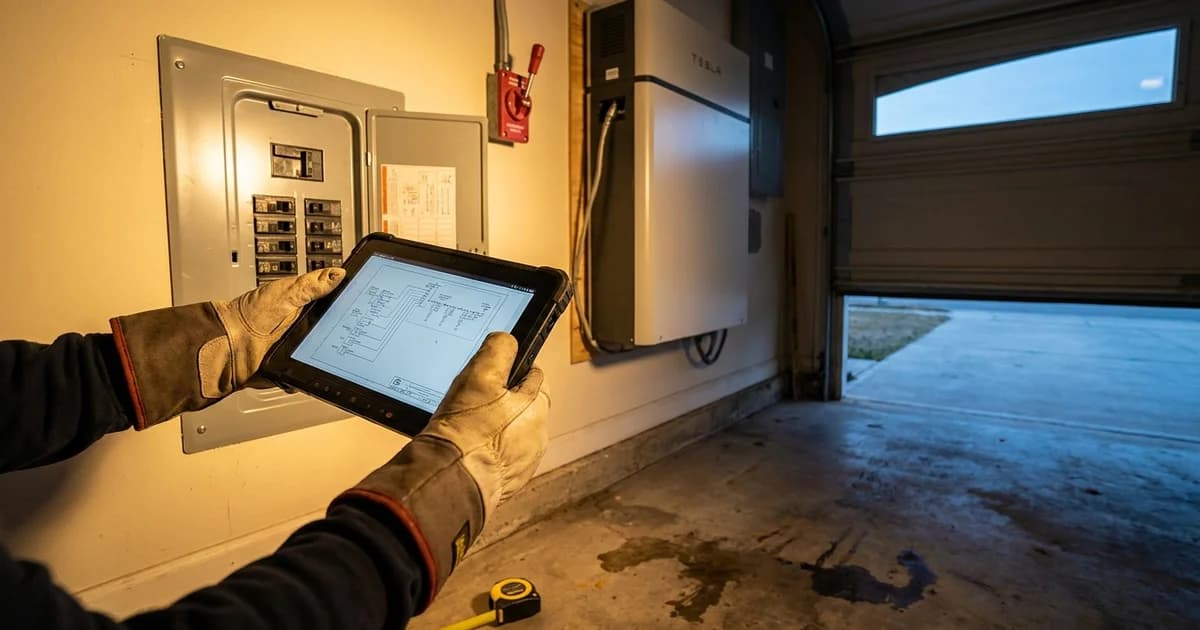
If you searched for why a home battery install fails inspection in Houston, the honest answer has changed. For most single-family systems, there is no city inspector looking at the battery anymore.
That is not a loophole. It is state law, in effect since September 1, 2025. What it did not do is make the electrical code optional. The same rules still apply, and now fewer people are positioned to catch a mistake before you do.
Key Takeaways
- Texas SB 1252 bars cities from regulating the installation or inspection of a residential energy backup system that provides no more than 50 kilowatts or stores no more than 100 kilowatt hours (TDLR, 2025).
- Houston's own notice says the City will inspect service connections and fuel gas piping, and will not inspect the batteries, inverter or generator themselves (Houston Permitting Center).
- State law still requires licensed Texas electrical contractors and the National Electrical Code for the work (TDLR).
- A municipally owned utility can still regulate installations inside its own service area, so your electric bill matters.
What did SB 1252 actually change?
The bill defines a "residential energy backup system" as one installed at a residential property that can provide no more than 50 kilowatts to the residence, or that has a storage capacity of no more than 100 kilowatt hours (SB 1252, enrolled text).
For systems inside that definition, the text says a municipality "may not adopt or enforce an ordinance, rule, or other measure that would regulate the installation or inspection" of the system. The Act took effect September 1, 2025 (SB 1252).
Eos residential plans each use a single controller rated 11.5 kW continuous, and the largest stores 43.8 kWh usable, per our published specifications (Eos plans). That is well inside both numbers. If you are sizing something larger than a typical home system, ask your installer which side of the definition it falls on.
What does Houston still inspect?
The City of Houston Permitting Center published a notice after the law passed. Under it, the City inspects service connections: the electrical service equipment, through a temporary cut-in or reconnect permit, and fuel gas piping, through a gas permit. It will not inspect the generator, inverter or batteries (Houston Permitting Center).
Read that carefully. If your project touches your service equipment, the City may still be involved in that part. The battery cabinet itself is outside its review.
A companion law, SB 1202, took effect the same day. It lets electrical inspectors and licensed master electricians review and inspect home backup power installations as third parties, and it sets a three business day window for the approvals it covers (SB 1202, enrolled text). It uses its own defined terms, so ask your installer which review path your job follows.
Does the electrical code still apply?
Yes. TDLR's guidance is explicit that non-exempt electrical work in Texas, including work on residential energy backup systems, must follow Chapter 1305 of the Texas Occupations Code and the National Electrical Code, and be performed by licensed Texas electrical contractors (TDLR, 2025).
Texas made the 2023 NEC the statewide minimum for electrical work started on or after September 1, 2023 (TDLR, 2022). Article 706 of the NEC covers energy storage systems (NFPA 70).
The practical change is who checks. The rules did not relax. The municipal second pair of eyes did, for the battery itself.
What should a licensed electrician still get right?
These are the items that were always the common trouble spots in the code text. With no city visit scheduled for the battery, they are worth confirming yourself.
Working space. NEC 110.26 sets the clear area around electrical equipment. For a typical 120/240 volt panel, that means 3 feet of depth, a width of 30 inches or the equipment width, and clear height up to 6.5 feet (IAEI Magazine, 2020). In a garage, a freezer or shelf that drifted into that rectangle is the classic miss.
Disconnect. Under the 2023 NEC, the energy storage disconnect must be readily accessible, within the system or within sight and 10 feet of it, unless it can be locked open (HeatSpring, 2023).
Labels. NEC 705.10 calls for a permanent plaque or directory at the service equipment that identifies every power source and where its disconnect is (Legal Clarity). Article 706 pairs with it, describing a permanent plaque denoting all electric power sources on the premises (IAEI Magazine, 2019).
Conductors and protection. Wire and breakers must match the equipment's rating, with overcurrent protection per Article 240 (IAEI Magazine, 2019). Eos systems run at 11.5 kW continuous and 17.1 kW surge per controller, which is where conductor and breaker sizing starts (Eos plans).
The manual. NEC 110.3(B) requires listed equipment to be installed per its listing and labeling instructions, so a clearance or torque value in the manufacturer's manual is enforceable through the code, even without a city inspector (NFPA 70).
What about fire-code location rules?
Location rules for residential batteries come from NFPA 855 and, in the model codes, Section R328 of the International Residential Code (NFPA 855). Houston adopted the 2021 International Codes effective January 2, 2024 (PHCP Pros, 2024).
What I could not verify from a primary source is how those fire-code provisions apply to a home battery after SB 1252, since the law removes the city's authority to regulate installation for these systems. Do not treat my silence as an answer. Ask your installer how they handle clearance from doors and windows, and put the answer in writing. Our article on what NFPA 855 and UL 9540A actually require covers the standards themselves.
Who verifies the work now?
Mostly the people doing it, which is why choosing well matters more. A licensed electrician carries state license accountability. Your installer's own quality check is the main control. Beyond that, other parties can still ask questions: an insurer who wants documentation, a homeowners association, and the inspector hired by whoever buys your house later.
I cannot give you a rate for how often residential battery installs have errors, because no public dataset exists. If a company quotes you a "first-time pass rate," ask what data it comes from and whether the rate still means anything when no city inspection applies.
Our list of installer red flags in Texas and the installation day walkthrough cover what a careful crew does. Both were written before this law took effect, so use them for installer behavior, not for city permit steps.
How do you protect yourself?
- Confirm the size. Make sure the system is within 50 kW or 100 kWh, and ask the installer to write it down.
- Check the license. Ask for the electrical contractor and electrician license numbers and look them up with TDLR.
- Ask the code edition. The statewide minimum is the 2023 NEC.
- Get the paperwork. Equipment listing, the manufacturer's installation manual, and a plan that matches what was built.
- Do the tape measure walk. Working space, disconnect, plaque, and distance from doors into the house.
- Ask whether your service equipment changes. If it does, ask who pulls the reconnect permit.
- Check your electric bill. If a city-owned utility serves you, that utility may still set its own rules.
Or call Eos at 833-989-3737 to talk through your setup with an installer.
Frequently Asked Questions
Does the City of Houston inspect my home battery?
Not the battery itself, for a residential system within the 50 kW or 100 kWh definition. Houston's notice says the City inspects service connections and fuel gas piping, and does not inspect the generator, inverter or batteries (Houston Permitting Center).
Do I still need a licensed electrician?
Yes. TDLR states that non-exempt electrical work on these systems must follow the NEC and be done by licensed Texas electrical contractors (TDLR, 2025).
Does SB 1252 apply if my electricity comes from a city-owned utility?
The law keeps the authority of a municipally owned utility to regulate installation or inspection inside its own service area (SB 1252). Check your bill to see who your utility is.
Does this make older permit advice wrong?
Some of it. Articles that describe city plan review and battery inspection predate the law and may be out of date for systems inside the definition. Confirm the current process with your installer and, if you want, with the Houston Permitting Center.
What should I do if my installer says the city will inspect the battery?
Ask which law or permit they mean. It may be the service connection, which the City still inspects. If they cannot point to a specific requirement, ask them to put it in writing before you sign.