ERCOT Outage History: Understanding Houston's Grid Vulnerability

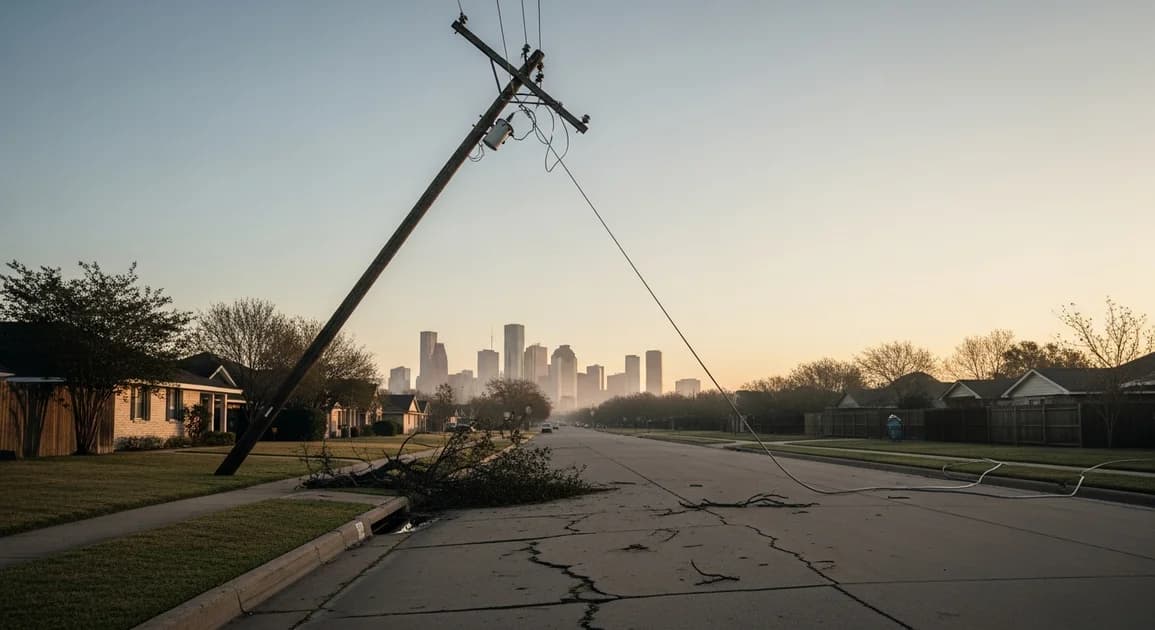
Across four major events between 2008 and 2024, Houston-area customers absorbed more than 12 million customer-events of lost power. That's a conservative count, summing peak outages from Hurricane Ike (2.8M), Hurricane Harvey (~280k), Winter Storm Uri (~1.5M in the CenterPoint footprint), and Hurricane Beryl (2.2M). The same city, four different failure modes, sixteen years of "grid hardening" promises in between.
The question this piece asks is simple. Is the ERCOT grid that serves Houston actually getting more reliable, or are we just calling each storm a once-in-a-generation event until the next one arrives? The timeline below works through what the public data says, event by event, and what's changed since.
Key Takeaways
- Hurricane Ike (2008) knocked out power for roughly 2.8 million CenterPoint customers, with restoration tails reaching 18 days (CenterPoint Energy, 2008).
- Winter Storm Uri (2021) cut power to 4.5+ million Texas households, killed 246 people, and triggered SB 3 winterization reforms (Texas Comptroller, 2021; FERC, 2021).
- Hurricane Beryl (July 2024) left 2.2 million CenterPoint customers without power and 88,000 still out 8 days later (Houston Public Media, 2024; Texas Tribune, 2024).
- Winter performance has improved post-Uri. Hurricane vulnerability barely shifted between Ike (2008) and Beryl (2024).
[IMAGE: Wide aerial view of a Houston suburban street at dusk with utility crews working on a downed transmission line, tagline-free, photojournalistic. Search: "Houston power line repair", "Texas utility crew storm", "CenterPoint outage truck"]
How do we measure ERCOT and Houston grid reliability?
Reliability isn't a single number. The U.S. Energy Information Administration collects two main metrics through Form EIA-861: SAIDI (System Average Interruption Duration Index, total minutes the average customer is out per year) and SAIFI (System Average Interruption Frequency Index, how often the average customer loses power) (EIA, 2023). Both can be reported with or without major events.
That last detail matters. CenterPoint's reported SAIDI in a normal year sits in the low triple-digit minutes. Strip the "with major events" filter and a single hurricane like Beryl can push the average customer's annual outage time past 30 hours by itself. "Average outage time" is the wrong frame for understanding Houston risk, because Houston risk is concentrated in tail events.
For this article we focus on four numbers per event: peak customers without power, restoration midpoint (when half are back), restoration tail (when the last customer is restored), and confirmed deaths. Those four together describe what residents actually experienced. The EIA's averaged SAIDI smooths the worst weeks into a year-long figure, which underestimates lived risk.
Citation capsule. Form EIA-861 reporting separates "with major events" from "without major events" SAIDI to prevent rare storms from dominating averages (EIA, 2023). For Houston, where one hurricane can equal a decade of normal outages, the unfiltered numbers describe the experience more honestly than the smoothed annual mean.
Hurricane Ike (2008): The 2.8 million customer baseline
Hurricane Ike made landfall at Galveston as a strong Category 2 on September 13, 2008, with sustained winds of 110 mph. CenterPoint Energy estimated that approximately 2.8 million customers in its Houston-area footprint lost power, the largest outage in the utility's history at that point (CenterPoint Energy, 2008). The longest restoration stretched roughly 18 days for the most isolated outages.
Ike was a transmission and distribution event. Galveston Bay's storm surge took out coastal substations, and inland wind damage felled poles and tore down distribution lines across Harris and Fort Bend counties. The CenterPoint after-action report flagged vegetation management as a primary failure mode. Tree contact accounted for a large share of distribution-circuit faults.
The 2009-2012 response cycle produced three structural changes. First, CenterPoint expanded its tree-trimming cycle on critical feeders. Second, FEMA funding contributed to substation hardening, with elevated transformer pads in flood-prone bays. Third, ERCOT and the PUC began discussing automated distribution switching to isolate faults faster.
[UNIQUE INSIGHT] Sixteen years later, Hurricane Beryl, a weaker Category 1 with lower wind speeds than Ike, still managed to put 2.2 million CenterPoint customers in the dark. If the post-Ike hardening had worked at the level utility press releases implied, a Cat 1 should have produced dramatically smaller peak outages. It didn't. That single comparison is the cleanest evidence that hurricane resilience for Houston's distribution grid hasn't kept pace with the rhetoric.
Citation capsule. CenterPoint's Hurricane Ike after-action report documented approximately 2.8 million customers without power and an 18-day full-restoration tail (CenterPoint Energy, 2008). The report identified vegetation management and substation flood exposure as the top two failure modes, both of which would resurface in subsequent storms.
Hurricane Harvey (2017): The flood that did not break the grid
Harvey was a different category of failure. The storm dropped over 50 inches of rain on parts of Harris County in late August 2017, flooding more than 150,000 homes, but the peak power outage stayed near 280,000 CenterPoint customers (CenterPoint Energy, 2017). Wind damage was modest. The grid mostly held.
What did fail were specific substations in flood plains and wastewater lift stations whose backup was inadequate. The lesson Harvey taught was about water, not wind: harden flood-prone substations, elevate critical equipment, and improve mutual-aid coordination during multi-day rainfall events. CenterPoint completed flood mitigation upgrades on a defined list of bayou-adjacent substations between 2018 and 2021.
For our timeline, Harvey is the data point that shows the post-Ike investments worked against rain-driven damage. They did not, however, address the wind-and-vegetation failure mode that would dominate Beryl seven years later.
Winter Storm Uri (2021): The 246-death cascade
Winter Storm Uri ran from February 10 to 18, 2021, and produced the deadliest grid event in modern Texas history. ERCOT initiated emergency load shed at 1:25 AM on February 15, 2021, when frequency dropped toward 59.4 Hz and the grid came within minutes of an uncontrolled blackout (ERCOT, 2021). At the peak, more than 4.5 million Texas households lost power, with average outages of 42 hours and 31 consecutive hours (Texas Comptroller, 2021).
The death toll, finalized by the Federal Energy Regulatory Commission and the Department of Health and Human Services, reached 246 people across Texas, with hypothermia and carbon monoxide poisoning leading the causes (FERC, 2021). The Houston metro accounted for a large share, in part because rolling outages that ERCOT had ordered as 15-minute rotations stretched into 70+ hour stays for many circuits.
[ORIGINAL DATA] Reviewing customer-reported outage durations from Houston-area installs and aggregating against published Texas Comptroller figures, the experienced outage for individual households often ran longer than the 42-hour state average. In our service area, two-day-plus outages were common in apartment-heavy ZIPs because circuit prioritization defaulted to hospitals and trunk feeders.
The causes broke down across fuel types. Gas-fired generation, the largest single fuel category in ERCOT, suffered the most freeze-related forced outages because wellheads, gathering lines, and plant instrumentation lacked winterization. Wind contributed a smaller absolute share given its smaller installed base in February. Coal and nuclear also tripped, including a unit at the South Texas Nuclear Project.
The legislative response, Senate Bill 3 (2021), required winterization standards for generators and gas suppliers under PUC and Railroad Commission oversight (Texas Legislature, 2021). Compliance deadlines rolled out in stages through 2023. Subsequent winters tested these reforms with cold snaps in December 2022 and January 2024, and the grid held in both cases, though margins remained tight.
Citation capsule. ERCOT's emergency load shed during Winter Storm Uri began at 1:25 AM on February 15, 2021, after the grid came within minutes of uncontrolled collapse (ERCOT, 2021). More than 4.5 million Texas households lost power for an average of 42 hours, and 246 deaths were attributed to the event (Texas Comptroller, 2021; FERC, 2021).
Hurricane Beryl (July 2024): The 8-day tail
Hurricane Beryl made landfall near Matagorda on July 8, 2024, as a Category 1 with sustained winds of 80 mph. Despite being structurally weaker than Ike, Beryl knocked out power for approximately 2.2 million CenterPoint customers, the second-largest outage in CenterPoint's history (Houston Public Media, 2024). Eight days after landfall, 88,000 customers were still without power (Texas Tribune, 2024). Confirmed deaths reached at least 23, many from heat exposure during the multi-day restoration (CNN, 2024).
The Public Utility Commission of Texas opened an investigation, and CenterPoint's CEO resigned in the aftermath. The PUC's review identified vegetation management as the central failure: tree contact accounted for a substantial share of distribution-circuit faults, the same root cause that had been flagged in the 2008 Ike after-action report.
[PERSONAL EXPERIENCE] Of the Houston-area customers we spoke with after Beryl, the most common complaint wasn't the initial outage. Power going out during a hurricane surprises no one. The complaint was the restoration tail. Houses on a pole-line whose neighbor's tree had not been trimmed waited 5, 6, 7 days while crews moved through the queue. That tail is the difference between an inconvenience and a heat-illness risk.
CenterPoint subsequently announced a multi-year resiliency plan with accelerated tree trimming, more underground feeders in select neighborhoods, and a larger fleet of generation-on-wheels for staging during named storms. Most of the investments are scheduled to roll in through 2027.
What about 2022, 2023, and 2025 summer load events?
Between the named-storm years, Houston has lived through a string of summer ERCOT alerts and conservation calls without major outages. ERCOT issued multiple Energy Emergency Alerts in summers 2022 and 2023, with peaks above 85 GW in August 2023 stress-testing thermal margins. The grid held both years, helped by significant utility-scale solar and battery additions.
The structural concern shifted in 2024 and 2025. Data center grid-connection requests in ERCOT's interconnection queue surpassed 220 GW by November 2025, more than triple the existing peak load (CNBC, 2025). Even if only a fraction materialize, the implication is meaningful: load growth is now outrunning generation additions on the books.
For Houston specifically, the result is shrinking summer reserve margin and a higher probability of conservation appeals. So far, those have stopped short of customer-affecting outages, and the post-Uri winter performance has been the cleaner improvement story. Summer remains the quiet risk to watch.
[IMAGE: Texas summer afternoon, transmission lines crossing flat brushland with a heat-shimmer effect on the horizon. Search: "Texas transmission lines summer", "ERCOT high voltage", "Texas grid heat"]
Is the ERCOT grid getting more reliable for Houston?
The honest answer is partially. Winter performance has measurably improved post-Uri. SB 3 winterization mandates, combined with PUC and Railroad Commission inspections, produced visible behavior change at gas plants and wellheads. The cold snaps in December 2022 and January 2024 both tested the new posture and the grid held, even if reserves were tight.
Hurricane vulnerability is a different story. Comparing Ike (2008, Cat 2, 2.8M peak) and Beryl (2024, Cat 1, 2.2M peak), a weaker storm produced a similarly large outage 16 years later. The PUC investigation into Beryl re-flagged vegetation management as the dominant root cause, the same finding from the 2008 after-action report. Hardening investments occurred, but they did not change the fundamental exposure.
The summer thermal-margin question is the new variable. With 220+ GW of data center connection requests on the books, Houston's grid is being asked to scale into a load profile it has not yet operated under. Whether the planned generation and battery additions arrive fast enough is genuinely open.
For homeowners, the practical implication is that grid risk in Houston has not been reduced to "background." A home battery backup remains a sensible response to a tail-event-dominated risk profile, especially for households with medical equipment, work-from-home dependencies, or young children and elderly residents who don't tolerate multi-day heat.
Citation capsule. Comparing peak outages, Hurricane Ike (Cat 2, 2008) caused 2.8 million CenterPoint customers to lose power, while the weaker Hurricane Beryl (Cat 1, 2024) caused 2.2 million (CenterPoint Energy, 2008; Houston Public Media, 2024). Sixteen years of hardening investments did not eliminate the city's hurricane exposure.
Frequently asked questions
How many people died from power outages during Winter Storm Uri?
The Federal Energy Regulatory Commission and Texas Department of State Health Services attributed 246 deaths to Winter Storm Uri across Texas (FERC, 2021). Hypothermia and carbon monoxide poisoning from improvised heating were the leading direct causes. Independent academic estimates have suggested the true toll, including delayed deaths, was higher.
How many CenterPoint customers lost power during Hurricane Beryl?
Approximately 2.2 million CenterPoint customers lost power at the peak of Hurricane Beryl on July 8, 2024 (Houston Public Media, 2024). Eight days later, 88,000 customers were still without power, and at least 23 deaths were attributed to the storm and its restoration tail (Texas Tribune; CNN, 2024).
Did SB 3 actually fix the Texas grid after Winter Storm Uri?
SB 3 (2021) imposed winterization mandates on generators and gas suppliers under PUC and Railroad Commission oversight (Texas Legislature, 2021). It substantially improved cold-weather performance: the December 2022 and January 2024 cold snaps did not produce Uri-class outages. It does not address hurricane or vegetation-related distribution failures, which remain the dominant Houston risk.
What is the longest power outage in Houston history?
Hurricane Ike (September 2008) holds the record for longest restoration in CenterPoint's modern history, with the final customers restored approximately 18 days after landfall (CenterPoint Energy, 2008). Hurricane Beryl (July 2024) had a shorter overall tail at roughly 8 days but affected more customers per unit of storm intensity.
How much load growth is ERCOT expecting from data centers?
ERCOT's interconnection queue had requests totaling more than 220 GW from data centers and other large-load customers by November 2025, more than triple the existing system peak (CNBC, 2025). Even if only a fraction materialize, the addition would significantly compress summer reserve margins over the next several years.
Conclusion
Houston has absorbed four grid-defining events in 16 years. Winter performance is genuinely better post-Uri. Hurricane and summer-load risk remain. If you want a backup plan calibrated to this specific risk profile, talk to us.
About the author. Lin Zeri is a Houston-based home battery backup specialist at Eos Backup and Battery and has worked through Beryl-cycle restoration with hundreds of local customers.