Hyundai Ioniq 5 and Ioniq 6 V2H Home Backup: Setup Guide for Houston

The Ioniq 5 long-range pack holds 77.4 kWh of usable energy (Hyundai, 2026). That is more than five Tesla Powerwall 3 units stacked on a wall. So why isn't every Houston Ioniq owner running their house off the car during a CenterPoint outage? Because raw battery size is not the same as home backup. The car ships with V2L, not V2H. One powers a fridge through a small outlet. The other actually backs up a panel, and it needs hardware Hyundai does not include.
This guide walks through the real setup path. [INTERNAL-LINK: V2H complete guide -> /blog/v2h-explained]
Key Takeaways
- The Ioniq 5 (77.4 kWh) holds more battery than five Powerwall 3 units, but raw capacity is not home backup.
- V2L is a 1.9 kW outlet built into the car. V2H is full panel backup and requires a bidirectional charger.
- A Houston V2H install for an Ioniq runs $8,000 to $12,000 all-in based on Eos field jobs.
- Hyundai's V2H rollout trails Ford's. Aftermarket chargers like Wallbox Quasar 2 fill the gap.
- 77.4 kWh covers 5 to 10 days of essential loads for a typical Houston home.
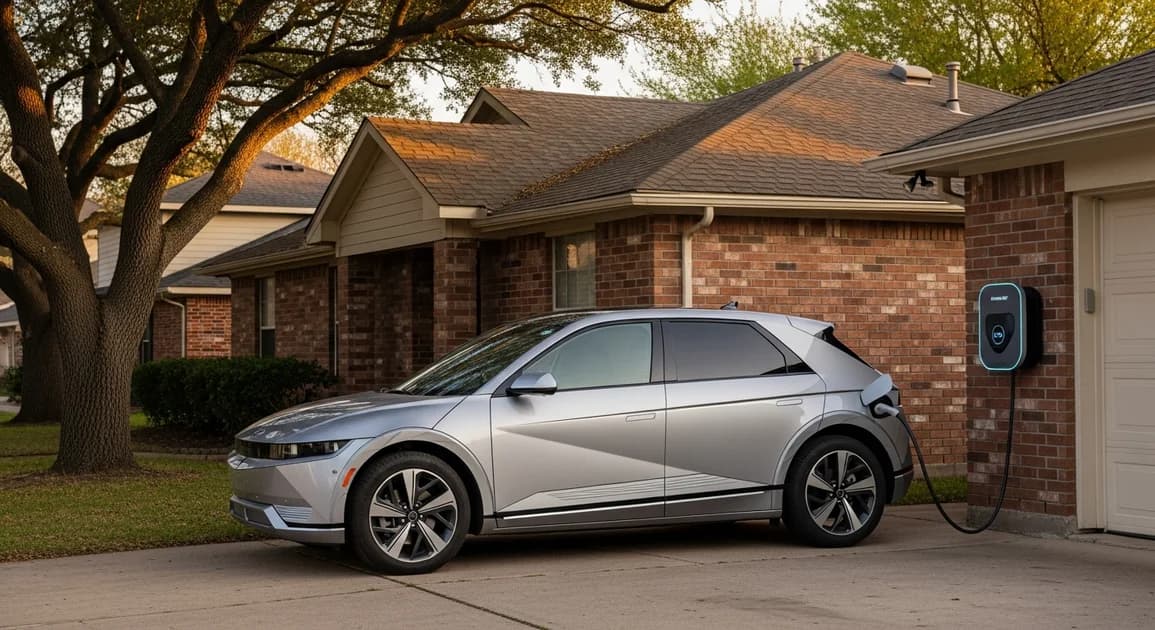
[IMAGE: Hyundai Ioniq 5 parked in a Houston driveway with a wall-mounted bidirectional charger and CCS1 cable connected, residential electrical panel visible. Search: "Hyundai Ioniq 5 driveway home charger"]
What is the difference between V2L and V2H on a Hyundai Ioniq?
V2L stands for vehicle-to-load and pushes up to 1.9 kW out of an adapter plug (Hyundai, 2026). V2H stands for vehicle-to-home and feeds the entire electrical panel through a bidirectional charger and transfer switch. The Ioniq 5 ships with V2L. V2H is aftermarket and requires installed hardware.
V2L is the camping outlet. Plug in a coffee maker, a CPAP, a small fridge, a window unit. It runs through a standard 120 V plug from an adapter that ships with the car. Useful in a tailgate, useful for a long power outage in one room, but it is not whole-home anything.
V2H is the actual backup story. A bidirectional charger sits between the car and the panel. When the grid drops, the charger pulls DC from the traction battery, inverts it to 240 V AC split phase, and feeds it through a transfer switch into the breaker box. Lights, AC, well pump, garage door, full house.
[UNIQUE INSIGHT] In our Houston intake calls, V2L gets misread as home backup more than any other EV feature. People see "1.9 kW" on the spec sheet and assume the car can run the house. It cannot, not without thousands of dollars of additional hardware.
Citation capsule: The Hyundai Ioniq 5 includes V2L, a 1.9 kW outlet that powers small loads from an adapter (Hyundai, 2026). V2H, which feeds an entire home panel, requires a separate bidirectional charger and transfer switch and is not factory-included on any 2026 Ioniq trim.
Which Ioniq models support V2H home backup in 2026?
The Ioniq 5, Ioniq 5 N, and Ioniq 6 all use the E-GMP platform with battery packs between 74 and 84 kWh (Hyundai, 2026). All three are CCS1 native and pair with most third-party bidirectional chargers. The Kona Electric is partial: V2L works, V2H support depends on aftermarket charger compatibility.
V2L hardware is consistent across the Ioniq 5 lineup, including SE, SEL, and Limited trims. The 1.9 kW limit is the same regardless of pack size.
V2H is the messier picture. Hyundai has not shipped a factory bidirectional inverter on any 2026 US Ioniq. Owners route through aftermarket chargers, which talk to the car over CCS1 using ISO 15118 handshakes. Some chargers list explicit Ioniq 5 and Ioniq 6 support. Others require firmware updates.
Ford rolled V2H out earlier on the F-150 Lightning, which carries up to 131 kWh of usable battery on the Extended Range trim (Ford, 2026). Hyundai's slower rollout is the main reason Ioniq V2H jobs need a careful spec review before quoting.
[INTERNAL-LINK: every V2H-compatible vehicle in 2026 -> /blog/v2h-compatible-vehicles-2026]
What bidirectional charger do you need for a Houston V2H install?
The three chargers we install most often for Ioniq V2H in Houston are the Wallbox Quasar 2, the dcbel r16, and the Indra V2H. The Wallbox Quasar 2 retails near $6,500 and supports 11.5 kW bidirectional output (Wallbox, 2026). All three use CCS1, which matches every US-market Ioniq.
Sizing depends on what the homeowner wants to back up. A 7.4 kW charger covers essentials and a single AC tonnage. An 11.5 kW unit covers a full Texas home including two AC compressors, a heat pump water heater, and an EV charger on a different circuit.
[PERSONAL EXPERIENCE] On Houston jobs we always do a service review before quoting. Many homes here run 200 A panels with no spare double-pole slots. A V2H install usually means adding a sub-panel for backed-up loads, a manual or automatic transfer switch, and a critical-loads breakdown the homeowner signs off on. Skip that conversation and the install scope balloons mid-project.
Houston permitting also matters. CenterPoint and most municipal jurisdictions treat a bidirectional charger as a parallel generation source. The interconnection paperwork takes weeks, not days.
[INTERNAL-LINK: V2H installer in Houston -> /blog/v2h-installer-houston]
How long can a Hyundai Ioniq power a Houston home?
A typical Houston single-family home runs 5 to 8 kWh per day on essentials only (EIA RECS, 2024). Against a full 77.4 kWh Ioniq 5 pack, that is 9 to 15 days of fridge, lights, fans, internet, and a window AC unit. Add a central AC compressor and the runtime drops fast.
Essentials means fridge, freezer, internet router, lights, ceiling fans, phone charging, a microwave, and a single window or mini-split AC. That load profile is what we size most Houston backup jobs around.
Add a 3-ton central AC running through summer heat and the daily load triples to 25 to 35 kWh. The same 77.4 kWh pack now covers 2 to 3 days, not 10. Hurricane Beryl knocked out power for 2.2 million CenterPoint customers in July 2024, with restoration taking over a week in some neighborhoods (CenterPoint Energy, 2024). Plan for the long tail of those events, not the average.
[ORIGINAL DATA] Across Eos field jobs, Ioniq owners running V2H during summer outages typically cycle the car between 80 percent and 30 percent state of charge, then top up via solar or DC fast charge mid-event. That cycling strategy stretches the car's usable runtime while keeping enough range to drive if needed.
The car does become temporarily undrivable when the pack drops below your set reserve. That tradeoff is the honest cost of using a vehicle as home backup.
How much does a Houston V2H install cost for an Ioniq owner?
A complete Houston V2H install for an Ioniq runs $8,000 to $12,000 in our jobs. The bidirectional charger is $5,000 to $7,000 (Wallbox, 2026). Install labor adds $2,000 to $3,000. Transfer switch, sub-panel, and breaker work bring another $1,000 to $2,000. Permits and inspection fees vary by jurisdiction.
Compare that to a dedicated 27 kWh home battery backup system, which runs $20,000 to $25,000 installed in Houston. The V2H route saves money up front because the battery is already in your driveway. The catch: you cannot drive the car while it is feeding the house, and the car's warranty does not formally cover bidirectional cycling.
[INTERNAL-LINK: V2H installation cost breakdown -> /blog/v2h-installation-cost]
[INTERNAL-LINK: compare battery backup plans -> /plans]
What are the warranty and reliability tradeoffs?
Hyundai's high-voltage battery warranty runs 10 years or 100,000 miles (Hyundai, 2026). V2L use is explicitly supported. V2H, performed through an aftermarket bidirectional charger, sits in a documentation gray area. Hyundai has not published a clear policy for or against it on US-market Ioniqs.
Bidirectional cycling adds wear to the pack. The cycle count from regular daily driving is small compared with a charger that cycles the pack every few days for backup. Owners who plan to V2H weekly should expect more state-of-health degradation than a comparable driving-only Ioniq.
Real-world reports from Ioniq drivers using Quasar 2 setups have been stable, with most issues tied to charger firmware rather than the car itself.
FAQ
Can I use my Ioniq 5 V2L outlet to back up my whole house?
No. V2L tops out at 1.9 kW total, which is less than a single 3-ton AC compressor draw on startup (Hyundai, 2026). It powers a fridge, a few lights, fans, and a window unit through extension cords. Whole-house backup needs V2H, which requires a bidirectional charger and transfer switch.
Does Hyundai sell a factory V2H charger for the Ioniq 5?
Not in the US market as of April 2026. Hyundai has demonstrated bidirectional concepts but has not released a US-market factory charger for the Ioniq 5 or Ioniq 6 (Hyundai, 2026). Owners use aftermarket chargers like the Wallbox Quasar 2, dcbel r16, or Indra V2H to enable home backup.
Will V2H void my Ioniq battery warranty?
It is not a clean yes or no. Hyundai's 10-year, 100,000-mile high-voltage battery warranty does not explicitly exclude V2H use (Hyundai, 2026). Excessive cycling could trigger denied claims around degradation. Get the install done by a licensed electrician with documentation, and keep cycle logs from your charger.
How does Ioniq V2H compare with the Ford F-150 Lightning?
The Lightning Extended Range carries 131 kWh of usable battery, almost 70 percent more than the Ioniq 5 long-range (Ford, 2026). Ford ships an integrated bidirectional system. The Ioniq route is cheaper on the vehicle side but more complex on the install side because the bidirectional hardware is aftermarket.
Do I need solar panels for an Ioniq V2H setup?
No, but solar makes the system more useful. Without solar, you recharge the car at a public DC fast charger during long outages, which assumes those chargers have grid power. With solar plus V2H, you can keep cycling the car through a multi-day event (EIA RECS, 2024).
Where to go from here
V2H on a Hyundai Ioniq is real, workable, and cheaper than a dedicated home battery backup system, but only if you go in with eyes open. Pick the right charger, plan the panel work, and accept the warranty gray zone. If the math does not work for your house, a stationary system might.
[INTERNAL-LINK: talk to Eos about a Houston V2H install -> /contact]