Can You Add More Batteries Later? Expanding a Texas Home Battery System

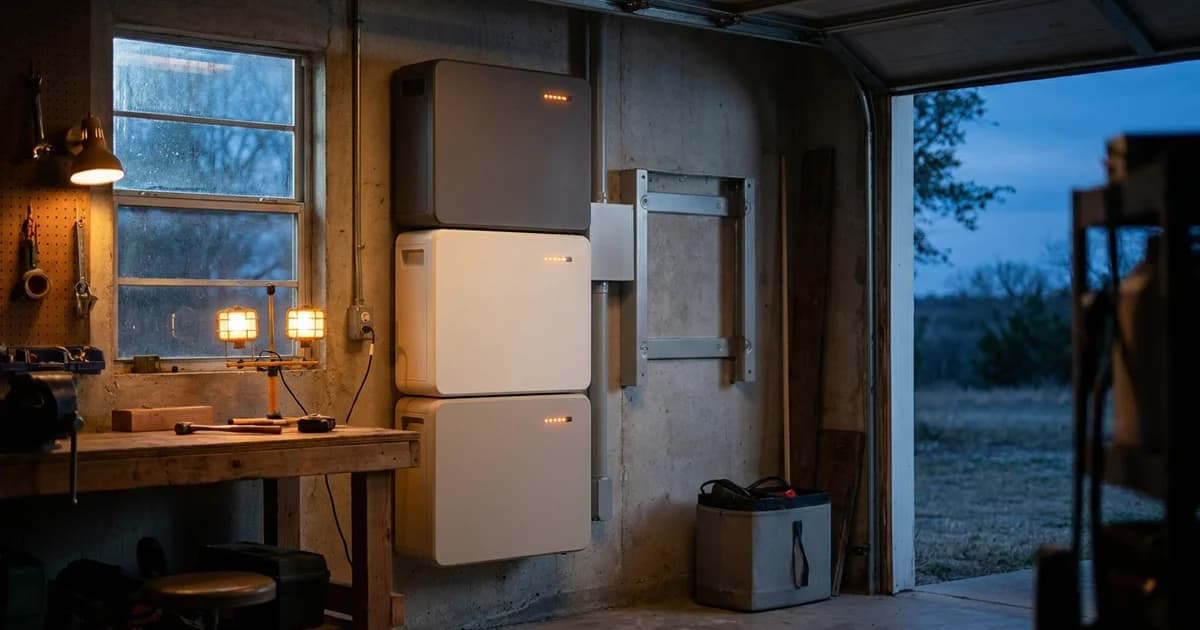
Yes. Battery modules are the part of a home backup system designed to be added after the original install. What almost nobody gets right is what that addition buys. More batteries give you more hours, not more watts. Whether your system can run the air conditioner, the well pump, and the oven at once is decided by the controller, and the controller does not change when you hang another battery off it.
That confusion is why so many Texas homeowners freeze on tier choice. They worry about picking a size that cannot handle the house, when size mostly decides how long they last. In 2024, U.S. electricity customers averaged 11 hours of interruptions, and major events including Hurricane Beryl accounted for 80% of those hours (U.S. Energy Information Administration, 2025). Hours is the right unit to plan in.
Key Takeaways
- Batteries are modular. The controller is not. Adding batteries extends runtime, not how much you can run at once.
- Output stays 11.5 kW continuous and 17.1 kW surge per controller, whatever the battery count.
- Each battery adds 9 kWh nominal and 8.76 kWh usable, roughly 6 hours at a light 1.5 kWh per hour draw.
- Siting on install day sets your expansion ceiling, because NFPA 855 caps aggregate stored energy by location.
Can you add batteries to a home backup system later?
Yes. Battery modules are the modular element of a home backup system, and they are built to join an existing stack rather than replace it. Each unit adds 9 kWh nominal and 8.76 kWh usable capacity. The controller and smart panel you already own keep doing their job, and the new battery reports into the same system.
A stack is a column of battery units mounted on a wall and wired to one controller. Adding to it is an electrical and mechanical job on hardware that already exists: mount the unit, land the conductors, update the configuration, get it inspected. It is not a second system.
The catch is that the original install has to leave room. Not budget room. Physical room, wiring room, and code room. All three are decided the day the first unit goes on the wall, which is why most of this article is about install day rather than about the addition itself.
If you have not settled on a starting size yet, read how to size a home battery in Texas first.
What adding a battery actually changes: hours, not watts
Adding a battery extends how long you run, not how much you can run. Continuous output stays 11.5 kW and surge stays 17.1 kW per controller regardless of battery count. A five-battery system and a one-battery system have identical simultaneous-load capability. They differ only in how long that load can be sustained.
Think of it as a fuel tank and an engine. Batteries are the tank. The controller is the engine. Adding fuel does not make the engine bigger. It makes the trip longer.
The consequence is blunt, and it saves people from an expensive mistake: if a load will not start on one battery, it will not start on four. A compressor that trips the system at startup is a power problem, not a capacity problem. Motor-driven equipment such as air conditioners, pool pumps, and well pumps pulls far more current at startup than while running, which is ordinary induction motor behavior and the reason NEMA Design B motors are defined against locked-rotor current limits in NEMA MG 1 (UpCodes, 2021). That spike is what the 17.1 kW surge rating absorbs, and stored energy does not change it.
So the honest framing is this: pick the controller for what you want running, pick the battery count for how long you want it running. Two separate purchases that happen to arrive in one box. You can see the full output and capacity specs side by side.
Which parts are modular and which are not
Batteries are modular. The controller and its smart panel are not. A stack holds up to six battery modules on one controller and one smart panel, so a single stack tops out at 54 kWh of fixed capacity, and the residential plan ladder runs to five of those six positions. Passing the stack ceiling means a second stack, which means a second controller.
Three elements are in play, and only one grows incrementally:
- Battery modules. Modular. Add them one at a time within the stack, subject to siting and permitting.
- Controller. Fixed. It sets 11.5 kW continuous and 17.1 kW surge. Adding one is a new stack.
- Smart panel. Fixed, and paired with its controller. It decides which circuits get priority when supply is short.
One wrinkle worth knowing before you buy: the V2X module and its battery slot. The module occupies one battery position, so a V2X-equipped stack tops out at 45 kWh instead of 54 kWh. Wanting both a bidirectional electric vehicle connection and the full fixed capacity means planning for more than one stack from the start.
When a second controller is the right answer instead of more batteries: when the problem is simultaneous power, not duration. Two controllers deliver 23 kW continuous and three deliver 34.5 kW, which is how commercial configurations get built. If your complaint is "it will not carry both air conditioning compressors at once," batteries are the wrong purchase and always will be. Often the cheaper fix is neither, but sequencing the loads, which is what prioritizing circuits with a smart panel does.
How many hours does each battery actually add?
At a light household draw of roughly 1.5 kWh per hour, each 9 kWh battery adds about 6 hours of runtime, so the residential ladder runs from about 6 hours at one battery to about 30 hours at five. Outage data says that range covers most of what happens: major-event interruptions averaged nearly nine hours nationally in 2024, against nearly four hours per year across 2014 through 2023 (U.S. Energy Information Administration, 2025).
| Batteries | Nominal | Usable | Approximate runtime at 1.5 kWh/h |
|---|---|---|---|
| 1 | 9 kWh | 8.76 kWh | about 6 hours |
| 2 | 18 kWh | 17.52 kWh | about 12 hours |
| 3 | 27 kWh | 26.28 kWh | about 18 hours |
| 4 | 36 kWh | 35.04 kWh | about 24 hours |
| 5 | 45 kWh | 43.80 kWh | about 30 hours |
Read that table with one caveat attached. Runtime is a function of your draw, and the draw is yours, not the table's. A home riding out a July afternoon on central air conditioning empties the same capacity in a fraction of the time.
So pick the starting rung for the outage length you want covered, not for the appliance list. The appliance list is a controller question. If the multi-day scenario worries you, read up on multi-day Texas outages first, because the answer there usually involves recharging rather than storing.
Every rung has its own configuration and its own cost, and both are listed on what each configuration costs.
The four decisions to get right on install day
Whether you can add a battery in year three is decided on install day, by where the stack goes and how the wiring was run. NFPA 855 caps aggregate stored energy by location, so siting is the real ceiling on expansion, not the wallet. Four decisions carry almost all of the weight.
1. Siting and aggregate capacity. NFPA 855 limits an individual residential energy storage unit to 20 kWh of stored energy and caps aggregate capacity at 40 kWh in an interior utility or storage space, and 80 kWh in an attached or detached garage, a detached accessory structure, or an outdoor location (Mayfield Renewables, Code Corner: NFPA 855 ESS Unit Spacing Limitations, 2023). Do that arithmetic before you choose a wall. At 9 kWh per unit, an interior utility room caps out at four batteries, because 36 kWh fits under the 40 kWh aggregate limit and a fifth unit would pass it. A garage or exterior-wall location clears the full five-battery ladder with headroom left. Your authority having jurisdiction makes the final call, and local adoption varies.
2. Physical clearance. NFPA 855 calls for at least three feet of separation between individual units and from doors and windows opening into the dwelling, reducible only where large-scale fire testing documents that less is adequate and the authority having jurisdiction approves it. UL 9540A is the test method that produces that documentation (UL Solutions, Understanding UL 9540A and NFPA 855, 2024). Reserve the wall run on day one, or the fourth unit has nowhere legal to live.
3. Conductor and raceway sizing. Pulling conduit sized for the final configuration during the original install costs almost no extra effort. Re-pulling it two years later is its own project. Federal guidance on building-ready construction makes the same point: wiring a home for equipment before it is installed lowers the cost of adding it later (U.S. Department of Energy, 2026).
4. Panel headroom. Confirm the service panel and busbar can carry the final configuration, not just today's. Check whether your 200A panel supports it and how a battery connects to your electrical panel before the first unit is mounted.
Our practice note: we reserve the wall run and the clearance for the next unit even on a single-battery install. At rough-in that costs nothing. After the enclosure is set, the same decision turns into a return visit.
Mixing battery ages, permits, and when to just buy up front
Mixing a newer battery into an older stack is workable, and what actually degrades a mixed stack is uneven temperature, not the age gap. Peer-reviewed work on parallel-connected packs found that homogeneous temperatures produce convergent behavior across cells, while thermal gradients drive divergent degradation, with current and state-of-charge distributions growing more unbalanced over pack life (Communications Engineering, 2024).
The homeowner translation is short. Keep the whole stack in one thermal environment. Putting the new unit in a hot corner and the old one somewhere cool is a worse decision than the age gap ever was. Expect older units to carry slightly less, and remember warranty terms run per unit, so a later addition starts its own clock. Past the first few years, read maintaining a Houston battery system and how warranty claims work before you add.
Permits are not optional. A later addition is permitted work, not a plug-in accessory. Houston lists energy storage systems among the installations requiring a permit under its adopted fire code (UpCodes, Houston Fire Code 2021, 2021), with separate submittal guidance for stationary storage battery systems (Houston Permitting Center, 2024). The electrical side runs on the 2023 National Electrical Code, adopted by the Texas Department of Licensing and Regulation as the statewide minimum for non-exempt work started on or after September 1, 2023 (TDLR, 2022). Article 706 governs energy storage, including the dedicated disconnecting means and, for one and two family dwellings, an accessible emergency shutdown function (Mayfield Renewables, 2023). Changing a permitted configuration generally means an amended permit and a re-inspection.
And the honest case against expanding. Two installs mean two permit cycles, two inspections, two crew visits. If you already know you want the runtime, doing it once is cleaner, and the only good reason to split it is cash flow rather than engineering. Nobody selling modularity says that out loud, so here it is. What each path costs is on the plans page.
Or call Eos at 833-989-3737 to talk through your setup with an installer.
Frequently asked questions
Can you add more batteries to an existing home battery system?
Yes. Battery modules can be added to an existing stack, subject to the 54 kWh stack ceiling, the siting and clearance rules under NFPA 855, and a permit. The controller and smart panel you already own stay in place and manage the added capacity.
Does adding a battery let me run more appliances at the same time?
No. Simultaneous load is fixed by the controller at 11.5 kW continuous and 17.1 kW surge, regardless of battery count. More batteries add hours on the same set of loads. If a compressor will not start on one battery, it will not start on four.
Do I need a second controller to add batteries?
Only when you pass a stack ceiling or need more simultaneous power. Within a single stack, batteries connect to the existing controller. A second controller is what raises output, which is how commercial configurations reach 23 kW continuous.
Can I mix an older battery with a new one?
Generally yes. Keep the whole stack in one thermal environment, because uneven temperature across a parallel-connected pack drives divergent degradation while uniform temperature produces convergent behavior (Communications Engineering, 2024). The temperature gap matters more than the age gap.
Do I need a new permit to add a battery later?
Yes, in practice. Houston requires a permit for energy storage installations under its adopted fire code, and Texas electrical work follows the 2023 National Electrical Code as the statewide minimum. Changing a permitted configuration generally means an amended permit and a re-inspection.
The short version
Expansion buys hours, and hours are usually what people actually wanted.
- Batteries are modular. The controller and smart panel are not.
- Output is fixed at 11.5 kW continuous and 17.1 kW surge per controller.
- Each battery adds 9 kWh nominal and 8.76 kWh usable, roughly 6 hours at a light draw.
- Siting on install day sets the ceiling, because aggregate stored energy is capped by location.
Start smaller if that is what gets a system on the wall this year. Just make sure the wall, the conduit, and the panel were planned for the house you will have in five years.
Sources
- U.S. Energy Information Administration, "Hurricanes in 2024 led to the most hours without power in the United States in 10 years," retrieved 2026-08-22, https://www.eia.gov/todayinenergy/detail.php?id=66744
- Mayfield Renewables, "Code Corner: NFPA 855 ESS Unit Spacing Limitations," retrieved 2026-08-22, https://www.mayfield.energy/technical-articles/code-corner-nfpa-855-ess-unit-spacing-limitations/
- UL Solutions, "Understanding UL 9540A, NFPA 855 and Large-Scale Fire Testing for Battery Energy Storage Systems," retrieved 2026-08-22, https://www.ul.com/thecodeauthority/knowledge/understanding-UL-9540A-NFPA-855
- Marlow, Chen and Wu, "Degradation in parallel-connected lithium-ion battery packs under thermal gradients," Communications Engineering, retrieved 2026-08-22, https://pmc.ncbi.nlm.nih.gov/articles/PMC10955900/
- Texas Department of Licensing and Regulation, "2023 National Electrical Code is Almost Here," retrieved 2026-08-22, https://www.tdlr.texas.gov/news/2022/11/30/2023-national-electrical-code-is-almost-here
- Mayfield Renewables, "2023 NEC Updates for Energy Storage Systems," retrieved 2026-08-22, https://www.mayfield.energy/technical-articles/2023-nec-updates-for-energy-storage-systems/
- UpCodes, "Chapter 1 Scope and Administration, Houston Fire Code 2021," retrieved 2026-08-22, https://up.codes/viewer/houston/ifc-2021/chapter/1/scope-and-administration
- Houston Permitting Center, "IFC Electrical Storage Systems," retrieved 2026-08-22, https://www.houstonpermittingcenter.org/media/9346/download?inline=
- U.S. Department of Energy, "Solar Energy Guide for Homebuilders," retrieved 2026-08-22, https://www.energy.gov/eere/solar/solar-energy-guide-homebuilders
- UpCodes, "NEMA Design B Motor," retrieved 2026-08-22, https://up.codes/d/nema-design-b-motor
This article is general information for Texas homeowners and reflects Eos specifications as of August 2026. It does not promise a specific runtime, siting approval, or code outcome. Runtime figures assume a light household draw and will differ with your actual loads. Confirm siting, clearance, panel capacity, and permitting for your address with a licensed electrician and your local authority having jurisdiction.