Battery Backup for Extended Texas Outages: How Many Days?

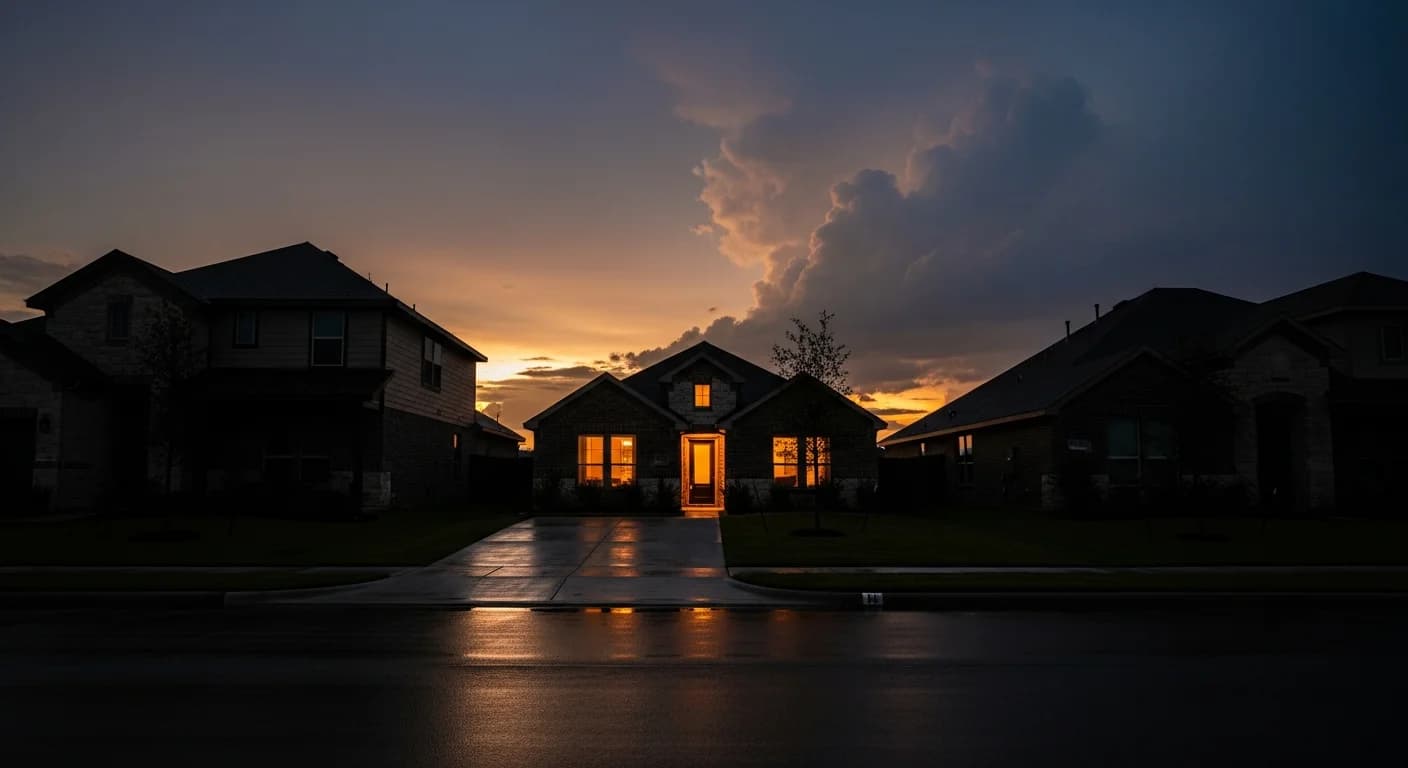
Hurricane Beryl knocked out power to 2.6 million CenterPoint customers in Houston in July 2024. More than 200,000 were still dark one week later, and some coastal communities waited two additional weeks for the lights to come back on (Texas Tribune, 2024).
Most battery backup articles answer the runtime question in hours. That works for a routine 4-hour Texas outage. It does not work when you're planning for another Beryl, or Ike, or Uri. Texas homeowners planning for real storms need an answer in days.
This guide answers that question with specific numbers, real storm scenarios, and a day-by-day battery management plan. We'll walk through exactly how many days each common system configuration covers, what solar recharging adds, and what to do when you're staring down day 3 with no grid in sight.
Key Takeaways
- A 13.5 kWh home battery covers essential loads for roughly one day without solar recharging (Good Faith Energy, 2024).
- Hurricane Beryl left some Houston neighborhoods dark for 10 days in July 2024 (Texas Tribune, 2024).
- A 27 kWh battery paired with a 6 kW solar array can realistically cover a Beryl-length outage on essential loads.
- Load management on day 2 separates homes that stay livable from homes that tap out.
What Texas Storm History Tells You About How Many Days to Plan For
Plan for at least 3 days of coverage. A Beryl-class storm requires 7 to 10. Winter Storm Uri knocked out power to 4.5 million Texas homes and businesses, with 8 counties seeing outages longer than 72 hours (PMC/NIH, 2023). These are the real numbers Houston homeowners are planning against, not the 11-hour national average.
The U.S. average outage jumped to 11 hours in 2024, nearly double the prior decade's average, with Hurricanes Beryl, Helene, and Milton accounting for 80% of those hours (EIA, 2025). Texas is a different story. The state's all-events SAIDI sat at 496.2 minutes per year in 2023, more than four times the everyday baseline.
Three storms define the modern Texas planning baseline. Hurricane Ike (2008) left the hardest-hit Houston neighborhoods without power for 21 days. Hurricane Harvey (2017) left flood-damaged districts dark for about 12 days. Hurricane Beryl (2024), only a Category 1 storm, still pushed full restoration past 10 days for more than 200,000 customers.
One Houston homeowner, Michael Shepard, ran his home for nine consecutive days after Beryl using a solar-plus-battery system (Texas Tribune, April 2026). That's the upper bound of what is actually achievable with current residential equipment. The lower bound is about one day, and the difference is almost entirely a sizing and solar decision.
Step 1: Calculate Your Days of Coverage (The Math)
A 13.5 kWh battery powers essential loads for about one day without solar recharging. A 27 kWh system covers roughly two and a half days. Adding solar recharge changes everything: the same 27 kWh system paired with 15 kWh per day of solar output can run indefinitely on essentials (Good Faith Energy, 2024).
Texas homes use more electricity than almost any other state's homes. The average Texas residence runs on about 36 kWh per day year-round, and summer peaks push daily consumption to around 46 kWh, about 24% above the U.S. national average (EIA, 2024). National sizing guides written from California or Massachusetts data consistently undersize for Houston.
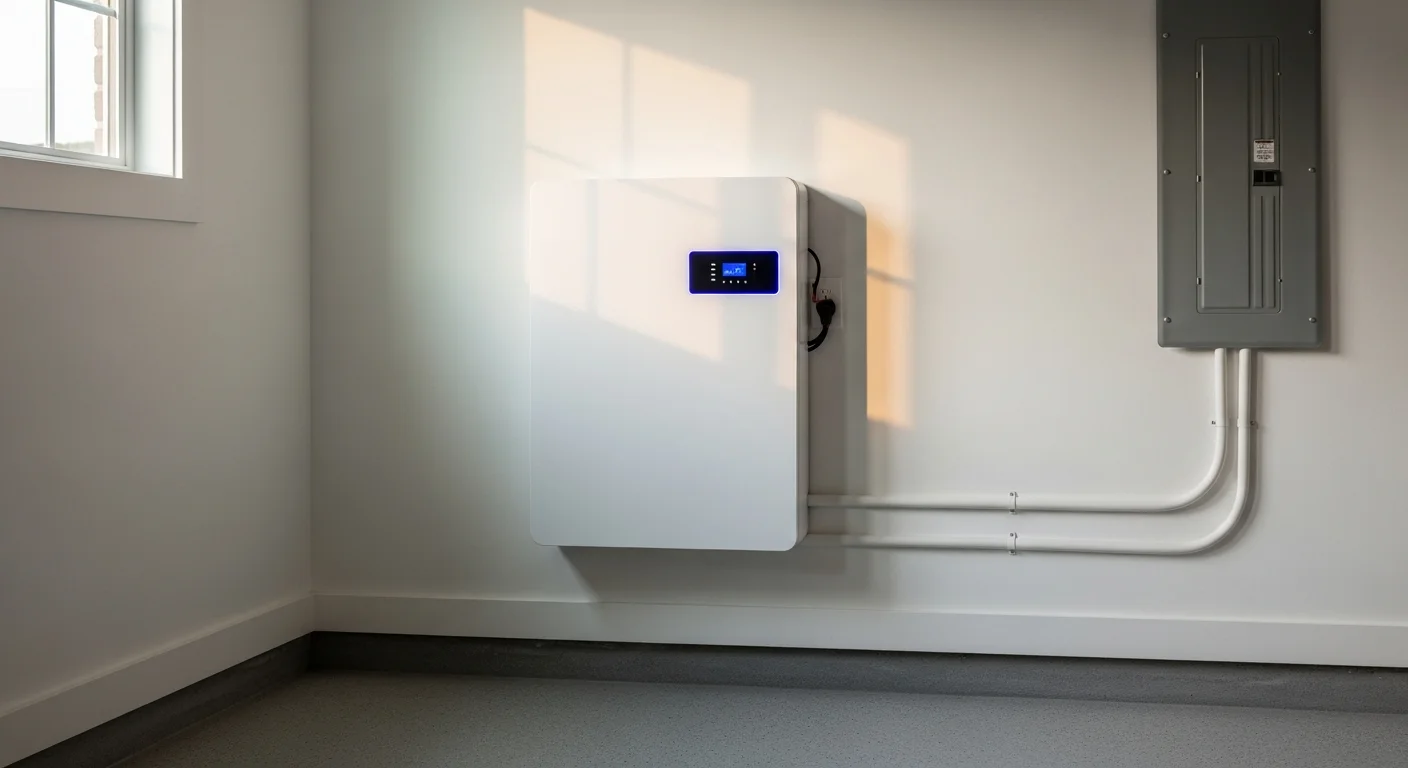
The math is the same in every case. Divide your usable battery capacity by your daily load to get days of coverage. For a 13.5 kWh battery running essentials at 10 kWh per day, that's 1.2 days. For the same battery running essentials plus central AC at 36 kWh per day, it's about 9 hours. The table below shows what that looks like across the systems most Houston homes actually install.
What counts as "essentials" at 10 kWh per day for a Houston home? A refrigerator runs about 1.5 kWh per day. Four LED lights and phone charging add another 0.5 kWh. A typical internet router and modem draw about 1 kWh daily. A single ceiling fan running overnight adds 0.5 to 1 kWh. Add a CPAP or other medical device at 0.5 kWh and you're still at roughly 5 to 6 kWh. The remaining 4 to 5 kWh covers incidental cooking, occasional TV, and headroom for variability. That's the load profile most homeowners actually run during a storm.
A Texas home uses about 46 kWh per day in peak summer, 24% above the U.S. national average (EIA, 2024). That's why a battery sized from a national guide keeps falling short: the math is calibrated for a 30 kWh day, not a Houston July. For the full sizing formula, see our
.Step 2: Add Solar Recharging to Stretch Coverage Indefinitely
A 6 kW rooftop solar array in Houston generates 15 to 25 kWh per day in summer, even on partly cloudy storm-aftermath days. That daily recharge is the difference between a two-day battery system and a two-week one. The Texas Tribune documented one Houston homeowner running his home for nine consecutive days after Beryl using exactly this setup (Texas Tribune, April 2026).
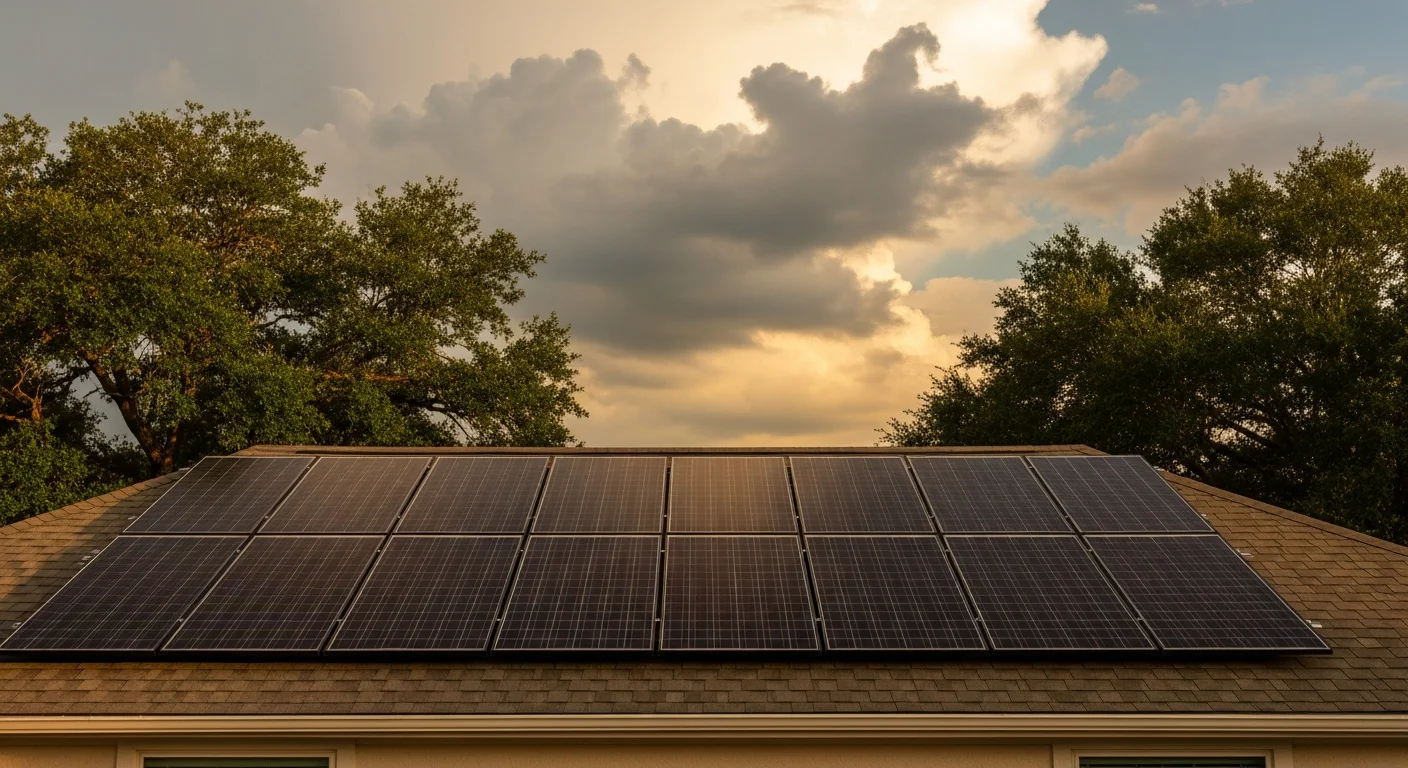
Houston averages about 5 peak sun hours per day over the course of the year. In June and July, when hurricane risk peaks, that climbs to about 6 peak sun hours. A 6 kW array at 5 peak sun hours produces 30 kWh on a clear day. Storm aftermath is rarely clear, of course. Partly cloudy conditions typically cut output to 50-60% of clear-sky production, which still delivers 15-18 kWh per day.
That's enough to fully refill a 13.5 kWh battery once per day, or to cover about two-thirds of a 27 kWh battery's daily essential draw. The feedback loop is what makes solar powerful for extended outages: the battery depletes overnight, solar refills it by early afternoon, and you wake up on day 4 with the same coverage you had on day 1.
One non-obvious detail matters here. Grid-tied solar without a battery does not keep your home running during an outage. By National Electrical Code, grid-tied inverters must shut down when utility power is lost so that linemen can safely work on downed lines. A battery is required to "island" your home and use solar-generated power during an outage. We cover the full
for homeowners adding solar and battery together.Step 3: Manage the Battery Day by Day
Battery management on day 2 and day 3 is what separates homes that stay livable from homes that tap out. Most homeowners focus on battery capacity at purchase and then forget about it until the grid fails. What you actually do during the outage is often the deciding factor.
Here's a day-by-day plan from our installation team, calibrated for Houston summer conditions with a 27 kWh battery as the baseline.
Day 1 (0-24 hours): Normal operation
Start with the battery at 100%. Run central AC at a higher setpoint, say 76 to 78°F. Keep the fridge running, lights on as needed, devices charging. Check state of charge every 4 to 6 hours through your battery's app or display. Target: end day 1 at 40-50% state of charge without solar, or near 100% if solar is cycling normally.
Day 2 (24-48 hours, no solar): Start shedding load
Drop central AC entirely. Switch to a single window unit or fans at night. Raise thermostat setpoints to 80°F if using any AC at all. Unplug the pool pump, EV charger, second refrigerator, and electric water heater. Target: stay above 30% state of charge by end of day 2.
Day 3 (48-72 hours, no solar): Essentials only
Fridge, lights, phone charging, and one fan. That's the list. If you have solar, monitor recharge progress starting mid-morning and expect 10 to 20 kWh of recovery by early afternoon on a partly cloudy day. A 27 kWh battery in essentials-only mode draws about 10 kWh per day, which matches the low end of cloudy-sky solar output almost exactly.
Day 4 and beyond (no solar): Tap out
A single-battery system without solar is exhausted. Real options are a small generator for supplementation, a hotel stay, or waiting it out. Knowing this in advance is the planning insight most battery buyers miss. A single 13.5 kWh unit was never going to cover a Beryl-length event by itself.
Day 4 and beyond (with solar): Recovery mode
The solar array has been adding 15 to 25 kWh per day since day 2. A 27 kWh system paired with solar is back near full charge by day 4 afternoon and can resume normal operation. This is the configuration that actually covers a Beryl.
One habit matters more than any of the above. Switch your battery to manual full-charge mode 48 hours before projected storm landfall. Most battery management systems maintain a partial reserve in normal operation to extend long-term cycle life. Overriding that to 100% before landfall adds 20 to 30% more stored energy at the moment the grid fails.
Step 4: Pick a System That Actually Covers a Beryl-Length Outage
A 27 kWh battery paired with at least 6 kW of solar covers a 10-day Beryl-class outage on essential loads in most Houston homes. That's the minimum we've seen perform reliably across actual customer installs. Systems smaller than 27 kWh can still buy you one or two days, which covers most routine Texas outages. They cannot cover a major hurricane.
Three scenarios show exactly where each common configuration taps out against a 10-day Beryl-length outage.
Scenario A, a single 13.5 kWh unit on its own, covers just over one day of essentials. That is fine for a Tuesday afternoon substation outage. It runs out by Tuesday night of a Beryl. Scenario B, two units stacked to 27 kWh without solar, buys you about two and a half days. Better, but still short of Beryl by a full week.
Scenario C is the minimum configuration that reliably covers the entire Beryl event on essentials. U.S. residential energy storage installations grew 92% year over year in 2025, with Texas ranking among the top 5 residential markets (American Clean Power Association, 2026). The reason Houston homeowners are installing at that pace is simple. They lived through Beryl and saw exactly which configuration would have kept them livable.
Common Planning Mistakes Houston Homeowners Make
Most single-unit installs cover one night. Most people buying them think they cover a week. That gap between expectation and reality is the single most common planning mistake we see across Houston-area customers. A University of Houston survey of 2,257 residents after Beryl found that only 26% of those affected had any generator at all, and even those that did often ran out of fuel by day 2 (University of Houston, July 2024).
Here are the five mistakes we see most often, and how to avoid them:
1. Sizing based on national averages, not Texas summer peak. A national guide uses 30 kWh per day. A Houston July uses 46 kWh per day. Sizing off the wrong number produces a system that looks adequate on paper and fails in practice. Use Texas-specific consumption data when you size.
2. Skipping solar because it "seems expensive." Without solar, day 2 coverage is essentially impossible for any realistic single-battery configuration. Solar is not an add-on for extended outages. It is the difference between one day and indefinite.
3. Leaving high-draw circuits on the backed-up panel. Pool pumps, EV chargers, and electric water heaters can each draw 2 to 5 kW. Leaving them on backed-up circuits during an outage drains your battery in hours. Have your installer put them on the non-backed-up side of the panel from day one.
4. Not pre-charging to 100% before landfall. Most battery management systems default to an 80-90% reserve for cycle life optimization. Switching to full-charge mode 48 hours before a storm adds 20-30% more stored energy at the moment the grid fails.
5. Buying the system but not auditing the backed-up circuit list. The most frustrating failure mode: the fridge is on a circuit the installer forgot to include in the backed-up panel. Walk through every circuit with your installer at commissioning and confirm in writing what's covered.
A sixth mistake shows up less often but hurts more when it does. Some homeowners install a battery and assume the automatic switchover handles everything. It does, for normal operation. What it does not do is protect you from the handful of load-management decisions that separate a 1-day system from a 3-day one. The battery is the tool. The management plan is how you actually get to day 7.
What Success Looks Like
If your system is sized correctly, here's what you should see during a 10-day Texas outage. Day 1: AC running, normal life, battery cycling normally with daily solar recovery. Day 4: thermostat at 80°F, one AC zone running in the main living area, battery holding 40-60% state of charge overnight. Day 10: essentials still covered, solar replenishing daily, family safe in the home.
The measurable indicators are specific. Your battery app should show overnight discharge of 8 to 12 kWh in essentials-only mode, and solar recovery of 12 to 20 kWh during daylight hours on partly cloudy days. State of charge at sunset should stay above 30% through day 5 and beyond. Interior temperature should stay under 82°F with managed AC and a ceiling fan. If any of these diverge from target by more than 20%, it's a sign to cut an additional load, not to panic about the system.
Texas utility-scale battery storage grew more than 4,100% from 2020 to 2024, reaching 5,707 MW, about 32% of national capacity (Texas Comptroller, 2024). Residential installs are growing for exactly the same reason. The grid cannot handle what the climate keeps delivering, and homeowners are filling the gap one backup at a time.
Frequently Asked Questions
How many days does a single Tesla Powerwall last in a Texas outage?
A single Tesla Powerwall (13.5 kWh) powers essential loads for roughly one day without solar, or about 9 hours with central AC running at Houston summer consumption rates. For multi-day coverage, two Powerwall units are the minimum for most Houston-area homes, and pairing them with at least 6 kW of solar is what actually covers a hurricane-length event.
Can a solar-only system without a battery keep my house running during an outage?
No. Grid-tied solar without a battery shuts off during an outage by National Electrical Code, to protect utility workers on downed lines. A battery is required to "island" your home and use solar-generated power when the grid is down. Most Texas solar installs are paired with at least one battery for this reason.
How much solar capacity do I need to recharge my battery every day?
A 6 kW solar array in Houston generates roughly 15 to 25 kWh per day in summer, even on partly cloudy storm-aftermath days. That fully recharges a 13.5 kWh battery each day and partially recharges a 27 kWh system in 1 to 2 days of clear weather. Most Houston homes install between 6 and 10 kW of solar.
What is the longest power outage on record in Houston?
Hurricane Ike (2008) resulted in full restoration taking up to 21 days in the most severely damaged neighborhoods. Hurricane Beryl (2024), only a Category 1 storm, still left more than 200,000 customers without power for over one week (Texas Tribune, 2024). Both events are within normal hurricane risk for the Houston metro.
Does adding a second battery double how many days I get?
Yes, roughly linearly. Each additional 13.5 kWh unit adds approximately one day of essential-only coverage, or roughly 9 to 12 hours of coverage with central AC. Adding solar alongside the second unit is the most efficient path to true multi-day coverage, because solar turns static capacity into a daily refill that sustains the system indefinitely.
Planning for Days, Not Hours
Houston homeowners aren't planning for a routine 4-hour outage anymore. The planning baseline is Beryl, and Beryl was 10 days for too many neighborhoods. A single battery covers one day of essentials. A single battery paired with solar covers an indefinite number of days. The gap between those two outcomes is the single most important decision in extended-outage planning.
The best time to install was before last hurricane season. The second-best time is now, before lead times stretch through May and June.