Can a Generator Charge Your Home Battery? How Hybrid Backup Actually Works

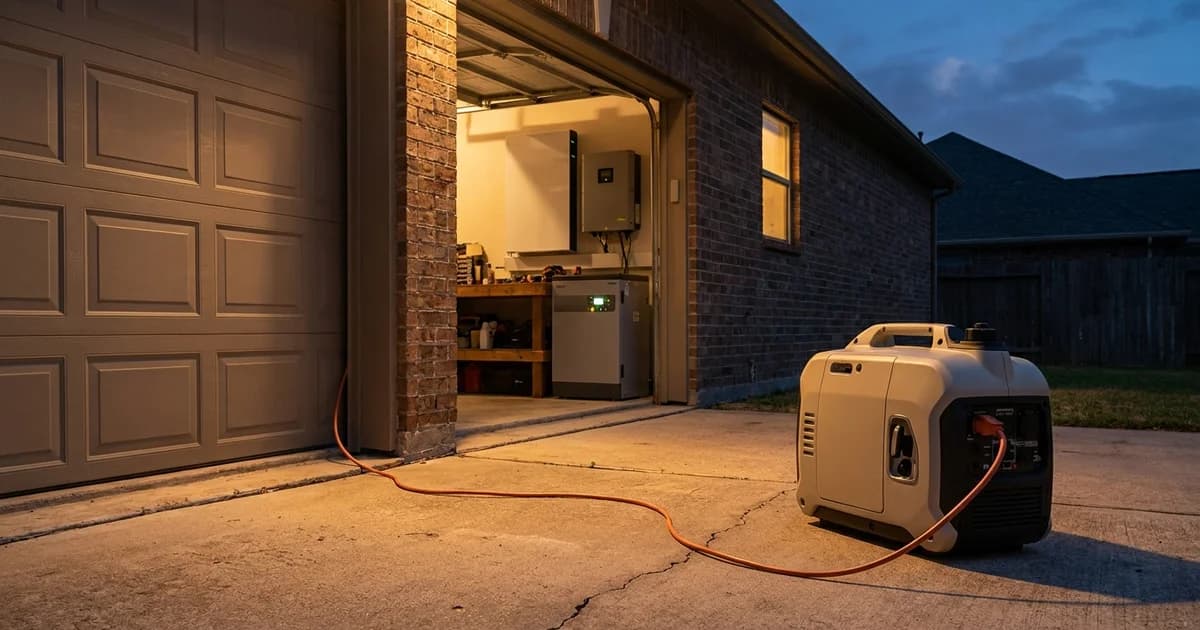
Day four of a hurricane outage is when this question stops being theoretical. The battery is at 8 percent, the sky has been the color of wet concrete since landfall, and there is a generator sitting in the garage. Can you use it to put charge back into the battery instead of running the whole house off the engine?
Short answer: usually yes. But the path from "I own both" to "the generator is charging the battery" runs through a small number of wiring topologies, and only some of them exist on residential equipment. This is the electrical question, not the buying question. If you are still deciding whether to add a battery to a generator you already own, that decision is covered in adding battery backup to a generator you already own. This piece is about whether the two machines can actually talk to each other.
Key Takeaways
- A generator can charge a home battery, but only through an inverter that accepts an external AC source. The generator never charges the battery directly.
- Acceptance windows are narrow and published. Victron's MultiPlus documentation lists a default AC disconnect below 180 Vac and above 270 Vac, with a selectable frequency range of 45 to 65 Hz (Victron Energy).
- Neutral bonding is the most common failure. A bonded generator plus a bonded service creates parallel neutral paths that NEC 250.6 prohibits (BuildingCodeGeek).
- Waveform quality matters. Conventional portable generators run 12 to 20 percent total harmonic distortion; inverter models run under 3 percent (Champion Power Equipment).
- Never backfeed through a cord. CPSC calls the practice dangerous and links it to electrocution and fire (CPSC, 2026).
Can a generator charge a home battery?
Yes, when the battery's inverter has an AC input that will accept a non grid source. The generator produces AC. The battery stores DC. Something has to sit between them and rectify, and on a residential system that something is the battery inverter, not the generator. Victron's MultiPlus documentation is blunt about why this is not trivial: "Power supply from a generator is typically more variable than a power supply from shore or the main grid" (Victron Energy).
That variability is the whole story. Your inverter is not being fussy when it refuses a generator. It is protecting the battery from a source that wanders.
Here is the part most articles skip. The useful outcome is almost never "generator charges battery." It is "generator runs for three hours, carries the house load and tops up the battery at the same time, then shuts off for the next twenty." The generator becomes a charger of opportunity. The battery is what you actually live on.
What are the three real generator plus battery topologies?
There are three, and only two are common on residential equipment. Under NEC Article 702, permanently connected residential generator systems are optional standby systems, and portable generators not connected to premises wiring fall outside the article entirely (JADE Learning).
Topology 1: generator upstream, battery downstream. The generator's automatic transfer switch stays ahead of the panel. The battery and its inverter live downstream on the backed up loads. When the generator runs, the battery sees what looks like restored utility power on its input and charges from it. This is the most common arrangement on Houston homes that added a battery after a standby generator was already in place, because nothing upstream has to be rewired.
Topology 2: dedicated generator input on the inverter. Some hybrid inverters carry a second AC input, separate from the grid input, intended for a genset. The inverter decides when to call for the generator, how much current to draw, and when to stop. That gives you automatic charge scheduling, but it requires that the inverter actually has the port. Do not assume it does.
Topology 3: manual changeover. A manual transfer switch, thrown by hand, moves the panel between utility, generator, and battery. It works. It is also the version where a human being at 2 a.m. is the interlock, which is why installers reach for it last on residential jobs.
Citation capsule: NEC 702.5 requires transfer equipment so that the normal service and the alternate power source cannot operate simultaneously, and Article 702 does not cover portable generators that are not connected to the premises wiring (JADE Learning). Every legitimate generator to battery topology therefore passes through listed transfer equipment, not through a cord.
What decides whether the inverter will accept the generator?
Four things, and none of them are the generator's badge. An inverter accepts or rejects an AC source on measured electrical behavior, so the question "will my generator work with this battery" resolves to voltage, frequency, waveform, and grounding, roughly in that order of how often each one breaks.
Voltage and frequency stability
Inverters publish their acceptance windows. Victron's MultiPlus defaults disconnect below 180 Vac and above 270 Vac, and the unit can be set to accept frequencies from 45 to 65 Hz (Victron Energy). A generator whose governor hunts when a well pump kicks on will slide outside those limits, and the inverter will drop the input, wait, and retry. From the kitchen this looks like the battery refusing to charge for no reason.
Waveform quality
Conventional portable generators put out 12 to 20 percent total harmonic distortion depending on load, while inverter generators and home standby units run under 3 percent (Champion Power Equipment). Battery chargers are switching electronics. They belong in the same category the manufacturer flags as needing low distortion, alongside UPS units and high efficiency furnace control boards.
Neutral bonding, the one that actually bites
This is the failure we see most, and it is a shock hazard, not an inconvenience. A generator is a separately derived system when its neutral is isolated from the utility system, typically by a transfer switch that switches the neutral. When it is not separately derived, the neutral stays solidly connected to the utility system (BuildingCodeGeek). Get the combination wrong and the generator's neutral is bonded to its frame while the same neutral is still bonded at the service. Normal neutral current then splits across paths that were never meant to carry it, which NEC 250.6 prohibits.
WINCO states the requirement plainly for its own portable units: "Whenever you connect a portable generator to a building's electrical system the NEC code requires you to brake the neutral to ground bond on the generator" (WINCO). The alternative is transfer equipment that switches the neutral itself, which is what three pole manual transfer switches exist to do.
For permanently installed generators, NEC 250.35 sets the parallel requirement from the other direction: a generator that is not separately derived needs a supply side bonding jumper run between the generator and the equipment grounding bus of the first disconnecting means (UpCodes).
GFCI on the generator's outlets
Full panel GFCI protection on a portable generator and a bonded neutral are a bad pair once you connect to a building. WINCO sells switched neutral transfer switches specifically because switching the neutral is what makes a bonded, GFCI protected generator connectable at all (WINCO). If your generator trips its own GFCI the second the transfer switch closes, that is the symptom, not a defective generator.
Why this matters most on day four in Houston
Because the storm that knocks out power also takes the sun with it. Clouds directly govern how much a rooftop array can make. NOAA notes that the output of ground based solar power generation "is dependent on the level of light they receive, both directly from the sun and via light reflected from all parts of the sky in the hemisphere above" (NOAA NESDIS). After a hurricane, that sky does not cooperate for days. A precise percentage for Houston post storm array output is not publicly available, so treat the harvest as unreliable rather than as a number.
The scale is not hypothetical here. In 2024, CenterPoint's own securities filing on Hurricane Beryl reported outages "peaking at more than an estimated 2.26 million customers out of 2.8 million customers," with restoration of its delivery facilities estimated at $1.2 billion to $1.3 billion (CenterPoint Energy, SEC Form 424B5, 2024).
What homeowners describe to us afterward is always the same shape. On the first day the battery carries everything and nobody thinks about it. By day three, with no solar harvest worth counting, the battery is the tank and the generator is the pump. Run the engine a few hours in the afternoon, recharge, shut it down, sleep in silence. That is the quiet, fuel efficient outcome people are picturing when they ask this question, and it only works if the charging path was wired and commissioned before the storm.
One honest limit. An Eos controller delivers 11.5 kW continuous and 17.1 kW surge, and a generator on the input does not raise that ceiling. It refills the tank. It does not widen the pipe. For how long a battery alone lasts across a multi day event, see battery backup through extended Texas outages, and for what the panel itself has to support before a second source lands on it, see connecting battery backup to your electrical panel.
What never to do: the cord
Do not connect a generator to your house with an extension cord. In 2026, CPSC warned consumers to stop using male to male extension cords, stating that the cords "are often used to supply power from a generator to a residential electrical system, a dangerous practice known as backfeeding that that can result in serious injury or death from electrocution or fire," and that their exposed prongs "can become energized when plugged into a power source" (CPSC, 2026).
Short cords also push the generator closer to the house, and CPSC ties that directly to carbon monoxide risk. In 2025 the agency reported that "an average of about 100 consumers die in the U.S. each year from CO poisoning from portable generators" and directed that generators be run outside only, at least 20 feet from the house (CPSC, 2025).
There is also the neighbor problem. Backfeeding energizes the utility side of your service, and line crews working a restoration have no way to know your cord is live. Every legitimate version of generator to battery charging goes through transfer equipment an inspector has seen.
If you are comparing the machines rather than wiring them, home battery backup versus a generator in Texas and whole house generator alternatives cover that ground, and the plan lineup shows the capacity tiers.
Or call Eos at 833-989-3737 to talk through your setup with an installer.
Frequently asked questions
Will any generator charge my home battery?
No. The inverter has to accept the AC source, and the windows are published. Victron's MultiPlus defaults to disconnecting below 180 Vac and above 270 Vac and can be set to accept 45 to 65 Hz (Victron Energy). A generator that wanders outside those limits under load gets rejected repeatedly.
Does a conventional generator damage a battery system?
Distortion is the concern, not instant damage. Conventional portables run 12 to 20 percent total harmonic distortion, while inverter and home standby units run under 3 percent (Champion Power Equipment). Chargers are switching electronics, so the low distortion source is the right one.
Why does my generator trip the moment the transfer switch closes?
Almost always neutral bonding. A bonded generator connected through a switch that does not break the neutral leaves two neutral to ground bonds in the system, creating parallel current paths prohibited by NEC 250.6 (BuildingCodeGeek). The fix is switched neutral transfer equipment, or removing the bond at the generator.
Can the generator and the battery both run at once?
Yes, in topologies one and two. The generator carries house load while surplus capacity goes to charging. Transfer itself is not instant on most standby setups: PNNL describes the open transition switch, the most common type, as one that "interrupts the load during the transition between primary and backup power" (PNNL).
Do I need a permit for this?
Treat it as yes. A permanently connected residential generator is an optional standby system under NEC Article 702, which requires transfer equipment so the service and the alternate source cannot operate simultaneously (JADE Learning). Any second source on your panel is inspected work.
Sources
- Victron Energy, MultiPlus FAQ (AC input acceptance and generator behavior), retrieved 2026-09-08, https://www.victronenergy.com/live/multiplus_faq
- Champion Power Equipment, Total Harmonic Distortion, retrieved 2026-09-08, https://help.championpowerequipment.com/article/dgn7qk3fzz-total-harmonic-distortion
- BuildingCodeGeek, Portable Generator Bonding and Grounding: NEC SDS vs Non-SDS Rules Made Simple, retrieved 2026-09-08, https://buildingcodegeek.com/portable-generator-bonding-and-grounding/
- UpCodes, NEC 250.35 Permanently Installed Generators, retrieved 2026-09-08, https://up.codes/s/permanently-installed-generators
- JADE Learning, National Electrical Code Articles 701 and 702, Legally Required and Optional Standby Systems, retrieved 2026-09-08, https://www.jadelearning.com/blog/national-electrical-code-articles-701-and-702-legally-required-and-optional-standby-systems/
- WINCO, A Manual Transfer Switch for GFCI and Bonded Neutral Generators, retrieved 2026-09-08, https://www.wincogen.com/a-manual-transfer-switch-for-gfci-and-bonded-neutral-generators/
- U.S. Consumer Product Safety Commission, CPSC Warns Consumers to Stop Using Male-to-Male Extension Cords, March 31 2026, retrieved 2026-09-08, https://cpsc.gov/Newsroom/News-Releases/2026/CPSC-Warns-Consumers-to-Stop-Using-Male-to-Male-Extension-Cords-Secures-Delisting-Commitments-from-e-Commerce-Platforms
- U.S. Consumer Product Safety Commission, CPSC Issues Safety Tips to Help Families Prevent Carbon Monoxide Poisoning and Fires, 2025, retrieved 2026-09-08, https://www.cpsc.gov/Newsroom/News-Releases/2025/As-Winter-Storms-Threaten-Millions-in-the-US-CPSC-Issues-Safety-Tips-to-Help-Families-Prevent-Carbon-Monoxide-Poisoning-and-Fires
- CenterPoint Energy, SEC Form 424B5, 2024, retrieved 2026-09-08, https://www.sec.gov/Archives/edgar/data/1130310/000119312524195889/d856210d424b5.htm
- NOAA NESDIS, Cloudy Days and Solar Arrays, retrieved 2026-09-08, https://www.nesdis.noaa.gov/news/cloudy-days-and-solar-arrays
- Pacific Northwest National Laboratory, Automatic Transfer Switches, retrieved 2026-09-08, https://www.pnnl.gov/projects/om-best-practices/automatic-transfer-switches