Complete Guide to Home Battery Backup in Houston, TX (2026)

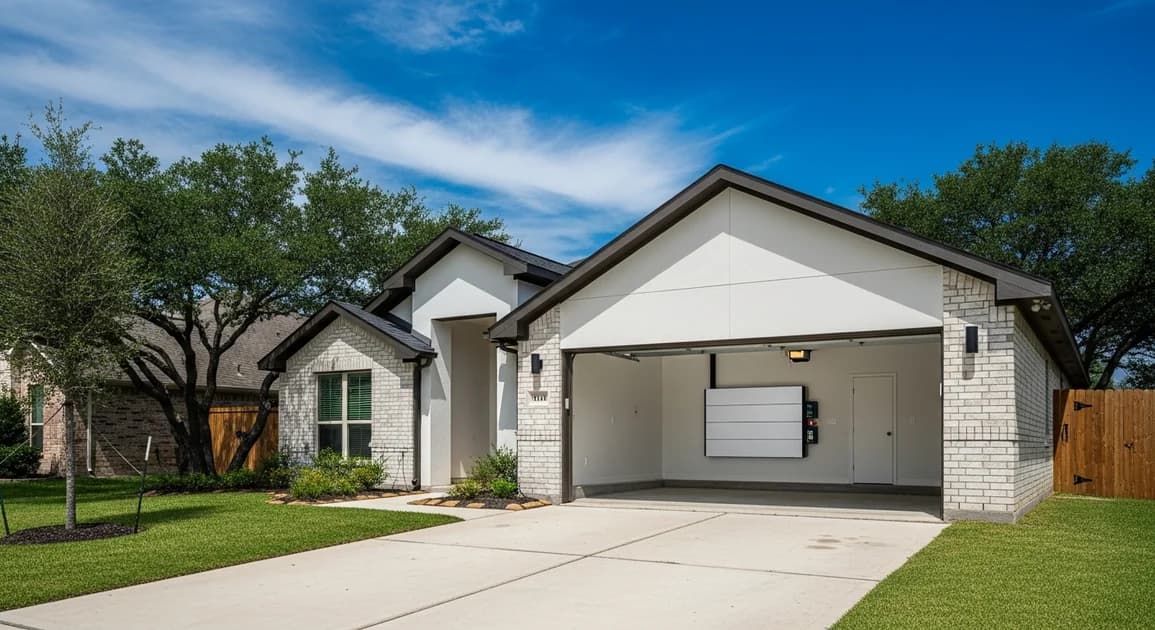
Complete Guide to Home Battery Backup in Houston, TX (2026)
Hurricane Beryl knocked out power to 2.26 million CenterPoint Energy customers in July 2024 (Houston Public Media, 2024). Some waited more than a week for restoration while indoor temperatures climbed past 100°F. At least 23 people died from the storm and the outages that followed.
Houston sits on one of the most outage-prone grids in the country. Between hurricane season, summer heat waves, and winter freeze events, the ERCOT grid faces pressure that keeps getting worse. Data center demand surged 270% in 2025 alone, and the grid's winter reserve margin has fallen below the industry safety standard (Texas Policy Foundation, 2026).
This guide covers everything Houston homeowners need to know about home battery backup: how systems work, what they power, what they cost, how they compare to generators, and what the installation process looks like.
Key Takeaways
- Houston's ERCOT grid reserve margin dropped to 10.1% in 2026, below the 15% industry safety standard, increasing outage risk during extreme weather.
- Home battery systems cost $10,000 to $23,000 installed in Texas depending on capacity. No solar panels are required.
- A 9 kWh battery runs essentials for 6+ hours. Whole-home coverage with central AC needs 27 kWh or more.
- LFP battery chemistry handles Houston's extreme heat far better than NMC, with a thermal runaway threshold of 270°C vs. 210°C.
- Texas Property Code §202.010 protects your right to install a battery system even if you live in an HOA community.
Why Do Houston Homeowners Need Battery Backup?
ERCOT's winter reserve margin dropped from 17.5% in 2021 to a projected 10.1% in 2026 (Texas Policy Foundation, 2026). That's well below the 15% threshold the electric industry considers necessary to avoid blackouts during extreme weather. Houston's grid isn't getting more reliable. It's getting more strained.
The demand side is part of the problem. ERCOT received 225 new large-load interconnection requests in 2025, representing a 270% increase in megawatt demand since January of that year. Data centers account for roughly 73% of those requests (Latitude Media, 2025). More load on the same grid means less margin for everyone.
Houston's Outage History Speaks for Itself
Houston homeowners don't need statistics to know the grid is fragile. They've lived through it. Winter Storm Uri in 2021 left 4.5 million Texas homes without power for an average of 42 hours. Hurricane Beryl in July 2024 knocked out 2.26 million CenterPoint customers, with some neighborhoods dark for eight days or longer (Texas Tribune, 2024). Even outside major storms, CenterPoint had the worst outage performance in the country in October 2025, with some neighborhoods losing power eight times in a single month (Click2Houston, 2026).
The consequences go beyond inconvenience. Spoiled food, failed sump pumps, medical device disruptions, lost remote work days, and dangerous indoor heat. In a Houston summer, a sealed home without AC can exceed 90°F within two to three hours.
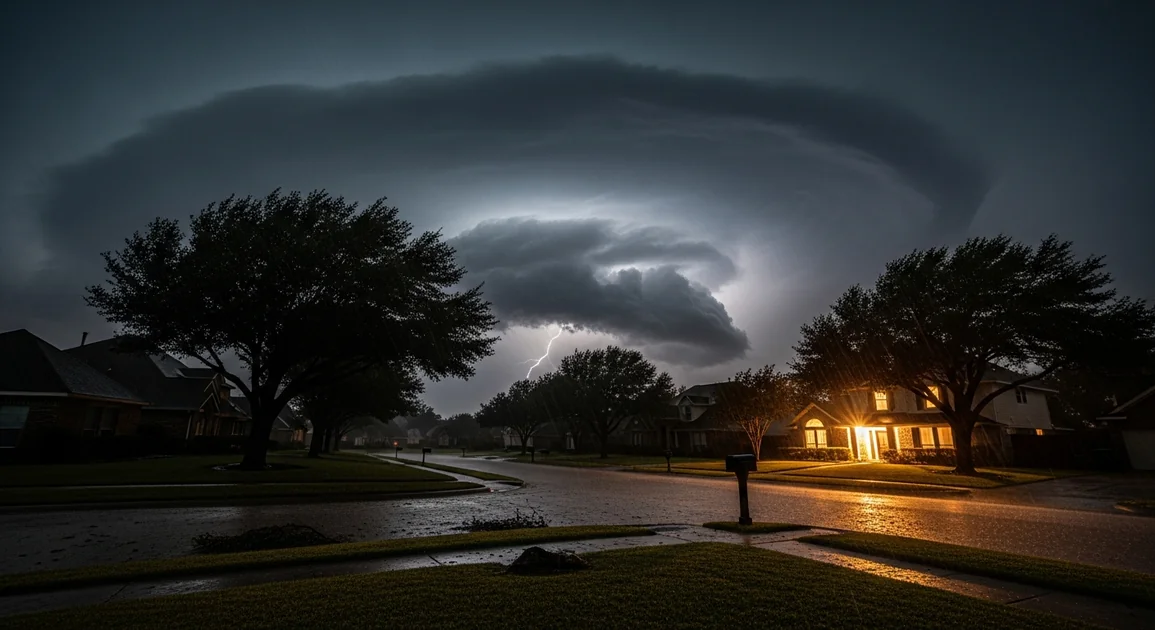
What Eos Backup and Battery sees in Houston: The most common reason our customers give for installing a battery isn't saving money on electricity. It's peace of mind. They've already lived through one multi-day outage and decided they won't do it again.
How Does a Home Battery Backup System Work?
A home battery stores electricity from the grid (or from solar panels, if you have them) and releases it automatically when the power goes out. Modern systems switch over in under 20 milliseconds. That's fast enough that you won't notice the lights flicker. Your refrigerator keeps running, your Wi-Fi stays connected, and your phone keeps charging.
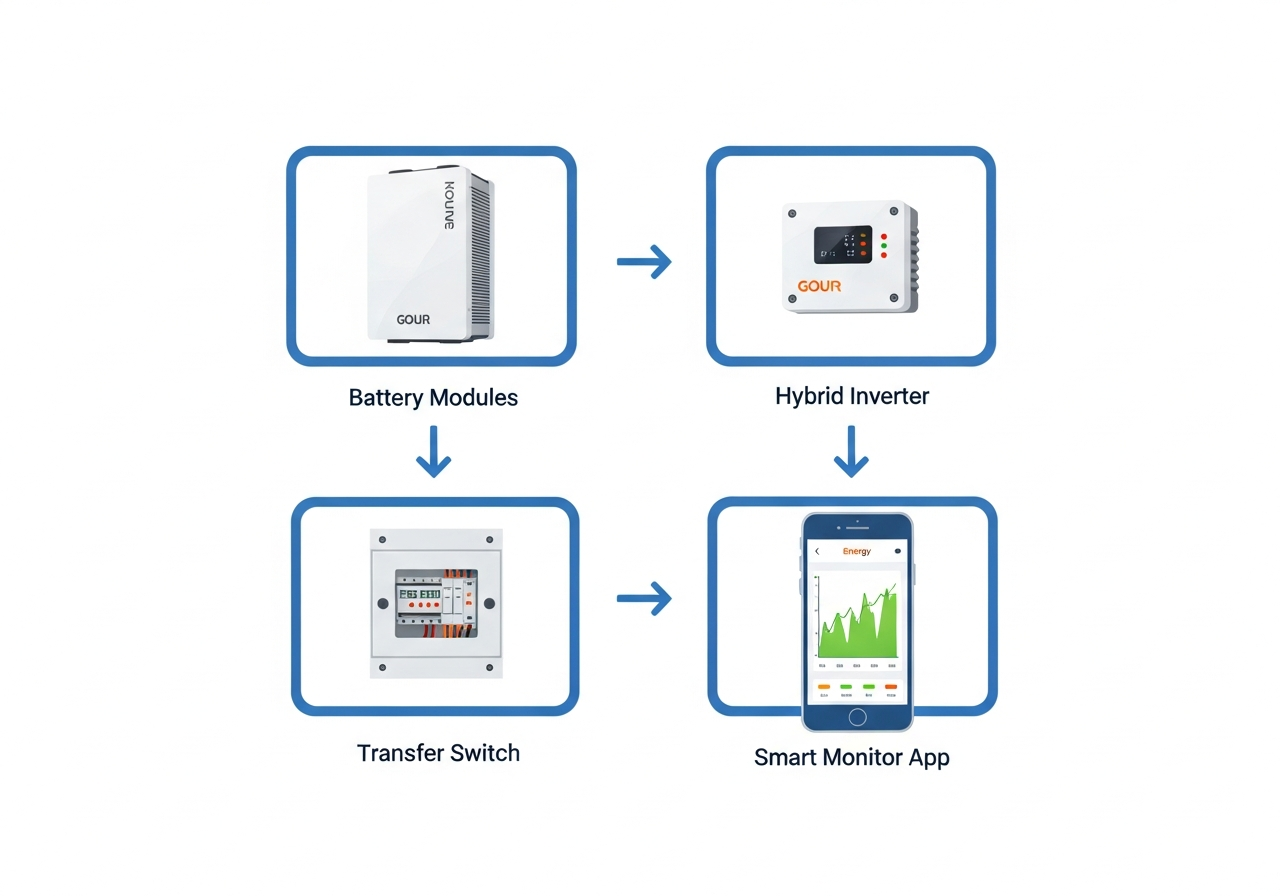
Here's what's inside a typical home battery installation:
- Battery modules: The storage units themselves. Lithium iron phosphate (LFP) is the chemistry used in most modern residential systems.
- Hybrid inverter: Converts stored DC power to AC power your home uses. Also manages charging from the grid or solar.
- Transfer switch: Automatically disconnects your home from the grid during an outage and switches to battery power.
- Monitoring app: Lets you see charge levels, energy usage, and system status from your phone.
During normal operation, the battery charges when electricity rates are lowest (typically overnight) and can discharge during peak pricing hours to save money. When the grid goes down, it becomes your backup power source automatically.
You Don't Need Solar Panels
One of the most common misconceptions about home batteries is that you need rooftop solar to use one. You don't. A home battery charges directly from the grid and provides full backup protection without any solar panels. Solar can be added later if you choose, but it isn't a prerequisite.
This matters in Houston especially. Many homes have tree canopy that limits rooftop solar potential, older roof structures that need replacement first, or homeowners who simply want outage protection without the cost and complexity of a full solar installation.
What Can a Home Battery Actually Power During an Outage?
A single 9 kWh battery can keep your refrigerator, lights, Wi-Fi, and phone chargers running for roughly six hours. That covers most grid outages in the Houston area. Scale up to 27 kWh, and you can run your entire home including central air conditioning for five to seven hours.
Runtime depends on two variables: how much energy your battery stores (measured in kWh) and how much power your home draws (measured in watts). For a full breakdown of how long batteries last in Texas by load profile, including the heat impact on lifespan, see
. Here's how that breaks down in practice:- Essentials only (~1,000W): Refrigerator, LED lights, Wi-Fi router, phone chargers, a few outlets. A 9 kWh battery runs this load for 6+ hours.
- Partial home (~2,500W): Add a window AC unit, sump pump, or a few more appliances. An 18 kWh system handles this for 6 to 8 hours.
- Whole home (~5,000W+): Central HVAC, kitchen appliances, laundry. A 27 kWh system provides 5 to 7 hours of coverage.
- Extended whole home: A 36 kWh system stretches whole-home coverage to 7+ hours, or runs essentials-plus-AC for a full day.
Sizing Your Battery for Houston's Climate
Central air conditioning is the single biggest power draw in any Houston home. A 3-ton unit, which is common in homes around 2,000 square feet, pulls 3,000 to 3,500 watts continuously when running. That single appliance will drain a small battery fast.
Houston-specific sizing advice: If you're installing a battery primarily for summer outage protection, 18 kWh is the minimum for running a single AC zone. For whole-home cooling, you'll want 27 kWh or more. Winter storms are actually less demanding on the battery since heating loads are smaller than cooling loads in most Houston homes.
During a summer outage, a sealed Houston home without AC can become dangerously hot within hours. For families with elderly members, young children, or pets, running the AC isn't a comfort choice. It's a safety requirement. That's why most Houston homeowners we work with choose the 27 kWh Pro plan or higher.
How Much Does a Home Battery System Cost in Houston?
Installed pricing in Texas ranges from about $10,000 for a single 9 kWh system to $23,000 for a 45 kWh whole-home setup. The statewide market average is $1,344 per kWh installed (EnergySage, 2026). Most Houston homeowners choose a system in the $13,000 to $17,000 range, which covers essentials plus partial or full air conditioning.
Here's what Eos Backup and Battery's plans cost, fully installed:
| Plan | Capacity | Installed Price |
|---|---|---|
| Essential | 9 kWh | $9,915 |
| Plus | 18 kWh | $13,194 |
| Pro | 27 kWh | $16,472 |
| Premium | 36 kWh | $19,751 |
| Ultimate | 45 kWh | $23,030 |
Those prices include everything: battery modules, hybrid inverter, transfer switch, all electrical work, permitting, and commissioning. There are no hidden fees for panel upgrades or permit applications.
What Affects the Final Price?
Four factors drive cost variation between installations:
- Number of battery modules: More capacity means more hardware. Each 9 kWh module adds roughly $3,200 to the system cost. All five residential plans share the same 11.5 kW controller, so you pay only for the batteries you need.
- Optional V2X add-on: Adding the bidirectional V2X module to use a compatible EV as extra backup adds about $2,700 to the installed price. It's optional, not required.
- Electrical panel upgrades: Some older Houston homes need a panel upgrade to support the battery system. Eos includes this in the quoted price when it's needed.
- Municipal permitting: Permit costs and timelines vary across the Houston metro area. City of Houston, Harris County, Fort Bend County, and surrounding municipalities all have different requirements.
EnergySage reports the average gross cost for a 13 kWh system in Texas at $17,472 (EnergySage, 2026). Eos Backup and Battery's comparable 18 kWh Plus plan, which provides 38% more capacity, starts at $13,194 with all installation costs included.
How Does Battery Backup Compare to a Generator?
Batteries are quieter, maintenance-free, switch on instantly, and produce no emissions. Generators cost less per watt of raw output, but they need fuel, annual servicing, and either manual startup or a 15- to 30-second automatic transfer delay. Over a 10-year span, the total ownership cost of a generator often exceeds a battery system once you factor in fuel and maintenance.
Here's how they compare on the dimensions that matter most to Houston homeowners:
Noise: Batteries produce zero noise. Generators run at 65 to 80 decibels, roughly the volume of a vacuum cleaner running continuously. In a dense Houston subdivision, your neighbors will hear it.
Maintenance: Batteries need nothing. No oil changes, no fuel stabilizer, no annual tune-ups. Generators require professional servicing every year, costing $200 to $600 annually. Over 10 years, maintenance alone runs $2,000 to $6,000 for a generator (EcoFlow, 2026).
Fuel: Batteries charge from the grid. Generators burn gasoline, natural gas, or propane at $3 to $6 per hour under load. During a hurricane, when you need backup power most, gas stations are either closed, out of fuel, or have hour-long lines.
Switchover speed: Batteries transfer in under 20 milliseconds. Automatic standby generators take 15 to 30 seconds. Portable generators require manual startup. Those 15 to 30 seconds mean your clocks reset, your computer reboots, and your smart home loses its connection.
Indoor safety: Batteries install in your garage or on an exterior wall. Generators must be outdoors due to carbon monoxide risk, which causes deaths every hurricane season.
HOA compatibility: Texas Property Code §202.010 explicitly protects homeowners' right to install solar energy devices, which includes battery storage systems (FindLaw, 2025). Your HOA cannot block installation. Generators don't have this protection and may face HOA restrictions on noise, fuel storage, and placement.
Which Home Battery Systems Are Available in Houston?
The Sigenergy system, installed by Eos Backup and Battery, uses lithium iron phosphate (LFP) chemistry specifically suited for Houston's extreme heat. Other systems available in the Houston market include the Tesla Powerwall 3, Enphase IQ Battery 5P, Franklin WholePower, and Generac PWRcell.
Here's a quick comparison of the most common options:
| System | Capacity | Chemistry | Approx. Installed Cost | Warranty |
|---|---|---|---|---|
| Sigenergy (Eos Backup and Battery) | 9-45 kWh (modular) | LFP | $9,915-$23,030 | 15 years |
| Tesla Powerwall 3 | 13.5 kWh | LFP | ~$12,500 | 10 years |
| Enphase IQ 5P | 5 kWh per unit | LFP | ~$10,000-$12,000 (2 units) | 15 years |
| Franklin WholePower | 13.6 kWh | LFP | ~$18,000 | 12 years |
| Generac PWRcell | 9-18 kWh | NMC | ~$12,000-$18,000 | 10 years |
What should you compare beyond price? Battery chemistry, modularity (can you add capacity later?), inverter type, warranty length, and how well the system handles heat. That last point matters more in Houston than almost anywhere else in the country.
Why LFP Battery Chemistry Matters in Texas
Not all lithium batteries are the same. LFP (lithium iron phosphate) and NMC (nickel manganese cobalt) are the two main chemistries used in home batteries. In Houston's climate, the difference is significant.
LFP has a thermal runaway threshold of 270°C, compared to 210°C for NMC. Thermal runaway, where a battery overheats uncontrollably, is approximately 80% less likely in LFP cells under equivalent abuse conditions (ScienceDirect, 2024). That's a meaningful safety margin when your battery sits in a Houston garage where summer temperatures regularly exceed 100°F.
LFP also lasts longer. Modern LFP batteries are rated for 3,000 to 5,000 full charge cycles before dropping to 80% capacity, compared to 1,500 to 2,500 cycles for NMC (evlithium, 2026). At one cycle per day, that's 8 to 14 years of use for LFP versus 4 to 7 years for NMC.
Perhaps the most relevant stat for Houston: at temperatures above 35°C (95°F), NMC cycle life degrades 40 to 50% below the manufacturer's rated spec (ScienceDirect, 2024). Houston exceeds 35°C for roughly four to five months per year. An NMC battery installed in a Houston garage won't last as long as the datasheet says it will.
What Does the Installation Process Look Like?
From first contact to a fully operational system, most Houston installations take two to four weeks. The actual install day is typically completed in four to eight hours with minimal disruption to your daily routine.
Here's the process, step by step:
Step 1: Site assessment and system sizing. An Eos Backup and Battery specialist evaluates your home's electrical setup, discusses your backup priorities (essentials only vs. whole-home), and recommends the right plan. This can be done virtually or in person.
Step 2: System design and permitting. Eos handles all permit applications. This is where timelines vary across the Houston metro area. City of Houston electrical permits are typically straightforward. Surrounding municipalities like Katy, Sugar Land, The Woodlands, and Pearland each have their own permitting offices and timelines.
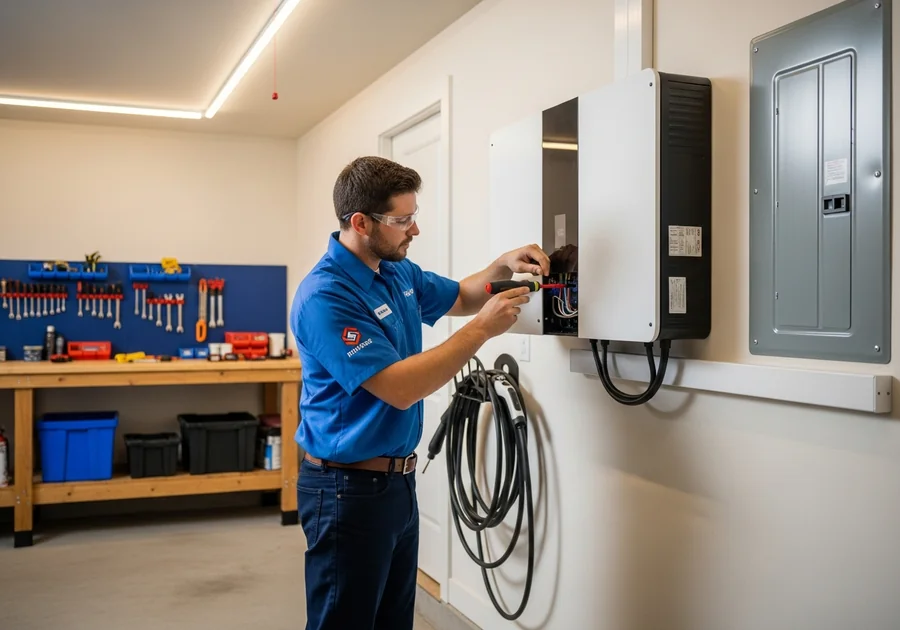
From our installation teams: Permitting in the City of Houston typically takes 5 to 10 business days. Fort Bend County and Katy tend to run faster. Montgomery County (The Woodlands area) can take slightly longer. We handle all the paperwork regardless of which jurisdiction your home falls in.
Step 3: Installation day. A licensed electrician installs the battery modules, inverter, and transfer switch. Your power will be off for a brief period (usually one to two hours) while the transfer switch is connected. The full installation takes four to eight hours.
Step 4: City inspection and utility interconnection. After installation, the city inspector verifies the work meets code. CenterPoint Energy is notified of the new system for interconnection purposes.
Step 5: System commissioning and app setup. The system is powered on, tested, and connected to the monitoring app. You'll see your battery's charge level, energy usage, and backup status in real time from your phone.
CenterPoint Energy reported a 45% reduction in customer outage minutes during the first half of 2025 compared to 2024 (CenterPoint Energy, 2025). That's encouraging progress, but it doesn't change the fundamental risk. The next hurricane, the next winter storm, or the next summer demand surge can still overwhelm the grid. A battery is a permanent solution that doesn't depend on utility improvements arriving on schedule.
Frequently Asked Questions
How long can a home battery power my house in Houston?
A 9 kWh battery runs essential loads (refrigerator, lights, Wi-Fi, phone chargers) for about eight hours. Whole-home backup including central air conditioning requires 27 kWh or more and provides five to seven hours of coverage. Houston's AC loads are the primary factor in sizing: a 3-ton central unit draws 3,000 to 3,500 watts continuously.
Do I need solar panels to install a home battery?
No. Home batteries charge directly from the grid and provide full outage protection without solar panels. Solar can be added later to increase self-sufficiency, but it's entirely optional. Many Houston homeowners install batteries without any solar at all.
Is a home battery worth it in Houston?
Yes. Hurricane Beryl left 2.26 million CenterPoint customers without power in 2024, with some waiting over a week for restoration (Houston Public Media, 2024). A battery eliminates disruption from grid failures and protects against food spoilage, medical device interruptions, and dangerous indoor heat.
How much does a home battery cost installed in Houston?
Between $10,000 and $23,000 depending on capacity. Most Houston homeowners choose a mid-range system (18 to 27 kWh) in the $13,000 to $17,000 range. Financing options are available. All Eos Backup and Battery pricing includes installation, permitting, and equipment with no hidden fees.
Can my HOA block a battery installation in Texas?
No. Texas Property Code §202.010 protects homeowners' right to install solar energy devices, which includes battery storage systems (FindLaw, 2025). Your HOA cannot prohibit the installation. This applies to communities across the Houston metro, including master-planned neighborhoods like Cinco Ranch, Sienna, and Bridgeland.
What happens to my battery during a hurricane?
The battery is installed inside your garage or on an exterior wall rated for weather exposure. Before a storm, you can set the system to charge fully from the grid. When the power goes out, it switches to backup mode automatically in under 20 milliseconds. A 27 kWh system can power essentials through most storm-related outages, which typically last one to three days.
Your Next Step
Houston's grid reality, from hurricanes to heat waves to an ERCOT system stretched thin by data center demand, makes battery backup a practical investment, not a luxury. Systems are available at multiple price points and capacity levels. You don't need solar. Your HOA can't block it. And installation takes weeks, not months.
The most popular choice for Houston homeowners is the Pro plan (27 kWh), which provides enough capacity to run essential loads plus air conditioning through a typical multi-hour outage. For families who want full peace of mind during extended events like hurricanes, the Ultimate plan (45 kWh) covers the widest range of scenarios.
Ready to get started? Schedule a free consultation with Eos Backup and Battery. We'll assess your home, recommend the right system size, and handle everything from permitting to installation.
Continue Learning
Guides:
Comparisons:
Plans and Specs: