Battery Backup for Houston Tutoring and Learning Centers: A Storefront Guide

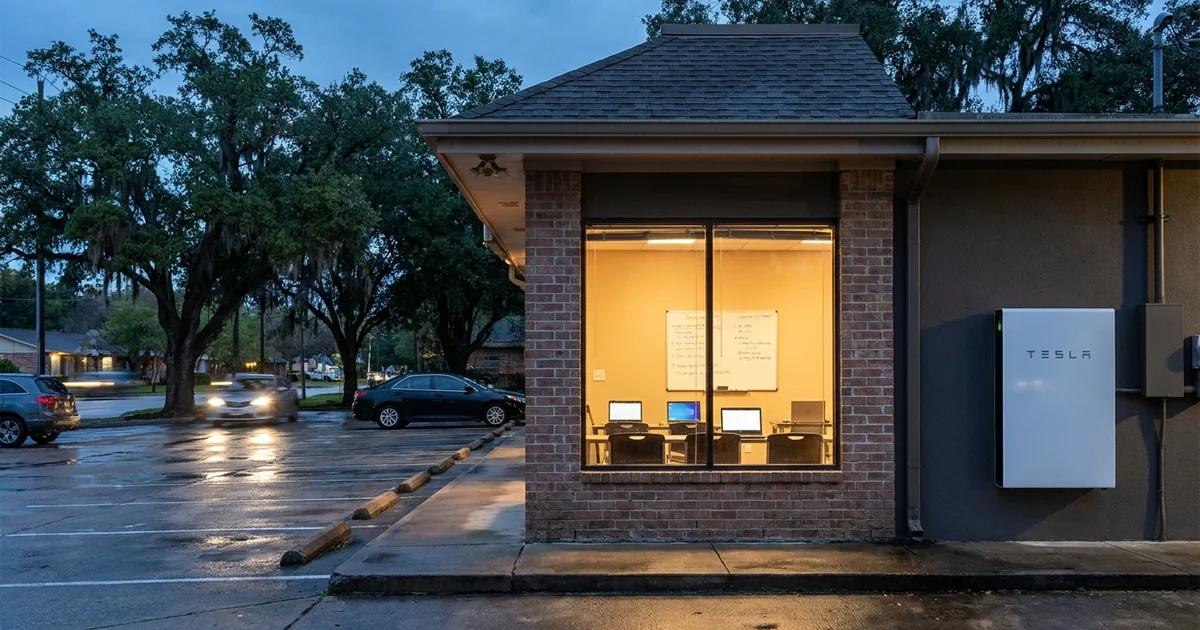
A tutoring center is a strange kind of business to lose power. Nothing spoils, no machine stops mid-cycle, and nobody is in danger from a quiet building. What breaks is smaller and more immediate: the lights, the Wi-Fi that the whole lesson plan runs on, the front-desk phone, and a room of kids whose parents are on their way at 5 p.m.
This guide is for the owner of a small learning center in a leased Houston storefront. It is not the daycare story and it is not the private-school story. Those have their own posts, and the stakes are different. Here the question is how to keep a lean, computer-and-Wi-Fi business running, and how to be honest about what a home-scale battery can and cannot do in a commercial space.
Key Takeaways
- Hurricane Beryl affected about 2.26 million CenterPoint customers, and the utility said it had restored more than 1 million of them in the first 55 hours (NBC News). That still left well over a million customers waiting after more than two days.
- Texas law does not name "tutoring" in its list of child-care licensing exemptions. A single-skill exemption exists, with conditions (Tex. Hum. Res. Code 42.041). Confirm your own status with the state, not with a vendor.
- A single residential-class system can carry the lights, internet, phones and a few computers. It is not built to run a whole storefront's air conditioning.
- If you lease, the building's electrical service and your lease decide what you can install, so start there.
What does an outage actually cost a tutoring center?
Mostly hours, and trust. A center that sells sessions loses revenue only when it cancels one, and the cancellations are what hurt. A parent who drives across Houston to find a dark storefront remembers it.
The risk is concentrated in a short window. After-school centers do much of their business in the late afternoon and early evening, when school lets out and many parents are working. That timing is my own observation of how these programs are scheduled, not a published statistic, so check it against your own calendar. If your busiest hours are also your most exposed ones, the question is not whether an outage is likely in a given week. It is what happens on the one afternoon it lands on a full schedule.
Outages can run long. Beryl in July 2024 is the local benchmark: CenterPoint reported that it had restored more than 1 million of 2.26 million affected customers in the first 55 hours, with another 400,000 expected by the end of Friday, July 12 (NBC News). Many outages are far shorter. But a center that depends on a single cellular hotspot and a phone flashlight is planning for the short ones only.
What does a tutoring center really need to keep running?
Less than most commercial buildings, which is the good news. A typical small center runs on a short list:
- Lighting in the teaching rooms and the entry.
- The router, modem and any Wi-Fi access point. If lessons or scheduling live online, this is the critical load. Our router backup guide covers how small that draw is.
- Laptops, tablets and a front-desk computer.
- The phone system and a card reader.
- A small refrigerator or water cooler, if you have one.
I am not going to give you a watts-per-computer figure for a "typical" center. I looked for a current, well-sourced number on laptop and desktop draw and the public measurements I found were either old or based on small samples, so I am leaving it out. The reliable method is to read the label on your own chargers and the nameplate on your own equipment, add them up, and size from your actual list.
What I would not put on that list is the building's air conditioning, which leads to the next section.
Can a battery carry the air conditioning in a storefront?
Usually not the whole thing, and this is where honesty matters. Eos plans are residential-scale. Every plan uses one controller rated for 11.5 kW continuous and 17.1 kW surge, and the Essential plan includes 8.76 kWh of usable capacity, which our plan specs describe as up to 6 hours at minimal load. The Plus plan doubles that to 17.52 kWh usable, enough for up to 12 hours under the same conditions. You can see the details on the Essential plan page and the plans overview.
A retail-strip unit with rooftop HVAC, several rooms and glass on the front is a different electrical animal from a house. A single residential controller can carry the critical circuits comfortably. Running a commercial rooftop unit for hours on top of that is not a promise I will make, and neither will a responsible installer. If keeping the whole space cool is the goal, that is a commercial design, sized by an engineer against your actual panel and equipment. Our guides to commercial battery backup for Texas businesses and commercial versus residential sizing explain where the line sits.
For most small centers the practical answer is a protected-circuits plan: lights, internet, phones, computers and a couple of outlets, with the HVAC left on the grid. A smart panel decides which circuits stay live, and our circuit prioritization guide shows how that works.
Do you own the electrical service, or does your landlord?
This is the question that decides whether any of the above is possible, and it is specific to a leased storefront. In many multi-tenant strip centers the landlord owns the building and controls the electrical room, the meter bank and what is allowed on the exterior walls. I cannot tell you how your lease reads, and I have no verified Houston-wide data on how common each arrangement is. Treat what follows as a checklist, not legal advice.
- Read your lease for alterations. Installing equipment on the building usually needs written landlord consent.
- Find your meter. A tenant with its own meter and panel has a simpler path than one on a shared service.
- Ask who owns the roof and exterior walls. That decides placement.
- Consider the portable question. Some tenants prefer equipment they can take with them when the lease ends. Our guide to rental property and landlord battery questions walks through the permission side, though it is written for residential rentals.
If you own the building, none of this applies and the process looks like a home install with a commercial review.
Does a tutoring center need to worry about child-care licensing rules?
Possibly, and it depends on how the program operates, so check before you assume either way. Texas regulates facilities that care for children who are not related to the operator. The Human Resources Code then lists situations that are exempt. The statute does not name tutoring. It does include an exemption for a program where a child "receives direct instruction in a single skill, talent, ability, expertise, or proficiency," with conditions: the program must not offer unrelated services and must not advertise as child care (Tex. Hum. Res. Code 42.041).
I could not confirm whether a particular homework-help or after-school tutoring format fits that exemption, and I will not guess. The statute also says these exemptions do not limit the inspection authority of health officials, the state fire marshal or local fire officials, so a licensing exemption does not mean a building is exempt from fire safety review.
Why it matters for backup power: if your center is licensed as a child-care or school-age program, the state's rules on safe, lit and ventilated space apply to you, which is a good reason to plan for an outage. Our daycare guide covers what the childcare rules say, and our private and charter school guide covers the campus side. If you are not sure which side of the line your program sits on, ask Texas HHSC Child Care Regulation directly. Do not rely on a vendor, including us.
How should an owner size and start?
Start from the lesson, not the battery.
- Write the list. Which rooms are used at the busiest hour, and what plugs in there?
- Pick the must-run loads. Internet, lights, phones and student computers come first.
- Decide your outage goal. Finish tonight's sessions, or stay open for a multi-day event? The first is a small system. The second is a bigger conversation.
- Check the building. Meter, panel, lease and placement.
- Ask for a site review. A commercial space needs a person to look at it.
If you also run your business partly from home, our home office battery backup guide covers that side.
What did we leave out on purpose?
A few claims that come up whenever people write about small businesses, which I could not support with a public source:
- A typical wattage for a tutoring center. No reliable current figure found.
- How many Houston tutoring centers operate in leased space. No verified count.
- How a specific tutoring format is treated under child-care licensing. The statute does not say, so ask the state.
- Install timelines and landlord approval times. They vary by building and cannot be quoted honestly.
What to do next
Call your landlord or property manager before you call anyone else, and ask who owns the electrical service. Then write the list of circuits you cannot lose. With those two answers, the sizing conversation is short.
Or call Eos at 833-989-3737 to talk it through with an installer.
Frequently asked questions
Can a home battery keep a tutoring center open during an outage?
For the critical loads, yes: lights, internet, phones and computers. It is not designed to run a full commercial HVAC system, which needs an engineered commercial solution.
How long will it run?
It depends on the load you connect. Per our plan specs, the Essential plan's 8.76 kWh of usable capacity delivers up to 6 hours at minimal load, and the Plus plan's 17.52 kWh delivers up to 12 hours. A small internet-and-lights circuit sits at the light end of that range.
Do I need my landlord's permission?
In most leases, almost certainly for equipment attached to the building. Read the alterations clause and ask in writing.
Is a tutoring center exempt from child-care licensing in Texas?
The statute does not mention tutoring by name. A single-skill exemption exists with conditions (Tex. Hum. Res. Code 42.041). Confirm your status with Texas HHSC Child Care Regulation.
Is this the same as backup for a daycare or private school?
No. A daycare has infants, milk and medication to protect, and a school has a cafeteria and a campus. A tutoring center is mostly a computers-and-connectivity question. See the daycare guide and the private school guide for those.