Mini-Splits and Window AC Units in an Outage: What a Home Battery Can Cool

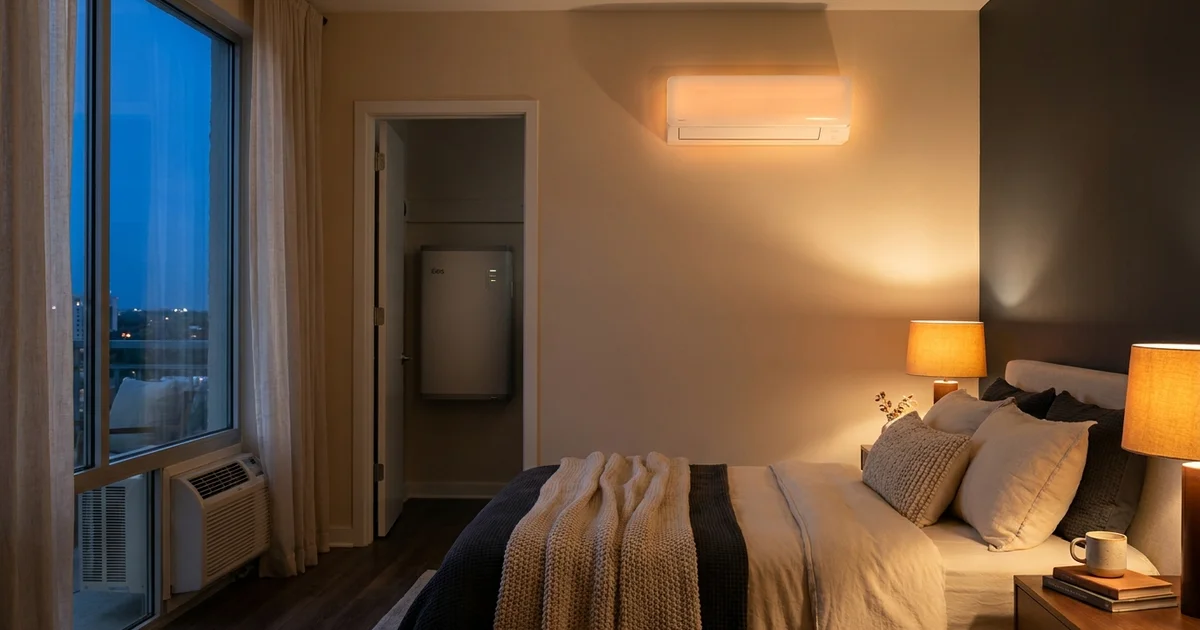
Most outage plans for a Houston summer start with the whole house and a central air handler. That is the right question if you want the entire home cool. It is the wrong one if the real goal is a place where a baby, a parent or a dog can sleep safely for a few nights.
Cooling one room is a different problem. It uses a different class of equipment, a different slice of the battery, and a different set of mistakes. This post covers the two usual options, a ductless mini-split and a window air conditioner, and what a home battery has to do to run either one.
I am going to be careful with numbers. I could not verify a published wattage for these units in a form I could cite, so I will not hand you a "typical draw." I will show you how to read it off your own equipment and do the math.
Key Takeaways
- Cooling one room means a much smaller air conditioner than cooling a house, so the battery energy per hour is a fraction of what central air needs. Your unit's nameplate decides the actual number.
- Ductless mini-splits typically use variable-capacity, inverter-driven compressors, and the U.S. Department of Energy's evaluation says that design cuts annual energy use by about 35 percent compared with fixed-capacity systems (DOE Building America / NREL).
- ENERGY STAR says a room AC that is too big "does not provide better cooling" and leaves a room damp (ENERGY STAR). Bigger is not safer.
- A mini-split is hardwired and needs an installer to put it on a backed-up circuit. A window unit plugs in, but only an outlet on a protected circuit works.
Why is cooling one room different from cooling a house?
Because the size of the machine sets the size of the draw, and the draw sets how long a battery lasts. A central system moves cool air through a whole house and its ducts. A single-room unit only has to handle one space.
Our central AC tonnage guide covers the whole-house case in detail, including compressor inrush and why a controller's kW limit matters as much as capacity. Our heat survival guide covers the no-power tactics that come first. This post covers the narrower strategy in between: protect one cool room, and let the rest of the house run warm.
There is a second reason one room works well. Ducts in Houston attics are a known weak point. The DOE evaluation of ductless mini-splits says duct leakage and conduction lose an average of 20 percent of the thermal energy delivered to ducts, and that the penalty tends to be greater, 25 to 40 percent, where ducts run through unconditioned spaces such as attics in southern locations (DOE Building America / NREL). A unit that cools the room it sits in avoids that loss entirely.
What makes a mini-split different from a window unit?
Both cool one room. They get there differently.
A ductless mini-split has an outdoor compressor unit connected by refrigerant lines to one or more indoor units. The DOE evaluation describes these systems as typically using variable-capacity compressors, inverter-driven for continuous capacity modulation, with variable-speed fans. It credits that design with annual energy savings of about 35 percent relative to conventional systems with fixed capacity and single-speed blowers (DOE Building America / NREL).
For a battery, the inverter design matters. A unit that ramps its compressor up and down smoothly draws gradually. A conventional fixed-speed compressor starts at full power every cycle. ENERGY STAR makes the same point about room units: variable-speed compressors are present in most ENERGY STAR certified models, and those models use 20 to 35 percent less energy than a standard model (ENERGY STAR).
A window unit plugs into an outlet and sits in a window. Many modern ones are variable speed. Older ones are not, and an older fixed-speed unit is the one most likely to be hard on a battery at startup. I do not have a verified startup surge number to give you, so check the label rather than relying on a rule of thumb from me.
Here is the practical split:
| Ductless mini-split | Window unit | |
|---|---|---|
| Connection | Hardwired, needs a dedicated circuit | Plug-in cord |
| Compressor | Usually inverter-driven (DOE) | Varies by model, check the label |
| Install for battery use | Installer routes its circuit through the backed-up panel | Plug into an outlet that is on a protected circuit |
| Cooling reach | One room per indoor head | One room |
| Dehumidification | Strong at low load (DOE) | Depends on sizing and speed |
How big should the unit be?
Smaller than you think, which is good news for your battery. ENERGY STAR publishes a sizing method for window units: measure the room, then look up capacity by square footage. The chart starts at 5,000 BTU per hour for 100 to 150 square feet. It then adjusts: reduce capacity by 10 percent for a heavily shaded room, increase it by 10 percent for a very sunny one, add 600 BTU per hour for each person beyond two who regularly occupies the room, and add 4,000 BTU per hour for a kitchen (ENERGY STAR, How to choose the right sized window AC).
The same page warns against oversizing. An oversized unit cools the room "before it has a chance to remove the humidity," which leaves it damp and clammy. In Houston, where humidity is half of the discomfort, a right-sized small unit often feels better than a big one.
This is guidance for window units. Mini-split sizing is a separate calculation done by a contractor, and the ENERGY STAR chart is not a substitute for it.
How do you work out what it will draw?
Read the equipment. I am not going to give you a "typical" wattage because I could not support one with a source I could cite.
- Window unit. Look at the label on the side or back. It lists amps and volts, sometimes watts. Multiply amps by volts to get watts.
- Mini-split. The outdoor unit has a data plate. Look for rated input power or running amps for cooling. A submittal sheet from the manufacturer or your installer lists the rated and maximum input power at specific outdoor temperatures. Use the maximum for controller limits and the rated figure for energy.
- Convert to energy. Watts times hours divided by 1,000 gives kilowatt-hours.
Then compare that to what the battery holds. Per our plan specs, the Essential plan has 8.76 kWh usable and the Plus plan 17.52 kWh usable, and every plan uses one controller rated for 11.5 kW continuous and 17.1 kW surge. A single-room unit sits far below that continuous limit, so the controller is rarely the problem. Your energy budget is.
A worked example, with a number I am making up to show the method and not claiming for any product: a unit that averages 500 W while cooling uses 0.5 kWh per hour. Over 10 hours that is 5 kWh. Add a refrigerator, Wi-Fi and lights, and you can see how a single bedroom plus the basics sits comfortably inside one module's energy for a night, while a whole-house system would not. Replace 500 with your own label number before you rely on any of this. The duty cycle, how much of each hour the compressor actually runs, matters as much as the label, and it depends on your house, the heat and the setpoint.
Our wattage chart for common Houston loads lists sourced ranges for the rest of the house, and our guide to cutting load before you size shows how much a smaller load shrinks the battery you need.
How do you get power to the unit?
This is where plans fail, so be specific.
A mini-split cannot be plugged into anything. It is wired to a breaker. To run it on battery, that breaker must sit on a protected panel or subpanel. In practice an installer either includes the circuit in the backed-up loads at install time, or adds it later. That is an electrician's job, not a DIY step. Our panel connection guide explains the options, and our smart panel guide covers prioritizing circuits so the cooling room does not compete with the refrigerator.
A window unit needs an outlet on a protected circuit. If your battery backs up only select circuits, the bedroom outlet may not be one of them. Check this before the storm, not during it. Do not run an extension cord through a window to a generator or from an unprotected outlet, and do not back-feed a house from any outlet. Use only what an electrician has connected.
Do not assume the whole house is protected. If your system backs up a critical-load panel, the central air handler may be left out on purpose. That is a feature. It is what keeps your battery from draining on a house you were never going to cool.
Can a battery run both a mini-split and a window unit?
Often, yes, if the energy budget allows it. Two small units together will still draw less than one central system. The question is the total hours you need to cover.
A sensible order when the grid goes down:
- Close the room off. Shut the door, close the blinds, and put a towel at the bottom of the door.
- Run only the room where people will sleep.
- Let the rest of the house run warm, with fans if they are on protected circuits.
- Raise the setpoint. ENERGY STAR suggests about 78 degrees for room units (ENERGY STAR).
If you have a mini-split with several indoor heads, you can choose which rooms to run. The DOE evaluation notes that systems with multiple indoor units inherently provide zoned conditioning, so occupants can let unused rooms float (DOE Building America / NREL). Turn off the heads you do not need.
For a longer look at how runtime stacks up across a long outage, see how long a home battery backup lasts in Texas.
What does a residential battery not do here?
Be honest about the limits.
- It does not make a wired mini-split plug-and-play. An installer must connect its circuit to the protected side.
- It does not guarantee a number of hours. Hours depend on your unit's real draw, how often it cycles, outdoor heat and any other load on the system. I have deliberately not given you a promised runtime.
- It is not medical equipment. If anyone in your home depends on cooling for a medical reason, tell your installer and make a plan that includes leaving the house if needed. Our heat survival guide covers when to go.
What I left out on purpose
- A typical wattage for a 9,000 or 12,000 BTU mini-split. I could not open a manufacturer source in a form I could cite, so I left the number out. Read your own data plate.
- A typical wattage for a window unit. The sourced wattage list I checked did not include air conditioners. Read your label.
- A promised runtime in hours. It depends on duty cycle and your other loads.
- Startup surge for a window unit. I have no verified figure.
If a page gives you confident wattage and runtime numbers without a source, ask where they came from.
What to do next
- Decide which single room has to stay livable. Sleeping space is usually the answer.
- Read the label on the AC you have or plan to buy, and write down the watts or amps and volts.
- Check whether that room's outlet or breaker is on a protected circuit. If not, ask an installer to add it.
- Size the battery from that load plus the refrigerator, Wi-Fi and lights.
Or call Eos at 833-989-3737 to talk through your setup with an installer.
Frequently asked questions
Can a home battery run a mini-split?
Yes, if the mini-split's circuit is connected to the protected side of the system and the battery has enough energy for the hours you need. Mini-splits are hardwired, so an installer has to make that connection. Check your unit's data plate for its power rating.
Is a mini-split better than a window AC on battery?
Often the mini-split is gentler on a battery, because it is typically inverter-driven and ramps up gradually (DOE Building America / NREL). A modern variable-speed window unit can be close. An older fixed-speed window unit is the hardest on a battery at startup.
What size window AC do I need for one bedroom?
Use the ENERGY STAR method: measure the room, look up capacity by square footage, then adjust for shade, sun, occupants and kitchen use (ENERGY STAR). A 100 to 150 square foot room starts at 5,000 BTU per hour.
Can I plug a window unit into any outlet during an outage?
No. Only outlets on circuits the battery protects will have power. Confirm which circuits are protected before you need them.
Can the battery run central air instead?
Larger Eos plans can, depending on your AC and the other loads. See our central AC sizing guide for the details, and our Essential plan page for the smallest system.