Battery Backup for Houston Auto Repair Shops: Bays Ready

Battery Backup for Houston Auto Repair Shops: Bays Ready
For an independent auto-repair shop, a Houston outage stops the work and the billing at the same moment. The lifts will not raise a car, the air compressor goes quiet, the scanners and shop-management computer go dark, and a vehicle in mid-repair is stranded on a rack. Labor cost keeps running while revenue stops. The good news is that a shop's motor-heavy loads are exactly what a battery with real surge headroom is built for.
Key Takeaways
- An automotive lift is a machine powered by an electric or hydraulic system (Automotive Lift Institute), so without power it cannot raise a car.
- Our smart controller delivers 11.5 kW continuously and 17.1 kW of surge, sized to absorb the startup inrush that motor-driven lifts and compressors briefly demand.
- Hurricane Beryl left about 2.2 million CenterPoint customers without power on July 8, 2024 (Houston Public Media, 2024), with more than 1 million still out days later in heat near 106 degrees (Texas Tribune, 2024).
- Beryl forced widespread closures: the SBA approved more than $216 million in disaster loans for the declaration (SBA, 2024).
- Honest sizing: one controller covers a critical bay and shop systems. A full multi-bay shop needs a larger design.
[INTERNAL-LINK: get a backup quote for your shop → /home-backup-planner?source=blog&slug=battery-backup-houston-auto-repair-shops]
Can a battery keep a Houston auto-repair shop working during an outage?
Yes, for a working bay and the systems around it, sized to the shop. A battery can run a service bay or two, the diagnostic scanners and shop-management software, the point-of-sale and parts ordering, security over the lot, and the lights. That keeps you diagnosing, repairing, and billing through an outage. What one small unit will not do is run every bay, compressor, and lift at full tilt at once, a larger multi-controller job.
That honesty shapes the design. We prioritize the loads that keep a bay productive and the shop billing, then scale for more. A shop rarely runs everything at once anyway.
Why an outage idles the bays
Because a modern shop is electric end to end. An automotive lift is a machine powered by an electric or hydraulic system (Automotive Lift Institute), so no power means no raising or lowering a vehicle, which can leave a car stranded on the rack. The air compressor that drives your impact tools is an electric motor too, and the diagnostic scanners and shop-management system are computers that need power to pull codes and write an invoice.
The result is that billable work simply stops. Technicians stand idle, cars back up, and customers get turned away, all while the shop's fixed costs keep running. For a small business, a multi-day outage is a real financial hit, not a slow afternoon.
The surge question: can a battery start a lift or compressor?
This is the right question for a shop, and the answer is about surge, not just capacity. Motor-driven equipment like a lift pump or an air compressor draws a brief inrush current on startup that is several times its running draw, a normal characteristic of electric motors. A backup system has to handle that spike, not just the steady load, or the motor will not start.
That is what the surge rating is for. Our controller delivers 11.5 kW continuously but 17.1 kW of surge for those startup moments, headroom sized specifically to absorb motor inrush. The chart shows the difference between the two.
What Hurricane Beryl meant for Houston shops
It meant days of stopped work for a lot of small businesses. Beryl knocked out power to about 2.2 million CenterPoint customers when it hit on July 8, 2024 (Houston Public Media, 2024), and more than a million were still without power days later, in heat that pushed the index near 106 degrees (Texas Tribune, 2024). For a shop, that is a week of dark bays and no billing.
The scale of the business impact is on the record. By late August, the Small Business Administration had approved more than $216 million in disaster loans for the Beryl declaration (SBA, 2024), a measure of how many businesses the storm forced to close. Our look at [INTERNAL-LINK: the cost of business interruption from a Texas power outage → /blog/business-interruption-power-outage-cost-texas] frames that math.
A composite look: a shop through a multi-day outage
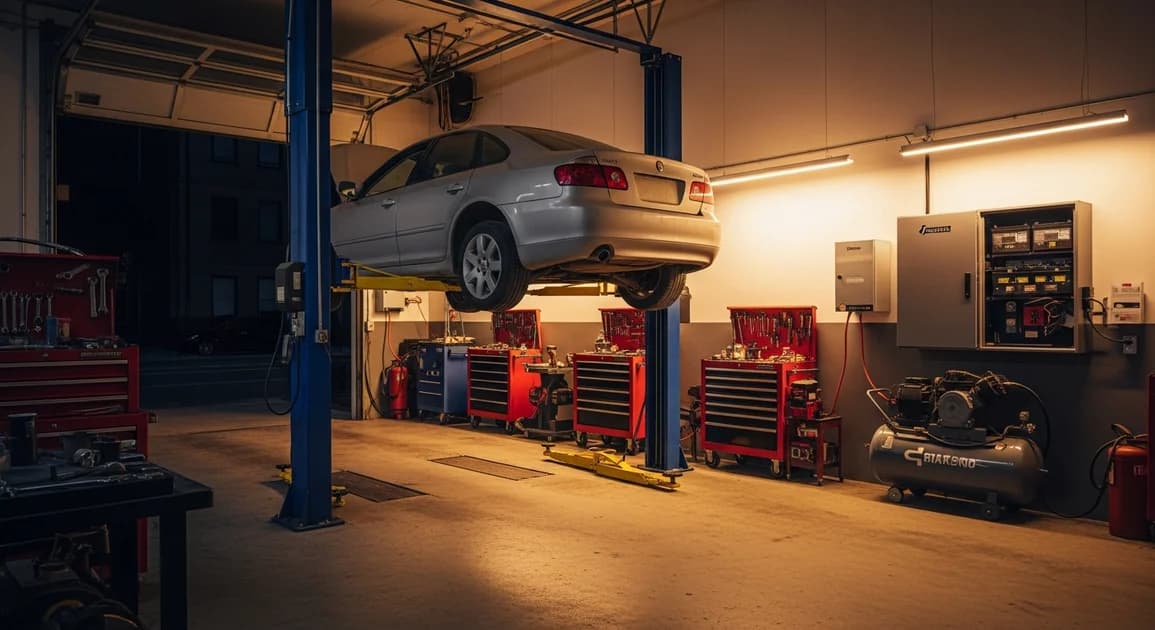
The following is a composite illustration, not a specific client, drawn from the shops we see across Houston. Picture a four-bay independent shop: two lifts, an air compressor, a wall of diagnostic and hand tools, the shop-management computer, a parts counter, and cameras over the lot. When the grid drops, the lifts freeze, the compressor dies, and a customer's car sits stranded on a rack.
With a battery system on a critical plan, the shop keeps a lift and the compressor working on a priority circuit, the diagnostics and shop-management software running, the point-of-sale and parts ordering up, and security live over the lot. The shop keeps a bay productive and billing instead of sending everyone home. To see how this compares with a franchised dealer, read our guide on [INTERNAL-LINK: battery backup for Houston car dealerships → /blog/battery-backup-houston-car-dealerships].
How much battery does an auto-repair shop need?
A good-to-moderate fit, sized to how much you run at once. A small shop protecting a bay, diagnostics, shop-management, POS, security, and lighting is a very reasonable target for one modular system or a small stack. Running several bays, multiple lifts, and a big compressor simultaneously pushes the sizing up, because those motor loads are heavy and spiky.
Here is the honest hardware picture. Our modular system uses 9 kWh nominal battery modules (8.76 kWh usable each), stacking to 45 kWh on one controller rated 11.5 kW continuous and 17.1 kW surge, with a 10-year warranty. One controller covers a critical bay and the shop systems around it. A busy multi-bay shop running heavy equipment at once typically needs a commercial design in the 40 to 120 kWh range across multiple controllers.
[INTERNAL-LINK: see commercial battery options and sizing → /plans/commercial]
The right first question is which bay and systems must stay live, not how many kilowatt-hours. Our guide on [INTERNAL-LINK: commercial battery backup for Texas businesses → /blog/commercial-battery-backup-texas-businesses] walks through that load-priority process.
[INTERNAL-LINK: talk through a shop backup plan → /home-backup-planner?source=blog&slug=battery-backup-houston-auto-repair-shops]
Prefer to talk it through? Call Eos at 713-207-2222 for a same-week Houston commercial site survey.
Frequently asked questions
Can a battery run an auto lift and air compressor?
It can, if it has the surge rating for the startup. Lifts and compressors are electric-motor equipment that draw a brief inrush spike when they start, several times their running draw. Our controller provides 17.1 kW of surge above its 11.5 kW continuous output to handle that, so a priority lift and compressor can run during an outage.
Why does a repair shop stop when the power does?
Because the core equipment is electric. An automotive lift runs on an electric or hydraulic system (Automotive Lift Institute), the compressor is an electric motor, and the diagnostics and shop-management system are computers. Without power, you cannot raise a car, run air tools, pull codes, or write an invoice.
How big a battery does a mechanic shop need?
It depends on how much you run at once. A single-bay critical plan with diagnostics, shop-management, POS, and security fits one 45 kWh controller. A busy multi-bay shop running several lifts and a big compressor at the same time typically needs a 40 to 120 kWh commercial design across multiple controllers. We size it to your shop.
Is a battery better than a generator for a shop?
Each has a role. A battery is silent, fuel-free, and switches over instantly, with runtime bounded by capacity, and it handles motor surge on a priority circuit. A generator adds longer runtime on fuel. Many shops use a battery for critical bays and systems and add a generator for extended runtime.
Can it keep a stranded car from being stuck on the lift?
That is one of the clearest benefits. Because the battery keeps a priority lift powered, you can lower a vehicle safely instead of leaving it stranded on the rack through an outage. Sizing that priority lift into the plan is a standard part of how we design a shop system.
This article is general information for Houston auto-repair operators and reflects Eos specifications as of July 2026. The case is a composite illustration, not a specific client, and does not promise a specific runtime or revenue outcome. Confirm equipment loads, electrical code, and permitting for your shop with the appropriate professionals.