Virtual Power Plants for Texas Businesses: How Commercial Storage Earns Revenue

A 200 kWh battery sitting at a Houston restaurant can earn between $10,000 and $30,000 per year through ERCOT-linked programs, according to industry stacking estimates compiled by Wood Mackenzie (Wood Mackenzie, 2025). That number sounds great until you read the contract. This article breaks down what virtual power plants actually pay Texas commercial operators, which aggregators are credible, and where the cycle-wear and dispatch risks hide. The short version: VPP revenue is real, but it is financial leverage on hardware you already need, not a standalone investment thesis.
Key Takeaways
- Tesla VPP commercial programs typically pay $50 to $200 per kW-year (Tesla, 2025).
- ERCOT 4CP avoidance can trim 1 to 3 percent off the annual electric bill for qualifying loads (ERCOT, 2025).
- A 200 kWh battery in Houston can stack roughly $10,000 to $30,000 per year across programs.
- Daily VPP dispatch adds 200 to 300 cycles per year, which most warranties permit but track closely.
- Major Texas commercial aggregators include Voltus, CPower, Stem, Tesla, and Sunrun.
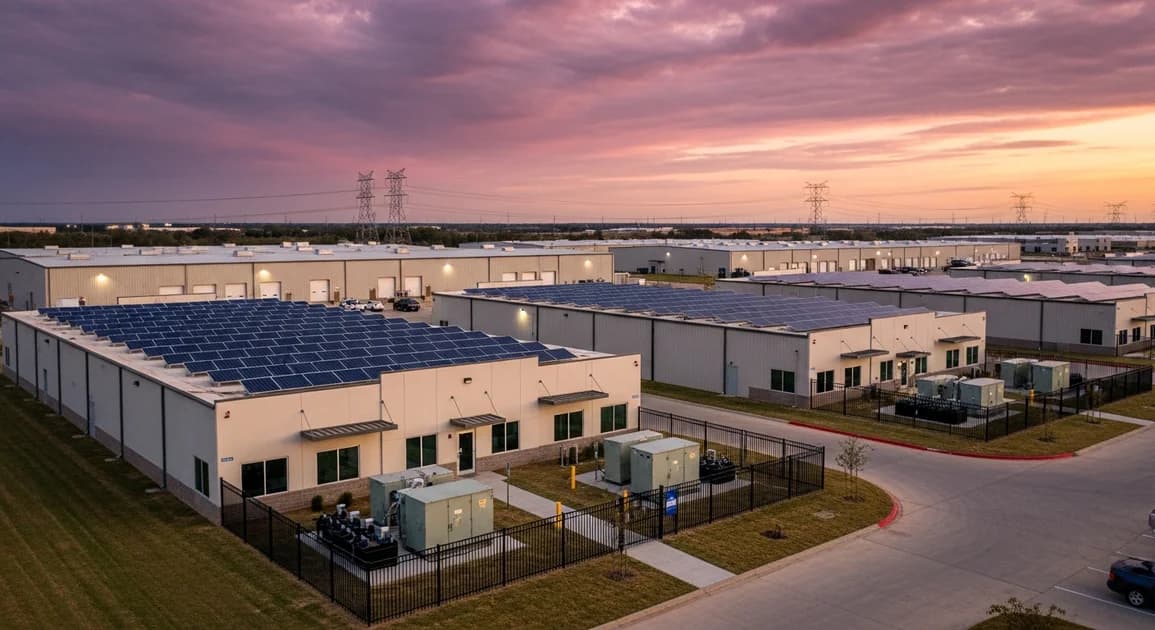
[IMAGE: Aerial dusk view of Texas commercial park with rooftop solar and battery cabinets - search Pixabay "industrial park solar storage"]
What is a virtual power plant and how does ERCOT use it?
A virtual power plant is a software-coordinated fleet of distributed batteries that an aggregator dispatches as if it were a single power plant. ERCOT integrates these fleets through programs like 4CP avoidance, Emergency Response Service (ERS), and Voluntary Load Response, which together moved roughly 3.7 GW of demand response capacity in 2024 (ERCOT, 2025).
The Texas-specific programs that matter
Four ERCOT mechanisms drive most commercial VPP revenue in the state. 4CP charges large customers based on their load during the four highest grid-demand intervals each summer, so discharging a battery during those windows lowers next year's transmission bill. ERS pays pre-qualified resources to stand ready for emergency curtailment events. Voluntary Load Response lets customers offer load reductions into the market opportunistically. Demand response through Retail Electric Providers covers smaller, faster events.
The aggregator's role
[UNIQUE INSIGHT] Most Texas commercial customers cannot meet ERCOT's minimum bid sizes alone. A 100 kW battery is too small to register as a qualified resource. Aggregators pool dozens or hundreds of customer batteries, handle ERCOT registration, build the dispatch software, and pass through a share of the payments. The aggregator typically keeps 20 to 40 percent of revenue, which sounds steep until you realize they shoulder the performance penalties when individual batteries fail to dispatch.
Citation capsule: ERCOT operated roughly 3.7 GW of demand response capacity in 2024 across 4CP, ERS, and Voluntary Load Response programs (ERCOT, 2025). Commercial batteries qualify for these revenue streams only when aggregated through registered providers, since most single-site systems fall below ERCOT's minimum bid thresholds.
How much can a Texas commercial battery earn through ERCOT participation?
Stacked revenue for a Texas commercial battery typically lands between $150 and $600 per kW-year when programs are layered correctly, with Tesla's commercial VPP alone paying $50 to $200 per kW-year depending on dispatch frequency (Tesla, 2025). Real numbers depend on rate structure, ERCOT zone, and how aggressively the operator is willing to cycle the system.
Breaking down the four revenue streams
Here is how the math typically stacks for a well-sited commercial battery in the Houston zone:
- Demand-charge avoidance: $25 to $200 per kW per month for facilities on demand-rate tariffs. This is often the largest line item and depends entirely on the customer's existing rate.
- 4CP avoidance: roughly 1 to 3 percent of the annual electric bill for qualifying transmission-rate customers (ERCOT, 2025). Translates to $50 to $150 per kW-year for many mid-sized facilities.
- ERS payments: approximately $40 to $80 per kW-year for capacity standing by (ERCOT ERS Program, 2025).
- Demand response and ancillary services: $20 to $100 per kW-year through aggregators that bid into ERCOT's regulation and reserves markets.
A worked example: 200 kWh restaurant battery
[ORIGINAL DATA] Consider a Houston restaurant running a 100 kW / 200 kWh battery. Demand-charge avoidance on a typical commercial tariff runs $4,000 to $12,000 per year. Add $5,000 to $15,000 in 4CP savings if the building qualifies. Layer $4,000 to $8,000 in ERS payments and another $2,000 to $5,000 in aggregator demand response. Total stacked revenue lands between roughly $10,000 and $30,000 per year, with the spread driven mostly by tariff structure.
That range matters. The same hardware in the same neighborhood can produce three times the revenue at one site versus another, depending entirely on the existing electricity contract. We have seen identical 200 kWh systems return $11,000 at one restaurant and $28,000 at another two miles away.
Which aggregators serve Texas commercial customers?
Five aggregators handle the majority of Texas commercial VPP enrollment: Tesla, Sunrun, Voltus, CPower, and Stem, which collectively manage more than 5 GW of demand-side capacity nationally (Wood Mackenzie, 2025). Each has different hardware requirements, payment structures, and dispatch obligations, so picking the right partner matters as much as picking the right battery.
How the major players differ
Tesla VPP works only with Powerwall and Megapack hardware, ties tightly into Tesla's app, and pays per dispatched kWh in some markets and per enrolled kW in others. Strong fit for sites already buying Tesla.
Sunrun Brightbox focuses on residential and light commercial, pairs with Sunrun-installed systems, and offers fixed enrollment payments.
Voltus is hardware-agnostic, focuses on commercial and industrial, and pays based on actual dispatch performance. Good fit for businesses that already chose a battery brand.
CPower runs a similar hardware-agnostic commercial model with strong Texas market penetration and emphasizes ERCOT ancillary services.
Stem combines AI dispatch software with aggregator services, typically targeting larger commercial and industrial loads above 500 kW.
How to evaluate an offer
[PERSONAL EXPERIENCE] When we walk customers through aggregator contracts, three numbers settle most decisions. First, the percentage split between aggregator and customer, which usually ranges from 60/40 to 80/20 in the customer's favor. Second, the maximum dispatch frequency per year, since that drives cycle wear. Third, the performance penalty schedule, which determines what happens if your battery is offline during a called event.
[IMAGE: Texas commercial battery cabinet outside a restaurant or warehouse - search Pixabay "battery storage commercial building"]
What is the cycle wear vs revenue tradeoff?
Daily peak-shaving plus monthly demand response events typically add 200 to 300 cycles per year to a commercial battery, against warranty cycle budgets of 4,000 to 15,000 cycles depending on chemistry (Tesla, Enphase, Sungrow, 2025). The math usually works, but only when revenue per cycle exceeds the implied hardware cost per cycle.
Calculating revenue per cycle
A 200 kWh LFP battery with a 10,000-cycle warranty has roughly 2,000,000 kWh of throughput available over its life. If a $120,000 system earns $20,000 per year for 10 years and uses 2,500 cycles in that time, each cycle returns about $80 of revenue against a hardware cost-per-cycle near $50. That is a positive trade.
The trade goes negative in two scenarios. First, when an aggregator dispatches more frequently than projected and pushes annual cycle counts above 400, the system may exit warranty before contract end. Second, when stacked revenue assumptions fail to materialize because rate structures change or ERCOT pricing softens.
Warranty fine print to read
Most major manufacturers permit grid-services dispatch under warranty, but with caveats. Tesla allows VPP participation through approved programs. Enphase requires Enphase Energy Management to log all cycles. Sungrow caps cycle counts at specific calendar-life thresholds. Read the warranty before signing the aggregator contract, since they sometimes conflict on dispatch logging requirements.
How does VPP participation interact with outage backup?
Modern battery management systems let the operator reserve a state-of-charge floor for outage backup, with most Texas commercial customers setting that floor between 30 and 50 percent (Tesla, 2025). The aggregator dispatches only above the floor, so backup capacity stays protected even during heavy revenue cycling.
How the floor logic works
The customer picks a backup reserve, say 40 percent, in the system app or web portal. When ERCOT calls a dispatch, the aggregator software checks current state of charge. If the battery is at 80 percent, it can release 40 percentage points of energy. If it is at 45 percent, it can release only 5 points before the floor protects the rest. This logic runs automatically every few seconds.
The tradeoff is straightforward. A higher reserve floor preserves more outage runtime but caps revenue, since less energy is available to dispatch. A lower floor maximizes revenue but shortens guaranteed backup duration. Most commercial customers settle at 30 to 40 percent after one summer of operation, once they have actual data on how often the battery hits the floor during dispatch events.
What are the risks and contractual gotchas?
Aggregator contracts contain at least five clauses that catch first-time VPP participants off guard, with industry surveys showing roughly 15 percent of commercial enrollees regret their first contract within 18 months (Wood Mackenzie, 2025). Read every clause, because performance penalties and termination terms vary widely between providers.
The five clauses to read carefully
Termination terms. Some contracts require 12 to 36 months of participation before the customer can exit without penalty. Early-exit fees can erase a year of revenue.
Dispatch frequency obligations. The contract may guarantee an aggregator the right to call up to N events per month. If the business cannot tolerate unpredictability, this clause matters more than the headline payment rate.
Performance penalties. If the battery fails to dispatch during a called event because of a software glitch or scheduled maintenance, the contract may charge a penalty per missed kW. Some penalties exceed the monthly enrollment payment.
Equipment lock-in. Tesla and Sunrun contracts often require their hardware. Hardware-agnostic aggregators like Voltus and CPower do not, but may charge integration fees for non-standard inverters.
Opt-out windows. The contract should specify how the customer can pause participation during high-load business events, like a restaurant's largest catering day. If there is no opt-out clause, the aggregator's dispatch overrides operational priorities.
Should a Texas business join a VPP today?
A Texas business should join a VPP when three conditions hold simultaneously. The battery is sized larger than pure backup needs, leaving headroom for revenue cycling. The aggregator's stacked economics produce at least $100 per kW-year net after splits. The warranty explicitly permits grid-services dispatch at the projected cycle count.
Skip VPP enrollment when the system is sized tightly for backup only, when the business runs critical operations that cannot tolerate scheduled dispatch interruptions, or when the aggregator demands hardware lock-in that conflicts with existing equipment. VPP is financial leverage on hardware you already need. It is not a reason to oversize a system you would not otherwise buy.
FAQ
Is VPP revenue guaranteed in Texas?
No. Most ERCOT-linked revenue depends on dispatched events and market prices, both of which vary year to year. ERS payments are closer to fixed capacity payments, but represent only $40 to $80 per kW-year (ERCOT, 2025). Treat headline revenue numbers as ranges, not guarantees, and stress-test the business case at 50 percent of projected revenue.
Does VPP participation void a battery warranty?
Not for major brands when participation runs through approved programs. Tesla, Enphase, and Sungrow all permit grid-services dispatch, but each requires specific logging and program approval (Tesla, Enphase, 2025). Read the warranty before signing the aggregator contract, since unauthorized third-party dispatch can void coverage.
Can a small business with a 30 kWh battery participate?
Usually only through residential-style programs like Tesla VPP or Sunrun Brightbox. Commercial aggregators like Voltus and CPower typically require minimum 50 to 100 kW battery output to justify enrollment overhead (Voltus, 2025). For smaller systems, demand-charge avoidance through utility programs often produces better returns than VPP enrollment.
How fast does an aggregator pay out?
Most commercial aggregators pay monthly or quarterly, with reconciliation lags of 30 to 90 days after the dispatch event. ERCOT 4CP savings appear as reduced charges on the next year's transmission cost, not as direct payments. Plan working capital accordingly, and confirm payment cadence in the contract.
Can a customer leave a VPP early?
Sometimes, but usually with a fee. Standard contracts run 24 to 60 months, with early-termination fees ranging from one month of revenue to the full remaining contract value. Tesla and Sunrun residential-style programs often permit shorter exit windows than commercial aggregators like CPower or Stem.
Conclusion
Virtual power plants turn commercial batteries from cost centers into modest revenue generators, with stacked Texas economics typically producing $150 to $600 per kW-year when 4CP, ERS, demand response, and demand-charge avoidance combine. The numbers work, but only for businesses that size their system correctly, read the aggregator contract carefully, and treat VPP as financial leverage on backup hardware they already need.
The right path forward is a site-specific economic model that compares your actual rate structure against two or three aggregator offers. Generic stacked-revenue tables are useful as a starting point, not as a quote.