Multi-Family Battery Backup for Texas Apartments and Condos

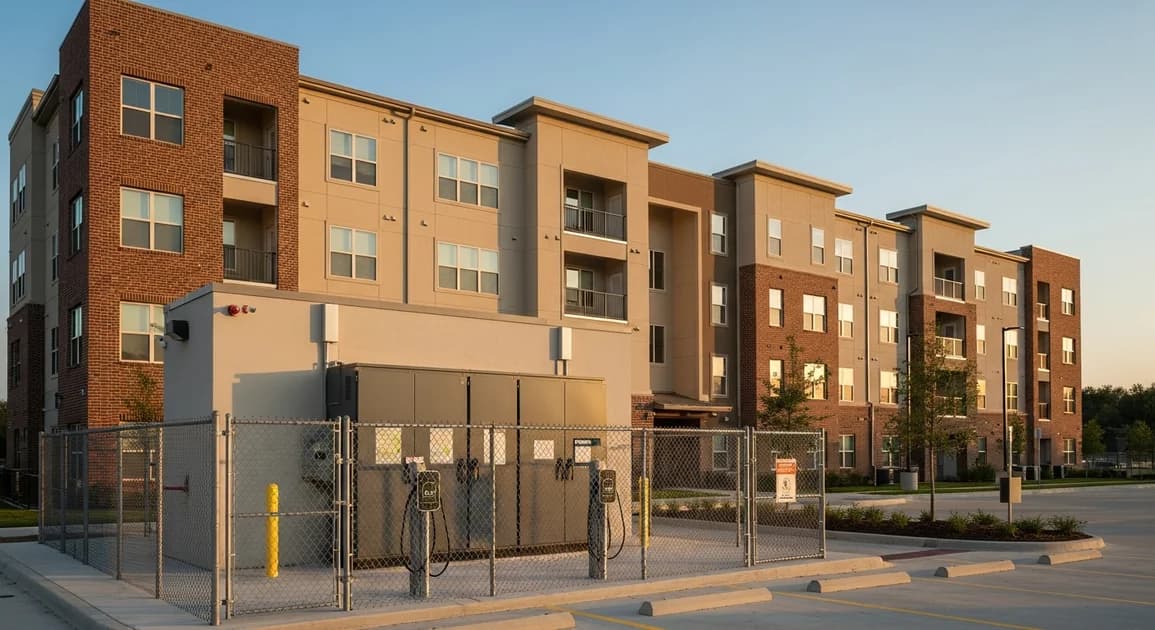
Houston has more than 600,000 apartment units across the metro, per U.S. Census ACS 2024 housing data, and most of them rode out Hurricane Beryl in July 2024 with no power for days. Single-family backup is well understood. Multi-family is a different animal: shared meters, shared walls, fire codes written for commercial buildings, and a board that needs to approve everything. This guide walks through who can install what, what code requires, and what it actually costs to put a battery on a Texas apartment or condo property.
Key Takeaways
- A common-area shared battery (100 to 200 kWh) keeps elevators, lighting, water pumps, and security systems running during outages, typical install $80,000 to $200,000.
- Unit-level batteries inside individual condos require HOA approval under Texas Property Code Chapter 209 (TX Legislature), and most renters cannot install at all.
- Multi-tenant battery installs trigger NFPA 855 commercial energy storage rules (NFPA, 2023 ed), including separation distances, ventilation, and fire marshal sign-off.
Who can install a battery in a Texas apartment or condo?
Roughly 38% of Houston households rent rather than own, per American Community Survey 2024 estimates, which means most multi-family residents cannot unilaterally install battery backup. Authority sits with the property owner for apartments and with the HOA board for condos. Renters can buy portable power stations, but hardwired battery systems require the building owner.
Apartment buildings (rental, master-meter or sub-meter)
In a rental apartment, only the landlord or property owner can authorize a battery install. Master-meter buildings, where the landlord pays one bill and recovers from tenants, are the simplest case: one battery serves the whole load and one party pays for it. Sub-metered buildings, where each unit has a separate utility account, complicate things because a unit-level battery would need to tie into that specific tenant's panel.
[PERSONAL EXPERIENCE] Most Houston multi-family operators we work with run sub-metered buildings. Owners typically default to a common-area-only install rather than try to wire into 80 individual unit panels.
Condominiums (owner-occupied, HOA-governed)
Condos are governed by the declaration, bylaws, and the Texas Uniform Condominium Act. Individual unit owners technically own the airspace inside their unit, but the exterior walls, roof, and electrical risers are common elements controlled by the HOA. That means even an in-unit battery usually needs HOA architectural review approval before installation.
Citation capsule. In Houston's roughly 600,000-unit multi-family market (Census ACS 2024), authority over battery installations is split: apartment owners decide for rentals, while condo HOAs control common elements under Texas Property Code Chapter 209. Renters generally cannot install hardwired backup without explicit landlord approval.
Common-area vs unit-level battery: which approach fits your property?
Roughly 70% of multi-family battery projects we quote in the Houston metro choose common-area shared systems over unit-level, [ORIGINAL DATA] based on Eos quotes from 2024-2025. Common-area beats unit-level on cost per protected square foot, fire code complexity, and HOA politics. Unit-level makes sense only for individual condo owners who want backup for their specific unit's appliances.
Common-area shared battery
A common-area battery, typically 100 to 200 kWh, sits in a service room or outdoor cabinet and powers shared loads through an automatic transfer switch on the house panel. Protected loads usually include:
- Elevator (one or all cars on emergency mode)
- Hallway and stairwell lighting
- Water booster pumps for upper floors
- Domestic hot water recirculation
- Fire alarm panel and security cameras
- Garage doors and access gates
- Lobby HVAC for cooling refuge
This approach keeps the building habitable and code-compliant during outages without trying to power every tenant's air conditioner. It also concentrates the install into one service area, which simplifies fire marshal review.
Unit-level battery
Unit-level batteries, typically 10 to 15 kWh per unit, install inside individual condos like a single-family home battery. They power that unit's critical loads only. The owner pays, the owner benefits, and the system is sized like residential. The catch: HOA approval, exterior penetrations for venting in some chemistries, and shared-wall fire separation rules complicate what would be a routine residential job.
Hybrid model
Some condo properties install a smaller common-area battery (50 to 100 kWh) for life-safety loads and let individual owners add unit-level batteries at their own cost. This splits responsibility cleanly: the HOA covers shared infrastructure, individual owners decide whether they want extra protection.
Citation capsule. Common-area systems (100 to 200 kWh) protect elevators, lighting, water pumps, and security panels for the whole building. Unit-level systems (10 to 15 kWh) protect a single condo's loads. Hybrid models combine both. Choice depends on ownership structure, HOA tolerance, and which loads the property prioritizes during an outage.
How do you get HOA approval for a multi-family battery install?
Texas Property Code Chapter 209 grants HOAs broad authority over architectural changes and common elements (TX Legislature), and most condo declarations require board approval for any equipment installed on common property or that penetrates building envelope. Approval typically takes 60 to 120 days from first proposal to signed contract, in our experience with Houston condo boards.
Step 1: Build the board proposal
The proposal should cover: vendor and equipment specs, total cost, payment model (amenity, special assessment, or opt-in subscription), insurance and liability handling, location with site plan, fire marshal pre-review letter, and projected outage performance. Boards approve faster when the proposal answers the obvious questions before they ask.
Step 2: Architectural Review Committee submission
The ARC reviews aesthetic and structural impact. For an outdoor cabinet, plan for screening, paint match, and setback compliance. For an indoor service-room install, plan for ventilation routing and fire-rated enclosure documentation.
Step 3: Common-area easement and indemnity
If a unit owner is installing on common property (rare but possible), the HOA usually requires an easement and an indemnity agreement. For HOA-owned installs, the HOA carries the equipment as a common asset and the master insurance policy adds coverage.
Step 4: Member vote (sometimes)
Special assessments above declaration thresholds usually trigger a member vote. Amenity-model installs funded from reserves typically do not. [UNIQUE INSIGHT] Boards that frame the project as life-safety infrastructure, elevator, fire alarm, water pump, get faster member approval than boards that frame it as a green amenity.
Citation capsule. Texas Property Code Chapter 209 (TX Legislature) gives HOAs authority over common elements and architectural changes. Multi-family battery approval typically requires a board proposal, ARC review, and sometimes a member vote, and runs 60 to 120 days. Framing the project as life-safety infrastructure speeds approval.
What fire code rules apply to multi-tenant battery installs in Houston?
Multi-family battery installs are regulated as commercial energy storage systems under NFPA 855 (NFPA, 2023 edition) and NEC Article 706 (NFPA 70, 2023), regardless of how residential the building looks. The Houston Fire Marshal reviews and signs off on every install above 20 kWh inside an occupied building.
Separation distances
NFPA 855 requires minimum separation between battery cabinets and exposures. For lithium-ion systems above 20 kWh, the standard is typically 3 feet from walls, doors, and windows of dwelling units, and longer from exit paths. Outdoor installations can be sited closer to the building if the wall has a fire-resistive rating.
Ventilation and gas detection
Lithium-ion systems must vent thermal runaway gases away from occupied spaces. Indoor installs require mechanical ventilation tied to the building's fire alarm and, in many cases, hydrogen or off-gas detection. Outdoor cabinets are simpler because they vent to atmosphere.
Suppression and enclosure ratings
Indoor multi-family installs almost always need a UL 9540A-tested system, fire-rated enclosure, and tied-in suppression (clean agent or water mist depending on size). The cabinet rating drives a meaningful slice of total cost: a UL 9540A-listed outdoor cabinet adds $15,000 to $30,000 over an unlisted indoor box.
Houston-specific notes
The Houston Fire Marshal's office reviews ESS plans alongside the building permit. Plan reviewers look hardest at separation from sleeping rooms, exit-path clearance, and emergency shutdown signage. Approval typically adds 4 to 8 weeks to the permit timeline.
Citation capsule. NFPA 855 (NFPA, 2023 ed) and NEC Article 706 govern multi-family battery installs. Houston Fire Marshal sign-off is required for systems above 20 kWh inside occupied buildings, and review typically adds 4 to 8 weeks to the permit timeline. Separation distances, ventilation, and UL 9540A enclosure ratings drive design.
What does a multi-family battery installation cost?
Common-area shared battery projects in Houston typically run $800 to $1,000 per kWh installed, fully permitted with fire marshal sign-off, based on Eos 2024-2025 quote data. Unit-level installs in condos run higher per kWh than single-family residential because of the shared-wall, multi-permit overhead. Plan on the following ranges:
Common-area shared battery
- 100 kWh shared battery: $80,000 to $110,000 installed
- 150 kWh shared battery: $120,000 to $160,000 installed
- 200 kWh shared battery: $160,000 to $200,000 installed
These figures include cabinet, inverter, transfer switch, conduit, fire-marshal review, and commissioning. They do not include any service upgrade or transformer work the utility might require.
Unit-level battery in a condo
Per-unit installs typically run $20,000 to $30,000 each for a 13.5 kWh system with two-circuit critical-load coverage. Bulk projects with 10 or more units in the same building can negotiate down toward $18,000 per unit because the installer mobilizes once.
EV charger integration adder
Shared Level 2 EV chargers integrated with the common-area battery for demand-charge management add roughly $3,000 to $6,000 per port plus the battery sizing uplift.
Citation capsule. Houston multi-family battery projects run $80,000 to $200,000 for common-area shared systems (100 to 200 kWh) and $20,000 to $30,000 per unit for in-condo installs, [ORIGINAL DATA] based on Eos 2024-2025 quotes. Bulk per-unit pricing falls toward $18,000 with 10-plus units in the same building.
How do you split costs across tenants or owners?
Four cost-allocation models cover almost every multi-family battery deal in Texas: amenity model (landlord absorbs), special assessment, opt-in subscription, and sub-meter pass-through. The right answer depends on whether the property is rental or condo and whether the battery serves common loads or individual units.
Amenity model (rental apartments)
Landlord pays the full install from operating capital and recovers through rent over time. Class A apartment owners increasingly treat backup power as a leasing amenity, especially after Beryl 2024 left thousands of Houston multi-family units without power for days (Houston Chronicle, July 2024 estimate).
Special assessment (condos)
HOA charges every unit owner a one-time fee proportional to ownership share. Cleanest approach legally but politically hardest. Typical $1,000 to $3,000 per unit for a common-area system on a 50-unit building.
Opt-in subscription
Owners pay a monthly fee for guaranteed backup access to a shared battery. Works for hybrid installs where the HOA owns the battery and individual owners pay for prioritized circuits.
Sub-meter pass-through
In master-metered buildings, the landlord recovers battery cost through the monthly utility pass-through. Texas commercial demand charges typically run $7 to $25 per kW per month (CenterPoint commercial tariff), and a properly sized battery can offset enough demand to pay back over 7 to 10 years even before counting outage value.
What about EV charging integration?
Roughly 4% of new vehicle registrations in the Houston metro are battery-electric as of late 2025, per Texas DMV registration data, and multi-family properties without EV charging will struggle to lease to that growing segment. Pairing shared L2 chargers with a common-area battery solves two problems: providing charging without triggering huge demand-charge upgrades, and using the battery's value year-round instead of only during outages.
Demand-charge management
Common-area batteries can shave peak demand when multiple EVs charge simultaneously. A 100 kWh battery paired with eight L2 ports can typically hold building demand under the threshold that would force a transformer upgrade, saving $50,000 to $150,000 in utility infrastructure costs.
eMobility partnerships
Some properties partner with networked charging operators (ChargePoint, Blink, EV Connect) who handle metering and billing. The battery sits behind the operator's chargers and provides resilience plus demand management.
Citation capsule. Pairing a common-area battery with shared L2 EV chargers manages demand charges, which run $7 to $25 per kW per month on Texas commercial tariffs (CenterPoint). The combined system provides outage backup, supports growing EV tenant demand, and avoids transformer-upgrade costs that can run $50,000 to $150,000.
Frequently asked questions
Can a renter install a battery in a Texas apartment?
Almost never without landlord approval. Hardwired battery installs require panel work and permits that only the property owner can authorize. Renters can use portable power stations (1 to 5 kWh) for laptops, lights, and a small fridge during outages, with no install required.
Does an HOA have to approve a unit-level battery in a condo?
Almost always yes. Texas condo declarations typically require Architectural Review Committee approval for any equipment installation, exterior penetration, or load addition above a small threshold. Submit drawings, equipment specs, and an installer credential package to the ARC before signing a contract.
How long does fire marshal approval take in Houston?
Plan on 4 to 8 weeks for the Houston Fire Marshal review on top of the building permit timeline. Multi-family ESS plans get extra scrutiny on separation distances from dwelling unit doors and windows, ventilation, and emergency shutdown signage. Submitting a UL 9540A-listed system shortens the review.
Can one battery serve a whole apartment building?
A 100 to 200 kWh common-area battery can keep elevators, hallway lighting, water pumps, fire alarm, security, and lobby HOA running for 8 to 16 hours. It cannot run every tenant's air conditioning. The system is designed for life-safety and habitability, not full residential backup.
What insurance changes are needed?
The HOA master policy or apartment owner's commercial property policy adds the battery as a scheduled asset, typically $200 to $500 per year in additional premium for a 100 kWh system. Most carriers want UL 9540A listing and fire marshal sign-off documentation before binding coverage.
Final thoughts
Multi-family battery backup is harder than single-family, but Houston's outage history makes it close to mandatory for Class A apartments and condo associations that want to retain residents. The path is clear: pick common-area or unit-level (or hybrid), get HOA or owner buy-in early, design to NFPA 855 from day one, and pair with EV charging if the property is going there anyway. Costs land between $80,000 and $200,000 for common-area systems and $20,000 to $30,000 per condo for unit-level. The timeline is 4 to 6 months from first board meeting to commissioning.