The Surge When the Power Comes Back: Protecting Your Houston Home at Restoration

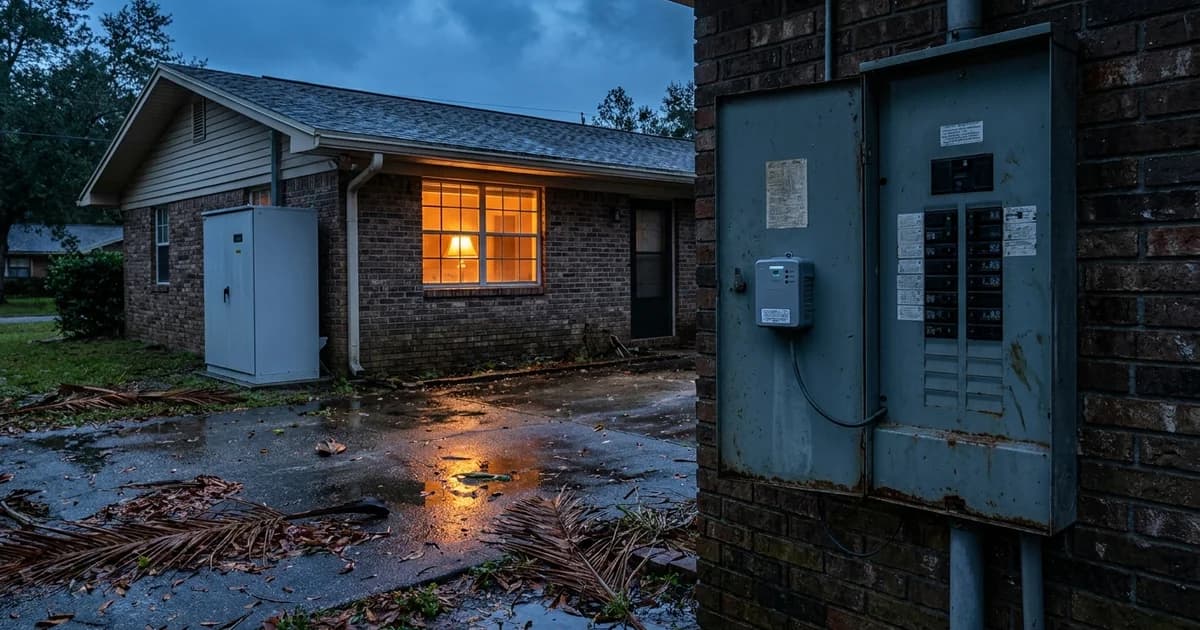
The outage is not the part that breaks your appliances. Restoration is. Ask any Houston homeowner who came home after a summer storm to a dead refrigerator control board, a fried garage door opener, or an air conditioner that hums but never starts. The lights came back, and something in the house did not.
That moment has real physics behind it, and it gets misunderstood often enough that people buy the wrong protection. Here is what happens on your service when the grid returns, what protects a house, and where a home battery genuinely changes your exposure.
Key Takeaways
- In 2024, US electricity customers averaged 11 hours without power, nearly double the prior decade (U.S. Energy Information Administration, 2025).
- The real risks at restoration are switching transients, cold load pickup, and sustained overvoltage from a compromised neutral.
- FEMA advises disconnecting equipment during an outage because "power may return with momentary surges or spikes that can cause damage."
- A plug-in strip is not service entrance protection. Layered protection starts at the panel.
- A battery keeps your home off the live service during the event, but it does not replace a service entrance surge device.
What causes a power surge when electricity comes back on?
In 2024, hurricanes Beryl, Helene and Milton accounted for 80% of all customer hours without electricity in the United States, and Beryl alone left 2.6 million Texas customers dark (U.S. Energy Information Administration, 2025). Restoration after events that size is not one clean flip of a switch. It is a sequence of switching operations on a heavily loaded system, and three separate things go wrong in three different ways.
Switching transients
Reclosers, breakers and capacitor banks operating upstream inject fast voltage transients onto the distribution line. These last microseconds. They are what a surge protective device is built to clamp, and they are why FEMA tells households to turn off or disconnect equipment during an outage: "Power may return with momentary surges or spikes that can cause damage" (Ready.gov, retrieved 2026-09-08).
Cold load pickup
Cold load pickup is the persistent power inrush upon a sudden load pickup after an outage (Li et al., IEEE Transactions on Smart Grid, 2021). Normally every thermostat on your block cycles independently. After a long outage that diversity is gone, and every compressor, heat pump, water heater and attic fan in the neighborhood wants to start at the same instant.
The IEEE Power System Relaying Committee describes cold load pickup as a composite of inrush and loss of load diversity, with an inrush phase lasting seconds and an enduring phase from thermostatically controlled loads that can run for minutes to hours (IEEE PES Power System Relaying Committee, Cold Load Pickup Issues). For your house, that means service voltage can sag and swing far longer than the instant the lights come on. Motors are the first casualty: a compressor starting on depressed voltage draws locked rotor current and overheats.
What we see in the field: the calls that reach us 48 hours after a Houston restoration are rarely about televisions. They are about compressors, well pumps and furnace control boards. That pattern points at voltage quality during the enduring phase, not at a microsecond spike.
Sustained overvoltage and an open neutral
This one destroys the most equipment and almost nobody plans for it. If the neutral conductor between the utility transformer and your panel is damaged or loose, the two 120 volt legs of your service end up in series across 240 volts. Load imbalance then pushes one leg far above 120 volts while the other collapses. "The voltage on one 120 volt leg can spike to nearly 240 volts while the voltage on the other leg plummets," and everything on the high leg sees sustained overvoltage rather than a brief spike (EngineerFix, retrieved 2026-09-08).
Storm damage to overhead service drops makes this a live risk during a Houston restoration. It is also the failure mode a plug-in strip handles worst, because those devices are rated for transient energy, not for a condition that holds for minutes.
What actually protects a house at restoration?
Surge protection works in layers, and the first layer belongs at your service equipment, not at your desk. Since the 2020 National Electrical Code, residences have been required to have surge protection safeguarding large appliances and equipment such as HVAC systems (Electrical Safety Foundation International, retrieved 2026-09-08). That requirement is 230.67, with the technical rules for overvoltage protection in Article 242 of NFPA 70 (NFPA). The layering, in order:
- Service entrance device. A Type 1 or Type 2 surge protective device listed to UL 1449, at or immediately adjacent to your service equipment. Type 1 is permitted on the line side of the main disconnect, Type 2 on the load side inside the panel. This layer takes the large externally sourced events.
- Branch panel device. Useful when a detached garage, pool equipment panel or workshop is fed separately.
- Point of use protection. Type 3 devices at the equipment itself: the AV rack, the home office, the medical device. NIST's homeowner guidance, Surges Happen! How to Protect the Appliances in Your Home, was built around coordinated protection rather than one device doing everything (NIST SP 960-6, 2001).
Be blunt with yourself about layer three. A power strip from a hardware store is not service entrance protection. It never sees the surge arriving on your air conditioner's dedicated circuit, and it does nothing about a lost neutral. Our teardown of surge protectors and battery backup covers what each device class actually does.
One more thing worth knowing: ESFI notes that 60 to 80% of surges originate from equipment inside our own buildings (ESFI, retrieved 2026-09-08). Restoration is the visible event. Your own compressor cycling is the invisible one.
Where does a home battery fit, and where does it not?
A grid-tied home battery changes your restoration exposure because of how interconnection standards require it to behave. IEEE Std 1547-2018 covers "abnormal conditions, power quality, islanding, and test specifications and requirements" for distributed energy resources (IEEE Standards Association, 2018). Under those rules a battery system must cease to energize the utility side during abnormal conditions, and it may delay entering service by an intentional adjustable period once conditions return (Energy Storage Interconnection, on IEEE 1547 subclause 4.10.3, retrieved 2026-09-08).
Translate that into your kitchen. During the outage your home is islanded behind the transfer equipment, running on the battery, with the utility service disconnected. Your loads are not sitting on a dead line waiting to be snapped back onto a live one. When the grid returns, the system verifies voltage and frequency are back inside their windows, waits out its delay, then transitions the house back under inverter control. Every Eos system runs a smart controller rated at 11.5 kW continuous and 17.1 kW surge, so that transition is managed rather than abrupt.
That is a real reduction in exposure. It is also the honest limit of the claim.
A battery is not a substitute for a service entrance surge device. It does not clamp a transient arriving on the utility conductors, it does not correct a damaged neutral upstream of your meter, and it does not protect circuits outside your backed-up panel. Skip the surge protective device and you have covered the outage while leaving the overvoltage risk untouched. Install both. They solve different problems.
If your concern is strike energy rather than restoration, that is a different discussion, covered in our piece on lightning strike protection for home battery systems.
Your restoration checklist for a Houston home
FEMA's outage guidance is the right baseline: disconnect equipment during the outage, keep the refrigerator and freezer closed, and expect the refrigerator to hold food about four hours and a full freezer about 48 hours (Ready.gov, retrieved 2026-09-08). Here is how that plays out on a real service.
When the power goes out
- Unplug sensitive electronics: televisions, computers, AV gear, consoles, anything with a control board you cannot easily replace.
- Turn the air conditioner off at the thermostat. This is the single most useful step, because it stops the compressor from trying to start into a weak restoration voltage.
- Switch off electric water heater and oven breakers if the outage will be long.
- Leave the refrigerator plugged in. Its own thermostat holds the compressor off, and reopening a warmed unit later costs you more than the surge risk. Keep the doors shut.
- Do not run extension cords from a portable generator into wall outlets.
When the power comes back
- Wait several minutes before turning things back on. Restoration is often followed by more switching as the utility balances feeders.
- Bring loads back one at a time. Air conditioner last, a few minutes after the rest of the house is stable.
- Look and listen at the panel and at outlets. Buzzing, a burning smell, flicker that will not settle, or lights unusually bright in one part of the house and dim in another are the signature of an open neutral. Shut off the main breaker and call your utility and an electrician.
- Check the indicator on your surge protective device. Many carry a status light showing the unit has been consumed and needs replacement.
Our guide on what to do when the power goes out covers the outage window itself, and the Houston outage safety guide covers heat, generators and medical equipment.
What if something fails anyway?
Document it before you throw anything away. In 2024, major weather events drove 80% of all customer hours without power nationally, so claim volume after a storm is heavy and adjusters move faster on complete files (U.S. Energy Information Administration, 2025).
Photograph the damaged equipment in place, model and serial plates included. Note the date and time power returned. Get an electrician's written diagnosis naming the failure mode, especially if an open neutral is suspected, because a sustained overvoltage event reads very differently to a carrier than a vague claim of a surge. Our walkthrough of power outage insurance claims in Houston covers what carriers ask for.
One pattern worth repeating from our install calendar: after a widespread restoration, the homes that call us are usually the homes with no service entrance device and a whole rack of point of use strips. The strips survive. The air handler does not.
Or call Eos at 833-989-3737 to talk through your setup with an installer.
Frequently Asked Questions
Is the power surge when electricity comes back on real, or a myth?
Real, but usually not one dramatic spike. FEMA warns that "power may return with momentary surges or spikes that can cause damage" (Ready.gov). The larger risk is cold load pickup and sustained voltage swings, which stress motors and compressors far more than a microsecond transient does.
Should I unplug my refrigerator during a power outage?
No. FEMA advises keeping refrigerators and freezers closed, noting a refrigerator holds food about four hours and a full freezer about 48 hours (Ready.gov). Its thermostat keeps the compressor off while power is out. Turn the air conditioner off at the thermostat instead, and unplug small electronics.
Does a whole home surge protector replace power strips?
They work together. A Type 1 or Type 2 device listed to UL 1449 at the service equipment handles large externally sourced surges and is required for dwellings under the 2020 and later National Electrical Code (ESFI). Point of use devices still add a final layer at sensitive equipment. Neither one covers the other's job.
Does a home battery protect appliances from restoration surges?
Partly. Under IEEE Std 1547-2018, the system disconnects from the utility during abnormal conditions and reconnects only after voltage and frequency return to their required windows (IEEE Standards Association). That changes your exposure meaningfully, but a battery is not a surge protective device and does not replace one at the service entrance.
How long do Houston outages usually last?
There is no reliable published figure for Houston specifically, so we will not invent one. Nationally, customers averaged 11 hours of interruption in 2024, and Hurricane Beryl alone left 2.6 million Texas customers without power (U.S. Energy Information Administration, 2025). Size your system for the storm case, not the average.
The short version
Restoration is a load event, not just a spike. The equipment that fails usually has a motor in it, and the protection that would have saved it belongs at the panel rather than at the outlet. Put a listed surge protective device at your service equipment, keep point of use protection where it earns its place, and treat the battery as what it is: the thing that decides when and how your house rejoins the grid, not a surge device. The Eos plan lineup lays out capacity and output by tier.
Sources
- U.S. Energy Information Administration, Hurricanes in 2024 led to the most hours without power in the United States in 10 years, retrieved 2026-09-08, https://www.eia.gov/todayinenergy/detail.php?id=66744
- FEMA / Ready.gov, Power Outages, retrieved 2026-09-08, https://www.ready.gov/power-outages
- Li, Sun, Yin, Lei and Hou, Restoration Strategy for Active Distribution Systems Considering Endogenous Uncertainty in Cold Load Pickup, IEEE Transactions on Smart Grid, 2021, retrieved 2026-09-08, https://www.osti.gov/pages/biblio/1845016
- IEEE PES Power System Relaying Committee, Cold Load Pickup Issues, report to the Line Protection Subcommittee, retrieved 2026-09-08, https://www.pes-psrc.org/kb/report/075.pdf
- Electrical Safety Foundation International, Surge Protection, retrieved 2026-09-08, https://www.esfi.org/surge-protection/
- NFPA, NFPA 70, National Electrical Code, retrieved 2026-09-08, https://www.nfpa.org/codes-and-standards/nfpa-70-standard-development/70
- Martzloff, F. D., Surges Happen! How to Protect the Appliances in Your Home, NIST Special Publication 960-6, 2001, retrieved 2026-09-08, https://www.nist.gov/publications/surges-happen-how-protect-appliances-your-home
- IEEE Standards Association, IEEE Std 1547-2018, Standard for Interconnection and Interoperability of Distributed Energy Resources with Associated Electric Power Systems Interfaces, retrieved 2026-09-08, https://standards.ieee.org/ieee/1547/5915/
- Energy Storage Interconnection (BATRIES), C. IEEE 1547, retrieved 2026-09-08, https://energystorageinterconnection.org/viii-incorporating-updated-interconnection-standards-into-interconnection-procedures/c-ieee-1547/
- EngineerFix, What Is an Open Neutral and Why Is It Dangerous?, retrieved 2026-09-08, https://engineerfix.com/what-is-an-open-neutral-and-why-is-it-dangerous/