Dickinson and Santa Fe Battery Backup: Flood Country on the Galveston County Line

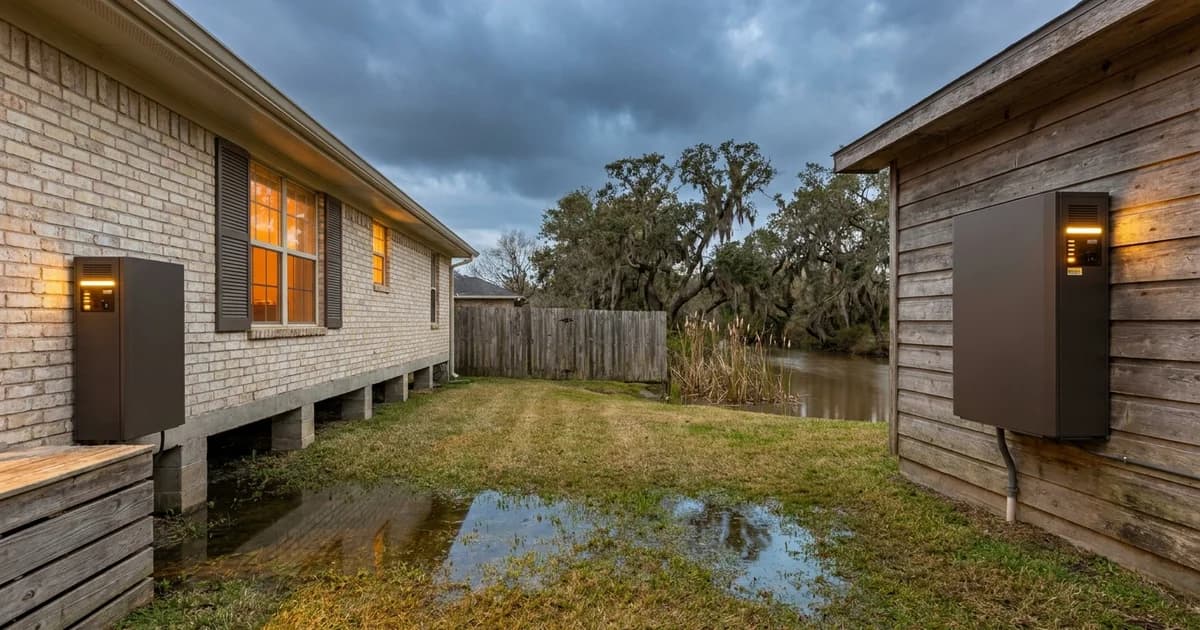
Fifty-four point seven seven inches. That is the storm total the National Weather Service logged three miles east northeast of Santa Fe during Hurricane Harvey in 2017 (NWS Houston/Galveston, Hurricane Harvey Storm Totals, 2017). More rain than the agency measured at its League City or Dickinson sites, in a town most people drive past on the way to the beach.
Dickinson and Santa Fe get folded into "Galveston County" battery backup advice that was really written for the island or the I-45 corridor. Three things here are genuinely different: where the equipment sits, who signs the permit, and what is on the load list. In that order.
Key Takeaways
- Harvey brought 54.77 inches near Santa Fe and 43.92 inches at the NWS Dickinson site (NWS Houston/Galveston, 2017), so height, not brand, is the first design decision here.
- Permitting splits three ways: Dickinson, Santa Fe, and unincorporated Galveston County, which runs floodplain development permits rather than a building permit program.
- TNMP's filed tariff names Dickinson and does not name Santa Fe, and CenterPoint also delivers in the county. Read the utility off your own bill.
- Well pumps and aerobic septic aerators are two loads that vanish with the grid, and most Houston backup guides skip both.
What Harvey actually did to Dickinson and Santa Fe
The rainfall pattern inverted the usual coastal instinct. In 2017 the NWS Houston/Galveston storm total table recorded 56.00 inches at Friendswood, 54.77 inches three miles east northeast of Santa Fe, 52.87 inches three miles south of League City, and 43.92 inches at the NWS Dickinson site (NWS Houston/Galveston, Hurricane Harvey Storm Totals, 2017). The quiet inland town took more water than the towns nearer the bay.
Dickinson's mapped flood zones follow Dickinson Bayou and its tributaries: Borden's Gully, Benson Bayou, and Gum Bayou (City of Dickinson, The Flood Hazard). The NWS impact summary for Galveston County describes catastrophic flooding from those bayous, major flooding from Cemetery Road past Highway 3, and 6,963 homes and 123 businesses affected or damaged countywide.
Local reporting later put the Dickinson figure higher, at roughly 55 inches with about 80 percent of the city flooded (ABC13, 2022). That is news coverage, not a gauge reading. Both numbers are worth knowing, and neither should be blended into the other. A Harvey crest height for Dickinson Bayou is not on any public page we could verify, so we will not invent one.
Flood risk changes where battery backup goes, not whether you get it
Elevation is the controlling decision. In 2022 FEMA put it directly: "Since most electrical components are not water resistant and can be damaged or destroyed when exposed to floodwater, elevation is the most effective overall solution for mitigating primary and secondary electrical system components in buildings" (FEMA P-2181, Fact Sheet 3.4.2, Building Utility Systems, Electrical, 2022). The same sheet adds that elevated equipment must still comply with NFPA 70, the National Electrical Code, for access and minimum working clearance.
That second half is why "just put it on a shelf" fails inspection. Height without clearance is not a design.
Our crews here default to an interior garage wall, with the battery, the controller, and the disconnect all mounted above the highest water line the homeowner can point to on their own wall or fence post. They can almost always point to one. That personal high water mark is often a better planning input than the map, because it accounts for sheet flow the map does not.
Check your parcel at the FEMA Flood Map Service Center before you pick the wall. Dickinson's effective Flood Insurance Rate Maps are dated August 15, 2019, and the city suggests owners of older homes review the historical maps too (City of Dickinson). The same logic applies to keeping a sump pump running when the grid goes down.
Who permits a battery backup install in Dickinson or Santa Fe
Three jurisdictions cover this small area, and the boundary is a parcel line, not a landmark. Inside Dickinson city limits, electrical work requires a permit and runs through the city's MyGov portal, with Building Permits and Inspections at 4403 Highway 3 (City of Dickinson). Inside Santa Fe city limits, permitting runs through the city's iWorQ portal or City Hall at 12002 State Highway 6, and the city asks that electrical, framing, mechanical, plumbing, and gas inspections all be requested together rather than one at a time (City of Santa Fe).
Unincorporated Galveston County is the bucket nobody explains. The county runs no general building permit program. What it does run is floodplain development permitting through Engineering, Floodplain Permitting and Right-of-Way, where a development permit confirms conformance with county floodplain regulations (Galveston County).
| Where the parcel sits | Who you deal with | What to expect |
|---|---|---|
| Inside Dickinson city limits | City of Dickinson, MyGov portal | Electrical permit plus inspection scheduling through the portal |
| Inside Santa Fe city limits | City of Santa Fe, iWorQ portal or City Hall | Electrical permit, inspections requested as a bundled set |
| Unincorporated Galveston County | County Engineering and Floodplain | Floodplain development permit where applicable, no general building permit program |
Here is the part that surprises people: two houses a quarter mile apart on the same farm road can face completely different paperwork. Do not resolve it with a phone call. Resolve it with a parcel lookup at the Galveston Central Appraisal District, which names the jurisdiction governing the parcel before anyone quotes you a timeline. The equipment questions, UL 9540 listing, NEC Article 706, and NFPA 855 clearances, are identical in all three buckets. Only the counter you walk up to changes.
CenterPoint or TNMP, and why the answer matters
Both utilities operate in Galveston County. TNMP's filed Tariff for Retail Delivery Service lists Brazoria, Galveston, and Matagorda counties for its Southeast Texas certified area, naming Dickinson, Friendswood, League City, La Marque, and Texas City among its municipalities. Santa Fe is not on that list (TNMP, Tariff for Retail Delivery Service, Chapter 2). CenterPoint serves county customers too, as its Beryl restoration reporting showed (Galveston County Daily News, 2024).
No public map resolves this street by street, and we will not guess. The reliable move takes ten seconds: read the delivery utility name printed on your bill. That company owns your interconnection application, your meter work, and your permission to operate date, so guessing wrong costs weeks. For the coastal edge version, see the playbook we use in League City.
Rural feeders restore last, and that changes your sizing
Restoration order is arithmetic, not a complaint about any utility. In July 2024, three days after Hurricane Beryl made landfall, roughly 27,000 TNMP customers in Galveston County were still dark, and county officials warned full restoration might run to July 22 (Galveston County Daily News, 2024). Beryl left more than 120,000 people in the county without power at its peak.
Crews work the densest circuits first, because that returns the most meters per truck roll. Long rural feeders, fewer meters per mile of line, tree contact along farm roads: all of that sits further down the list.
Between the 2020 Census and January 1, 2022, Dickinson grew from 20,847 to 21,404, up 2.7 percent, while Santa Fe went from 12,735 to 12,751, up 0.1 percent (Texas Demographic Center, 2021 Population Estimates by Place, 2023). One town's distribution network is being rebuilt around new subdivisions. The other's is not.
The sizing consequence is simple. If the realistic outage runs two to four days rather than eight hours, capacity buys runtime and the smart panel buys discipline. The Plus tier is where most of these households land: 17.52 kWh usable, 11.5 kW continuous, 17.1 kW surge.
Well pumps and aerobic septic, the two loads Houston guides forget
More than one million private water wells serve Texans in rural areas and on small acreages at the rural to urban edge (Texas State Soil and Water Conservation Board, Well Owner Network). Plenty of them sit in Santa Fe and unincorporated Galveston County. No grid means no pump, which means no water at all, including no toilets.
On survey calls at these addresses the load list carries two entries a League City homeowner never mentions. A well pump is a starting surge load, sharp and brief, and it is why surge headroom matters more here than on a city water lot. An aerobic aerator is the opposite: small, continuous, and easy to forget until the treatment unit goes anaerobic and the yard tells you about it.
Texas requires a permit and approved plan to construct, alter, repair, extend, and operate an on-site sewage facility (TCEQ, Permits for On-Site Sewage Facilities), and aerobic units carry maintenance obligations, with reports filed to the permitting authority at least every four months (TCEQ, Maintenance of On-Site Sewage Facilities). Both loads belong on the list before the panel is designed. Details in sizing a battery around a well pump and aerobic septic aerators during an outage.
What to have ready before you call anyone
Six items, and the design conversation goes twice as fast:
- Your parcel record from the Galveston Central Appraisal District, which settles the jurisdiction question.
- The delivery utility name off your electricity bill.
- Your FEMA flood zone, plus the elevation certificate if you have one.
- The highest water line you personally witnessed on the property.
- Whether you are on a private well, a septic system, or both.
- Twelve months of electricity bills.
If you filed after Harvey or Beryl, know what an outage claim actually covers before assuming the next one goes the same way. Neither town has its own Eos service page yet, so our League City service page is the nearest.
The short version
Elevation first. Jurisdiction second. Rural loads third.
Only the first is permanent. You can change your installer, your equipment, and your panel layout later. You cannot easily move a battery up four feet once it is bolted to a wall and wired. In flood country the battery backup detail that matters most is height, and height gets decided on paper before anything is ordered.
Or call Eos at 833-989-3737 to talk through your setup with an installer.
Frequently asked questions
Who issues the electrical permit for a home battery in Dickinson or Santa Fe?
The City of Dickinson or the City of Santa Fe if you are inside the limits. Unincorporated Galveston County has no general building permit program, but a floodplain development permit may apply through County Engineering (Galveston County). Confirm with a Galveston Central Appraisal District parcel lookup.
How high should a battery be mounted in a Dickinson flood zone?
Above the flood protection level for the parcel, with NFPA 70 working clearance preserved. In 2022 FEMA called elevation "the most effective overall solution" for electrical components, because most are not water resistant (FEMA P-2181, Fact Sheet 3.4.2, 2022).
Which utility delivers power to Dickinson and Santa Fe?
TNMP's filed tariff names Dickinson among its Southeast Texas municipalities and does not name Santa Fe (TNMP, Chapter 2). CenterPoint also delivers in Galveston County. No public map resolves this street by street, so read the utility off your bill.
Can a home battery run a well pump and an aerobic septic aerator?
Yes, when both are on the load list before the smart panel is designed. The pump is a brief starting surge that drives your surge headroom. The aerator is a small continuous draw. Over one million private wells serve Texans outside city water systems (TSSWCB).
How much rain did Santa Fe get during Hurricane Harvey?
In August 2017 the NWS Houston/Galveston office logged 54.77 inches three miles east northeast of Santa Fe, more than the 52.87 inches at its League City site or 43.92 inches at Dickinson (NWS Houston/Galveston, 2017).
Sources
All retrieved 2026-09-08.
- NWS Houston/Galveston, Hurricane Harvey Storm Totals, https://www.weather.gov/hgx/hurricaneharvey
- FEMA, P-2181 Fact Sheet 3.4.2, Building Utility Systems, Electrical, https://www.fema.gov/sites/default/files/documents/fema_p-2181-fact-sheet-3-4-2-building-systems-electrical.pdf
- City of Dickinson, The Flood Hazard, https://www.dickinsontexas.gov/1033/The-Flood-Hazard
- City of Dickinson, Building Permits and Inspections, https://www.dickinsontexas.gov/1053/Building-Permits-Inspections
- City of Santa Fe, Building, Permitting and Codes, https://www.santafetx.gov/1401/Building-Permitting-Codes
- Galveston County, Floodplain Permitting, https://www.galvestoncountytx.gov/county-offices/engineering-floodplain-right-of-way/floodplain
- TNMP, Tariff for Retail Delivery Service, Chapter 2, https://tnmp.com/sites/default/files/TNMP_Service_Territory_03_20.pdf
- Texas Demographic Center, 2021 Population Estimates by Place, https://demographics.texas.gov/Resources/TPEPP/Estimates/2021/2021_txpopest_place.pdf
- Texas State Soil and Water Conservation Board, Well Owner Network, https://tsswcb.texas.gov/index.php/news/well-owner-network-program-helps-texans-protect-private-water-wells
- TCEQ, Permits for On-Site Sewage Facilities, https://www.tceq.texas.gov/permitting/ossf/ossfpermits.html
- TCEQ, Maintenance of On-Site Sewage Facilities, https://www.tceq.texas.gov/permitting/ossf/ossfmaintenance.html
- Galveston County Daily News, Beryl restoration coverage, https://www.galvnews.com/news/power-restoration-for-county-might-not-be-complete-until-july-22/article_fcfc720a-7e8f-5fae-8f6d-cbdd4f7fb062.html
- Galveston County Daily News, CenterPoint restoration coverage, https://www.galvnews.com/news/many-galveston-county-residents-should-get-power-back-today-centerpoint-says/article_61635631-885b-5587-8938-e24034930101.html
- ABC13, Hurricane Harvey flooding in Dickinson five years after, https://abc13.com/post/hurricane-harvey-flooding-in-dickinson-rebuilding-five-years-after/12183892/