Battery Backup for a Residential Elevator in Houston

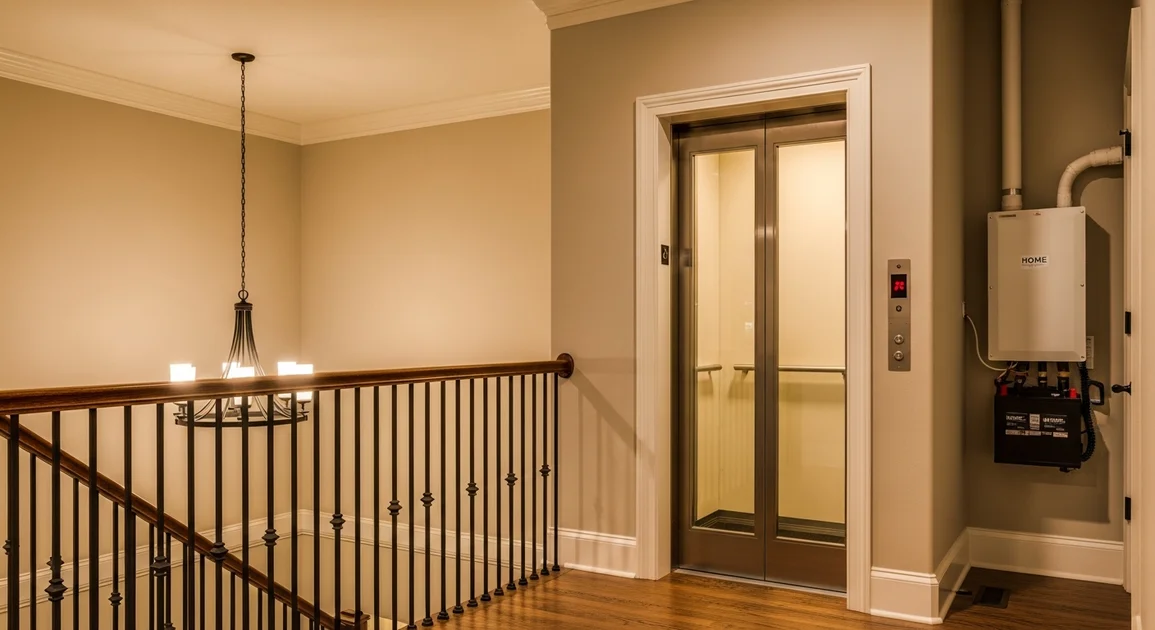
Battery Backup for a Residential Elevator in Houston
If your home has an elevator, a power outage can strand it, and anyone who relies on it, between floors. The good news is that a residential elevator is one of the easier loads to back up. Its motor is only a few kilowatts, and it runs only for the seconds the car is actually moving, so its daily energy use is small. A home battery keeps the elevator fully operating, not just lowering it to a floor the way its built-in emergency battery does.
Key Takeaways
- A home elevator motor is small, roughly 2 to 5 HP (about 1.5 to 3.7 kW), and draws power only while the car travels (Savaria; Symmetry, 2026).
- The motor has a brief starting surge of several times its running current (JADE Learning), which the Eos 17.1 kW surge rating handles easily.
- The elevator's built-in battery only lowers the car to the next landing and powers the cab light and alarm, not normal operation (Savaria, 2026).
- Because each trip lasts seconds, a home battery runs the elevator through an outage while easily covering the rest of your home.
- Hurricane Beryl left about 2.2 million Houston-area customers without power in 2024 (Houston Public Media).
[INTERNAL-LINK: keep your elevator running through the next outage → /home-backup-planner?source=blog&slug=battery-backup-residential-elevator-houston]
Can a home battery keep a residential elevator running in a Houston outage?
Yes, and the deciding spec is the startup surge, not the running power. A residential elevator motor draws only a few kilowatts while it runs, but like any motor it pulls a brief surge of several times that current at startup (JADE Learning). The Eos controller supplies 11.5 kW continuously and 17.1 kW of surge, clearing that starting spike with room to spare.
Just as important, the elevator only draws power for the 15 to 40 seconds a trip takes, then returns to nearly zero between rides. That is why keeping an elevator running uses far less battery energy than its motor rating might suggest.
How much power does a home elevator use?
Less than most people expect. Residential elevator motors run from about 2 HP on a geared traction unit to 4 or 5 HP on a hydraulic one, roughly 1.5 to 3.7 kW (Savaria; Symmetry, 2026). They run on a dedicated 208 to 240 volt circuit, plus a small separate lighting circuit. The chart shows the running motor size across common drive types.
What does the built-in emergency battery do, and not do?
Most residential elevators already include a small emergency battery, but it does one specific job. On a power failure, it lowers the car to the next landing, opens the doors, and keeps the cab light and alarm on, then it is spent (Savaria; Symmetry, 2026). It is a safety feature to get you off the elevator, not a way to keep using it.
A whole-home battery is different. It powers the elevator's normal operation for the length of the outage, so the car keeps moving between floors as usual. For a resident who depends on the elevator, that is the difference between being stranded on one floor and moving freely through the house.
What size battery do you need for a home elevator?
For a multi-story Houston home, Pro (27 kWh) or Premium (36 kWh) is the right target. The constraint is not the elevator's energy use, which is small per trip, but having the surge headroom to start the motor and the capacity to run the rest of the home at the same time. The 17.1 kW surge starts a residential elevator motor comfortably, helped by the soft-start controllers common on modern units.
When we size a system for a home with an elevator, we treat the elevator as a light but surge-heavy load and build around the household's other needs, air conditioning, the fridge, and lights. The elevator rarely changes the tier by itself.
[INTERNAL-LINK: size a Pro system for a multi-story home → /plans/pro]
Accessibility: staying independent between floors
For many families, the elevator is not a luxury but the way a resident moves through their own home. A multi-day Houston outage without it can mean being confined to one floor, away from a bedroom, a bathroom, or a kitchen. That is the real reason to back it up.
Coordinate the details with your elevator's maker or installer, since outage behavior varies by model, and pair that with a battery that keeps the car running. For related equipment, our guide on [INTERNAL-LINK: battery backup for stairlifts and mobility devices → /blog/battery-backup-mobility-devices-stairlift-wheelchair-houston] covers the rest of an accessible home.
[INTERNAL-LINK: get a home battery quote in under 2 minutes → /home-backup-planner?source=blog&slug=battery-backup-residential-elevator-houston]
Prefer to talk it through? Call Eos at 713-207-2222 for a same-week Houston site survey.
Frequently asked questions
Can a home battery run my residential elevator?
Yes. The motor is only about 1.5 to 3.7 kW while running, well within an Eos system's output, and the 17.1 kW surge starts it easily. Because trips last seconds, the elevator uses little battery energy over a day.
Does a home battery handle the elevator's startup surge?
Yes. Elevator motors pull a brief surge of several times their running current at startup (JADE Learning). The Eos controller's 17.1 kW surge rating clears that spike with headroom.
Does my elevator already have a battery?
Most do, but only for emergency lowering. The built-in battery brings the car to the next floor and powers the light and alarm, then stops (Savaria, 2026). It does not keep the elevator running like a whole-home battery does.
How much energy does a home elevator use in an outage?
Very little. A trip takes roughly 15 to 40 seconds of motor run time, so even many trips a day add up to only a small share of a home battery's capacity. The rest of your home is the larger load.
What size Eos system do I need for an elevator?
Pro (27 kWh) or Premium (36 kWh) for a multi-story home, chosen mainly to cover your whole household alongside the elevator. The surge rating, not capacity, is what matters for the elevator itself.
This article covers battery backup for a residential elevator in Houston and reflects Eos specifications as of July 2026. Elevator outage behavior varies by model; coordinate with your elevator maker or installer and confirm sizing at the free site survey.