Battery Backup for Houston Nurseries and Garden Centers: Irrigation, Greenhouses, and Heat

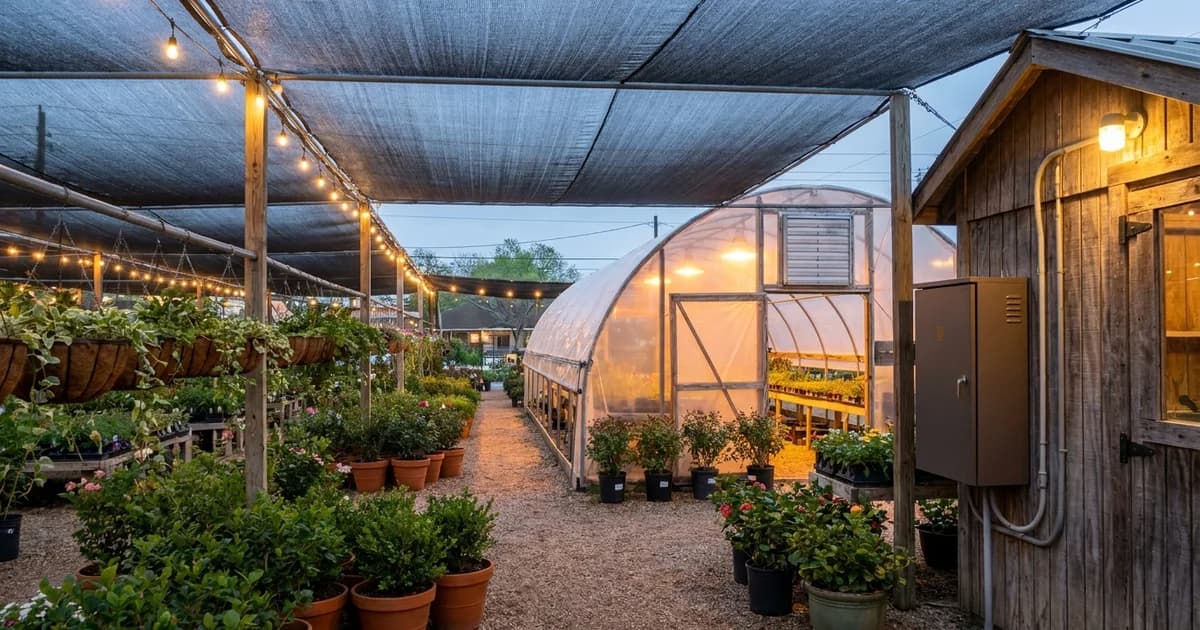
A nursery is one of the few retail businesses in Houston where the inventory is alive. When the grid drops at a garden center, the first casualty is not a freezer and not a server. The greenhouse stops exhausting heat, the irrigation pumps stop, and thousands of containers sitting in one-gallon pots begin drying out in whatever weather is happening outside. That failure mode is different from the refrigeration problem every other commercial site worries about, and it needs a different backup plan.
The site, load mix, and sizing scenario below describe a composite Houston-area independent garden center with a propagation greenhouse, a shade house, and a retail yard. It is modeled from published extension guidance, USDA horticulture data, and Gulf Coast outage records. It is not a real customer, and it does not describe any specific Houston nursery. Your numbers will differ.
Key Takeaways
- On a hot summer day, it takes only a few minutes without ventilation to push a greenhouse past 100 degrees Fahrenheit (eXtension Farm Energy).
- Texas horticulture operations sold $1.119 billion in 2024 across 729 operations, fifth highest in the country (USDA NASS, 2026).
- Ventilation fans and irrigation pumps are motor loads with a large startup spike, which is why surge headroom matters more than raw kilowatt-hours at a nursery.
- The Eos smart controller delivers 11.5 kW continuous and 17.1 kW surge, enough to carry greenhouse ventilation plus a booster pump plus the register on one controller.
- Full-site irrigation across a multi-acre yard is a multi-controller design, not a single-cabinet fix, and any installer who says otherwise is guessing.
What actually fails at a nursery when the power goes out?
Four things stop at once: greenhouse ventilation, irrigation pumping, propagation bottom heat, and the point of sale. In 2024, US electricity customers averaged 11 hours of interruption, with major storm events accounting for roughly nine of those hours (U.S. Energy Information Administration, 2025). Houston sits at the sharp end of that average.
The scale is not theoretical here. Hurricane Beryl knocked out power for about 2.2 million CenterPoint customers on July 8, 2024 (Houston Public Media, 2024), and EIA put the Texas total at 2.6 million customers for that storm. Restoration ran more than a week in parts of the metro. A cold-storage operator watching that clock is counting product temperature. A nursery operator is counting root balls.
Citation capsule. A grid outage at a Houston garden center disables greenhouse ventilation, irrigation pumping, propagation heat, and the register simultaneously, because all four run on the same service. Unlike refrigerated inventory, live plant stock has no thermal mass to coast on once airflow and water stop.
Here is the part that surprises people who have run other retail formats: a nursery has almost no coasting time. A walk-in freezer holds temperature for hours. A greenhouse does not.
Why a closed Houston greenhouse gets dangerous in minutes
Because the sun keeps loading heat into a sealed structure with no way out. Extension guidance is blunt about it: "During a hot summer day it takes only a few minutes without ventilation to create temperatures in excess of 100 degrees F" (eXtension Farm Energy). Even with fans running properly, extreme heat can leave the interior 10 to 20 degrees above outside air.
Now put that on a Houston calendar. The normal daily high at Bush Intercontinental in July is 94.5 degrees (National Weather Service Houston). Start there, add the greenhouse penalty, and remove the fans. Tender annuals, plugs, and freshly stuck cuttings are the first to go, and they are usually the highest-value trays in the building.
Sizing the fans is a known quantity. The same extension guidance calls for a fan system sized to provide one full air exchange per minute to a height of eight feet for summer ventilation. That is the load your battery has to carry, and it is the load most operators forget to put on the list, because the fans are usually just running.
Two structures behave differently. A gutter-connected polycarbonate house with fan-and-pad cooling is fully dependent on electricity. A hoop house with motorized roll-up sides is partly dependent: the sides can be cranked open by hand if someone is on site, but the motors, the thermostat, and the circulation fans still need power, and nobody is hand-cranking a row of hoop houses at 2am during a hurricane. The Texas A&M AgriLife Texas Greenhouse Management Handbook treats environmental control as a production system rather than a convenience, and that is the right framing for backup planning too.
Irrigation is a motor problem, not a lighting problem
Nursery irrigation runs on pumps, and pumps are the reason surge capacity decides your design. Well pumps and booster pumps draw a modest running load but spike hard at startup, commonly two to three times running draw (Franklin Electric AIM Manual, 2021). A 1 HP pump running near 1,400 watts can pull roughly 2,500 to 3,750 watts for the first moment of every cycle.
That number is small on its own and awkward in combination. A nursery does not start one motor. It starts a booster pump, then an exhaust fan bank, then a second zone valve controller, often inside the same minute, because irrigation controllers run zones in sequence. Every restart is another spike.
The Eos smart controller is rated at 11.5 kW continuous with 17.1 kW of surge for 10 seconds. That surge window is what clears a pump start without tripping, and it is why the first honest question at a nursery is never "how many kilowatt-hours do I need." It is "what is my worst simultaneous motor start," and capacity follows from the answer. If you pull from a private well rather than a municipal tap, our guide to well pump and water system backup covers the pump side in more depth.
The cold half of the year is the bigger financial risk
Freeze events kill inventory that heat only stresses. Winter Storm Uri in February 2021 caused at least $600 million in Texas agricultural losses according to Texas A&M AgriLife Extension economists, who reported collapsed greenhouses and plants that died when propane for heating ran out (AgriLife Today, 2021). AgriLife and the Texas Nursery and Landscape Association sent a loss assessment survey to more than 4,000 green industry businesses after that storm.
The outage itself was long enough to matter. A University of Houston Hobby School survey found that 69% of Texans lost electricity during Uri, for an average of 42 hours (University of Houston, 2021). Forty-two hours with no heat is a different event from forty-two hours with no air conditioning.
Propagation is the vulnerable zone in winter. Bottom heat systems typically hold the growing medium between 75 and 85 degrees Fahrenheit (UF/IFAS Plant Propagation). Electric mats serve small benches, and larger commercial operations use recirculating hot water, which still needs a circulation pump and a thermostat on grid power. A battery that carries the circulator, the controller, and the mat bank through a freeze protects the propagation crop even when the main house heater is gas fired and cannot run without its blower.
What we see in practice: operators size for July and get caught in February. A summer failure costs you part of a crop. A freeze failure costs you next spring's product line, because the plugs lost in February were going to be the shrubs sold in April.
What a garden center loses at the register on a peak weekend
Spring weekends are the year. Texas horticulture operations sold $1.119 billion in 2024, ranking fifth nationally behind California, Florida, Oregon, and Pennsylvania, across 729 operations (USDA NASS, 2026). Nationally, horticulture sales reached $18.3 billion across 23,060 operations (USDA NASS, 2026). Retail garden centers concentrate a disproportionate share of their revenue into a handful of weekends between March and May.
Losing the register on one of those Saturdays is a straight revenue hit, and it is the cheapest thing on the property to protect. Card terminals, POS tablets, the network switch, the router, and checkout lighting together draw a fraction of what a single pump does. Put them on backup and the business keeps transacting while the yard runs on daylight.
Other Texas operators face the same math from a different angle, which our overview of commercial battery backup for Texas businesses walks through, and refrigerated sites face the harshest version of it in our Houston cold storage guide.
Honest sizing: what one controller actually covers
One controller covers a defined critical zone, not the whole property. A realistic single-controller scope at a composite Houston garden center looks like this: exhaust and circulation fans for the primary propagation house, one booster pump for irrigation, the irrigation controller and zone valves, propagation bottom heat, the POS and network stack, and safety lighting. That fits inside 11.5 kW continuous, with the 17.1 kW surge window absorbing pump and fan starts.
What one controller does not cover: full-site irrigation across a multi-acre yard with several pumps running at once, fan-and-pad cooling on every gutter-connected house, or a large gas-fired heater's blower plus everything else during a freeze. Those are multi-controller designs, and the right first step is a load walk with a meter, not a quote off a photo.
Sequencing matters as much as sizing. Irrigation does not have to run every zone at once during an outage. A smart panel that staggers zones, sheds retail lighting, and protects propagation heat first will stretch the same battery bank considerably further than one treating every circuit as equal. Animal care facilities run the same load-shedding logic, described in our Houston pet boarding and grooming guide.
Or call Eos at 833-989-3737 to talk through your setup with an installer.
Frequently Asked Questions
How long can a greenhouse go without ventilation in a Houston summer?
Not long. Extension guidance states that on a hot summer day, only a few minutes without ventilation is enough to push interior temperatures past 100 degrees Fahrenheit (eXtension Farm Energy). With a July normal high of 94.5 degrees at Bush Intercontinental, the margin in Houston is thinner than in most growing regions.
Can a battery run my irrigation pump during an outage?
Yes, if the design accounts for startup surge. Submersible and booster pumps spike to roughly two to three times running draw at start (Franklin Electric AIM Manual, 2021). The Eos controller provides 11.5 kW continuous and 17.1 kW surge, which clears a typical single booster pump with headroom left for fans.
Is freeze or heat the bigger risk for a Texas nursery?
Freeze, financially. Texas A&M AgriLife Extension economists estimated at least $600 million in state agricultural losses from Winter Storm Uri, including collapsed greenhouses and plants lost when heating fuel ran out (AgriLife Today, 2021). Heat stresses a crop. A multi-day freeze without heat eliminates it.
Do I need one system for the whole nursery?
Usually not, and usually you should not try. One controller handles a critical zone: primary greenhouse ventilation, one booster pump, propagation heat, and the register. Full-site irrigation with multiple simultaneous pumps is a multi-controller design, and it starts with a metered load study of your actual site.
Sources
- eXtension Farm Energy, Greenhouse Ventilation, retrieved 2026-09-08, https://farm-energy.extension.org/greenhouse-ventilation/
- National Weather Service Houston/Galveston, Houston IAH Normals, Means and Extremes for July, retrieved 2026-09-08, https://www.weather.gov/hgx/climate_iah_normals_jul
- U.S. Energy Information Administration, Hurricanes in 2024 led to the most hours without power in the United States in 10 years, retrieved 2026-09-08, https://www.eia.gov/todayinenergy/detail.php?id=66744
- Houston Public Media, Houston power outages: Hurricane Beryl plunges 2.2 million into the dark, retrieved 2026-09-08, https://www.houstonpublicmedia.org/articles/news/hurricane/2024/07/08/492833/houston-power-outages-hurricane-beryl-centerpoint/
- University of Houston Hobby School of Public Affairs, New Report Details Impact of Winter Storm Uri on Texans, retrieved 2026-09-08, https://www.uh.edu/news-events/stories/2021/march-2021/03292021-hobby-winter-storm.php
- Texas A&M AgriLife Today, Uri agriculture damage estimates exceed $600 million in Texas, retrieved 2026-09-08, https://agrilifetoday.tamu.edu/2021/03/02/initial-ag-losses-from-uri-exceed-600-million/
- USDA National Agricultural Statistics Service, Highlights: Results from the 2024 Census of Horticultural Specialties, retrieved 2026-09-08, https://www.nass.usda.gov/Publications/Highlights/2026/HorticulturalSpecialties2024.pdf
- USDA National Agricultural Statistics Service, U.S. Horticulture Operations Report $18.3 Billion in Sales, retrieved 2026-09-08, https://www.nass.usda.gov/Newsroom/2026/02-26-2026.php
- University of Florida IFAS, Plant Propagation: Bottom Heat, retrieved 2026-09-08, https://propg.ifas.ufl.edu/02-environment/03-temperature/01-temperature-bottomheat.html
- Franklin Electric, Application, Installation and Maintenance Manual for Submersible Motors, retrieved 2026-09-08, https://www.geotechenv.com/Manuals/Franklin_AIM/Electric_Submersible_Motors_AIM.pdf
- Texas A&M AgriLife Extension, Texas Greenhouse Management Handbook, retrieved 2026-09-08, https://aggie-horticulture.tamu.edu/ornamental/greenhouse-management/