Battery Backup for Houston Ice Cream and Frozen Dessert Shops

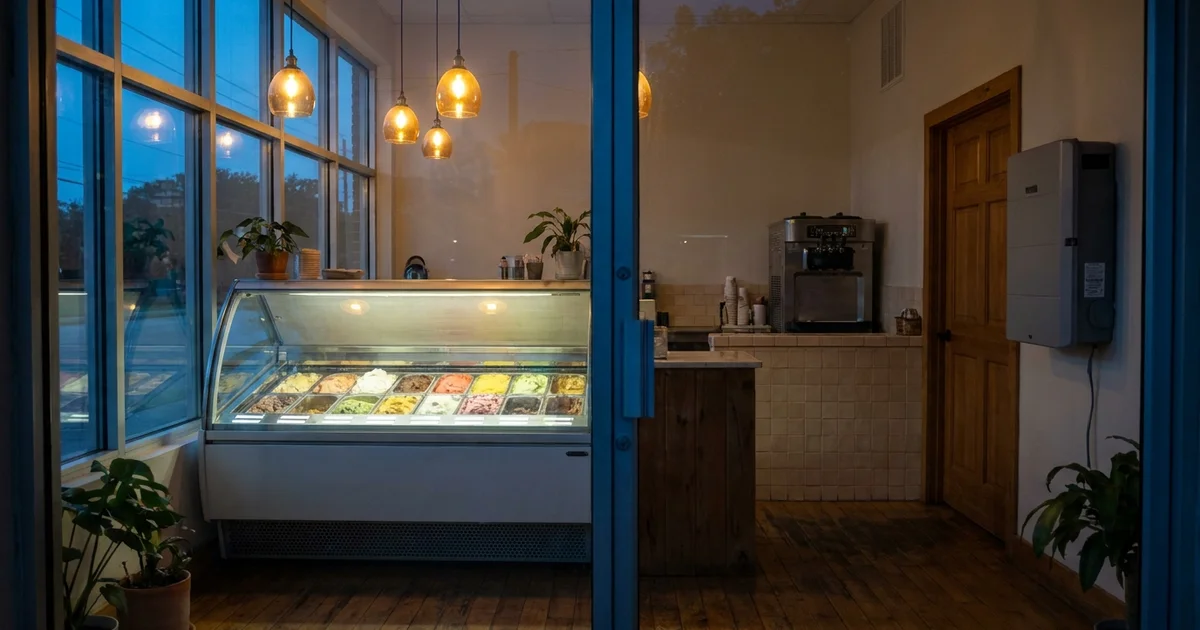
An ice cream shop sells a product that is only good in a narrow temperature band, and the band has a hard floor and ceiling. When Hurricane Beryl hit on July 8, 2024, CenterPoint had restored power to nearly 2.1 million customers by the Monday afternoon, and roughly 207,000 were still dark on an eighth day (Houston Landing, 2024). In July, in Houston, that is a long time to hold frozen cream.
This post is for owners of scoop shops, soft serve counters and frozen dessert stands. It covers what actually goes wrong in an outage, what I could verify about it, and what a residential-scale battery can and cannot carry. Where the public record runs out, I say so.
Key Takeaways
- The industry says ice cream is best stored at 0°F or colder, and a store freezer case should not run above 10°F (International Dairy Foods Association).
- Repeated softening and refreezing grows large ice crystals, so a short thaw can cost texture even when nothing is unsafe (same IDFA source).
- Heat-treatment soft serve freezers run a daily heating and cooling cycle, and a failed cycle can lock the machine out of automatic mode (Taylor Company).
- One Eos controller is rated 11.5 kW continuous and 17.1 kW surge. That fits a cabinet, a small freezer and a register, not a full multi-machine shop.
What temperature does ice cream actually need?
Here the hypothesis I started with was partly wrong, and the correction matters. I expected a single "0°F to 10°F" storage rule. The IDFA actually draws three different lines: the optimum is 0°F or colder, a supermarket freezer case should not be above 10°F, and ice cream is easy to dip between 6°F and 10°F (IDFA, Tips on Storing and Handling Ice Cream).
So 10°F is a ceiling for display, not a food-safety line. I could not find a public rule that sets 10°F as a legal limit for a Texas shop, and I am not going to invent one. What I can say is that a dipping cabinet is built to sit near the dipping range, and when the compressor stops, that range is the first thing you lose.
That is also why a short outage is a quality problem before it is a safety problem. The IDFA warns against letting ice cream repeatedly soften and refreeze, because small ice crystals that melt and refreeze can grow into large, unpalatable lumps (same source). A customer does not call that spoilage. They call it gritty, and they do not come back.
How long does a frozen dessert shop have in an outage?
The general food-safety clocks are the ones federal agencies publish for households: a full freezer holds its temperature for about 48 hours, a half-full one for about 24, and a refrigerator for about 4, in each case with the door kept shut (FDA). The FDA also says food in a freezer that still reads 40°F or below, or still has ice crystals, can be refrozen or cooked (same source).
Those numbers describe a closed household freezer full of solid food. A dipping cabinet is a different animal. It has a glass or open top, it gets opened constantly, and the tubs inside are partly scooped out, so they hold much less thermal mass than a packed chest. I have not found a published hold time for a shop dipping cabinet, so I will not give you one. Put a thermometer in it and learn your own cabinet's behavior on a slow day.
The back-of-house walk-in or chest freezer, packed with sealed tubs and cones, is the part with runway. The front cabinet is the part that warms in minutes.
What happens to a soft serve machine when the power drops?
Soft serve is the more fragile case, and it is where I could verify something concrete. Modern soft serve freezers with heat treatment, such as the Taylor C717, run a daily heating and cooling cycle that lets dairy mix stay in the machine for up to 28 days before a full teardown and cleaning (Taylor Company). The same page notes that the unit requires two dedicated electrical connections and is permanently connected.
I checked the hypothesis that these cycles are a problem for backup power, and the manuals I could reach support the concern in outline. Operator manual text surfaced in search describes a power-fail fault for a loss of power mid-cycle, a lockout from automatic mode after a failed cycle, and a warning that product may not be safe to serve afterward. I could not open those manual pages directly (the host blocked automated access), so I am treating them as a lead, not a citation. The point is simple and you can confirm it with your own manual: a heat cycle that fails halfway is not a cycle that quietly resumes.
I also could not find a published running wattage for a soft serve freezer on the Taylor page. It says the connections are dedicated but gives no kW figure in the text I could read. Your nameplate and the manufacturer's electrical chart are the only honest source. Ask your equipment dealer.
What this means for backup: if you run heat-treatment soft serve, the machine's schedule matters as much as its wattage. A battery that carries a cycle to completion is useful. A battery that dies mid-cycle can leave you worse off than a clean shutdown. Ask your manufacturer what the machine does after a power interruption before you design around it.
What can a residential battery carry in a scoop shop?
Eos plans are residential-scale. Every plan uses one controller rated 11.5 kW continuous and 17.1 kW surge, and one battery module is 9 kWh nominal, 8.76 kWh usable. Our own runtime figures are stated as up to 8 hours at minimal load on a single module, and they fall quickly as you add heavier loads. See the plans page and the Essential plan for the specifications.
Read that against a frozen dessert shop and a sensible triage emerges.
- Likely a good fit: a back-room chest or upright freezer holding sealed inventory, the point of sale, lighting, and network gear.
- Possible with care: one dipping cabinet, if you confirm its nameplate and its compressor start-up draw.
- Needs an engineer: a soft serve freezer with its dedicated connections, a walk-in freezer, a multi-case shop, or anything on three-phase service. Compressors draw far more at start than while running, and that is a design problem, not a rounding error.
For the commercial side of this question, our guides to commercial versus residential battery sizing in Texas and commercial battery backup for Texas businesses explain where a home system stops and a commercial design starts.
Is the walk-in freezer the right thing to protect first?
For most shops, yes. The same logic runs through the other cold-chain posts we have written. In a grocery or convenience store, the open cases fail early and the walk-in carries the inventory. In a butcher shop or seafood market, the display case is merchandising and the walk-in is stock.
Ice cream follows the same pattern with a twist: the product is cheap to make and expensive to replace in a hurry, because the tubs are often a local small-batch supplier's, not something you can reorder the same afternoon. I could not verify a typical Houston replacement lead time, so I will not quote one. Ask your distributor what happens to deliveries during a regional outage.
If you run the shop from a house, a garage kitchen or a cottage setup, the residential math applies directly. A chest freezer and a register are well within one controller.
What should you do in the first hour without backup?
Whatever you decide on hardware, the first hour is procedure. I would write this on a card and tape it inside the storeroom door.
- Stop opening the cabinet and the freezer. Every opening costs cold you cannot make back.
- Read the thermometers. Keep appliance thermometers in each freezer, as the FDA advises (FDA).
- Move scoop-ready tubs from the front cabinet into the back freezer if it is still cold.
- Do not refreeze softened tubs and keep serving them. The IDFA's warning about repeated softening is the reason.
- Call the local health authority if you cannot hold required temperatures. I am not giving legal advice, and rules for your specific permit vary.
- Photograph the thermometer readings and the inventory for your records.
Houston-area power can also fail without a storm. Ice is its own business, as our post on ice vending and packaged-ice sellers shows, and freezers do not care why the power is out.
How should you decide?
Start with a list, not a purchase. Write down every compressor in the shop, its nameplate watts, and whether it has a door. Decide which one or two you must protect: usually the back freezer and the register. Then ask each equipment manufacturer what the machine does after an interruption.
If that list fits a home-scale system, we can size it. If it does not, you want a commercial engineer, and I would rather tell you that now. For a home-based dessert business or a very small stand, a residential system can be the right answer. For a full scoop shop with soft serve, it is usually part of a bigger plan.
Or call Eos at 833-989-3737 to talk through your setup.
Frequently asked questions
What temperature should an ice cream dipping cabinet hold?
The IDFA says the optimum storage temperature is 0°F or colder, a store freezer case should not exceed 10°F, and ice cream dips easily between 6°F and 10°F (IDFA). Your permit and your cabinet manual may add requirements.
Can I refreeze ice cream after a power outage?
The FDA says frozen food that still has ice crystals or reads 40°F or below can be refrozen (FDA). The IDFA adds that repeated softening and refreezing makes large ice crystals and a lumpy texture. Safe and sellable are two different questions.
Can a home battery run a soft serve machine?
I cannot confirm that from public data. The manufacturer page I read does not publish a running wattage, and the machine needs dedicated connections. Get the nameplate and electrical chart, and have an electrician or commercial engineer size it.
How long will a battery keep my freezer cold?
It depends on the freezer's real draw and the battery size. A single Eos module is 8.76 kWh usable, and our runtime claims are expressed as up to a number of hours at minimal load. Measure your own freezer's watts before relying on any estimate.