Battery Backup for Houston Animal Shelters and Rescue Facilities

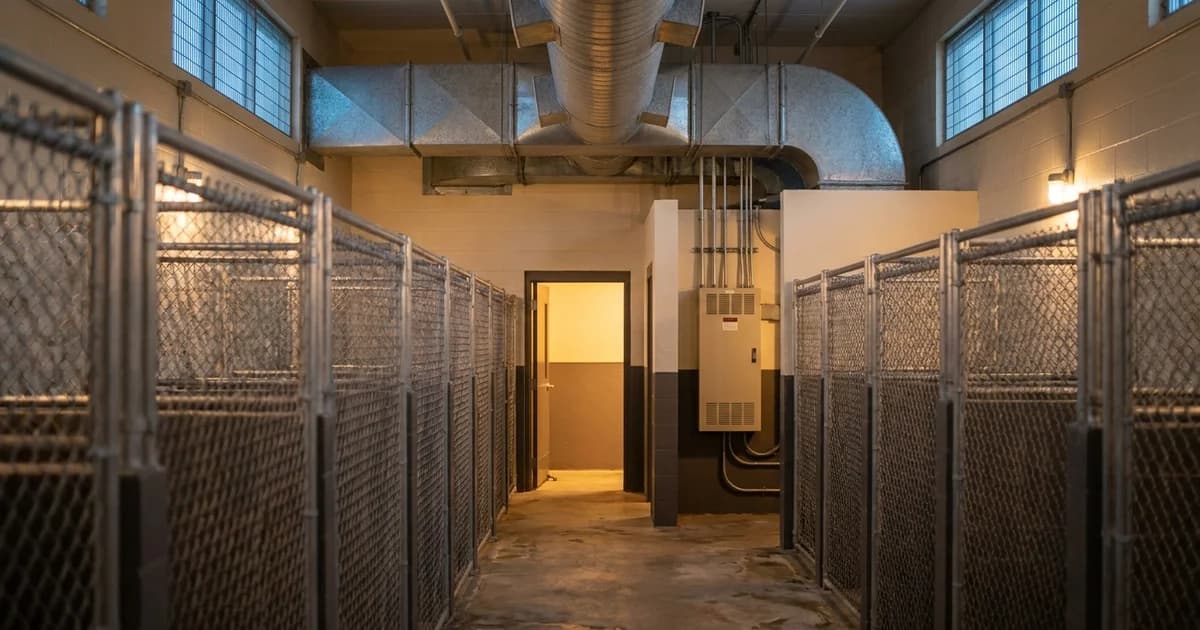
A veterinary clinic that loses power sends patients home. A boarding kennel calls owners to pick up early. An animal shelter has no one to call. The animals in the building are the ones nobody came for, the building is usually at or over capacity, and the outage that emptied every other facility on the block is the same event that fills the shelter further.
That is why animal shelter backup power in Houston is a different engineering problem, and a different budget problem, than the ones we cover for private practices. The failure mode is not lost revenue. It is a mass animal welfare event inside a building that is already full.
The shelter, loads, and scenarios in this article are a composite drawn from published shelter care standards, federal housing rules, and Gulf Coast outage data. No real shelter, municipal or nonprofit, is named or described. This is not veterinary advice.
Key Takeaways
- Shelter ventilation standards call for 10 to 20 room air exchanges per hour with fresh air, and the ASV states that fresh air limits the spread of infectious disease (ASV Guidelines, 2022).
- Federal rules say ambient temperature must not rise above 85F for more than 4 consecutive hours when dogs or cats are present (9 CFR 3.2).
- During Beryl, about 2.2 million CenterPoint customers lost power with a heat index reaching 106F (Houston Public Media, Texas Tribune, 2024).
- Shelters take in more animals after a disaster, not fewer, and federal planning obligations under the PETS Act assume that surge (FEMA).
- Sizing for a shelter starts with ventilation and refrigeration, not with the whole building.
Why is a shelter a different backup problem than a clinic or a kennel?
Because the population cannot be discharged. A shelter is a facility at capacity holding animals with no owner to collect them, run largely by a city department or a nonprofit on a fixed annual budget. BARC, Houston's municipal shelter, takes in between 20,000 and 30,000 animals a year and is the only city shelter required by law to accept every animal that arrives (Houston BARC Foundation). An open-admission mandate and a power failure are a bad combination.
The other difference is money. A clinic can model an outage against lost surgery revenue and reach a number. A shelter has no revenue line to protect, so backup power has to be justified on welfare, on regulatory exposure, and on the cost of an emergency animal transport that a preventable failure would trigger.
Here is the part that gets missed in most facility assessments. In a shelter, ventilation is not a comfort system. It is a disease control system, and it is the first thing that stops when the grid drops.
Our companion pieces on
and cover the revenue-driven versions of this problem.What does ventilation failure actually do in a kennel or cattery?
It converts a housing problem into an outbreak problem. The Association of Shelter Veterinarians' Guidelines for Standards of Care in Animal Shelters puts the standard recommendation at 10 to 20 room air exchanges per hour with fresh air, and states plainly that fresh air is essential for the well-being of shelter animals and personnel "as well as for limiting the spread of infectious disease" (ASV Guidelines, 2nd edition, 2022).
The same guidelines set environmental temperature between 64F and 80F and relative humidity between 30 and 70 percent. Proper ventilation, in their words, removes heat, dampness, odor, airborne microbes, and pollutant gases such as ammonia and carbon dioxide.
Now cut power to the air handlers. Air exchange goes to whatever the building leaks. Ammonia from waste starts accumulating in a densely populated kennel. Humidity climbs. Airborne pathogen load rises in a population that includes recent intakes with unknown vaccination histories. The respiratory disease consequences of that afternoon show up over the following two weeks, long after the lights come back.
Citation capsule. Shelter ventilation is an infectious disease control measure, not a comfort feature. The Association of Shelter Veterinarians recommends 10 to 20 fresh air exchanges per hour and states that fresh air limits the spread of infectious disease in shelter populations (ASV Guidelines for Standards of Care in Animal Shelters, 2nd edition, 2022). A powerless air handler suspends that control for the duration of the outage.
How fast does Houston heat become a welfare emergency?
Faster than the restoration window. Federal animal welfare rules for indoor housing state that ambient temperature "must not rise above 85F for more than 4 consecutive hours when dogs or cats are present," and that auxiliary ventilation such as fans, blowers, or air conditioning must be provided once ambient temperature reaches 85F (9 CFR 3.2). Four hours is the regulatory clock. Beryl's restoration was measured in days.
During that July 2024 storm, about 2.2 million CenterPoint customers lost power (Houston Public Media, 2024), and more than a million were still out days later with the heat index reaching 106F (Texas Tribune, 2024). A concrete kennel building with no air movement does not stay at 85F under those conditions.
The clinical stakes are documented. A 2025 review in Frontiers in Animal Science summarizing UK primary care data reports an overall mortality rate of 14.18 percent for heat-related illness in dogs, rising to a fatality rate of 56.76 percent in severe cases (Frontiers in Animal Science, 2025). Confined animals cannot move to shade, cannot find water on their own, and cannot tell anyone they are in trouble. Multiply that by a hundred runs.
The household version of this same math is covered in our guide to
.What about the shelter medicine cold chain?
Vaccines are the one shelter load that fails silently. Veterinary vaccines are federally regulated biologics licensed by the USDA Center for Veterinary Biologics under the Virus Serum Toxin Act (APHIS), and each product's label governs its storage conditions. USDA does not publish a single across-the-board temperature that applies to every veterinary product, so the honest answer is that the label is the standard.
In practice, shelter refrigerators are run to the same window used across vaccine programs generally: 2 to 8 degrees Celsius, or 36 to 46 Fahrenheit (CDC, 2023). Intake vaccination is the core of shelter medicine, and a shelter that cannot vaccinate on intake during a post-storm surge is admitting unvaccinated animals into a building with degraded ventilation.
Timing is unforgiving. Federal guidance for household refrigerators is that contents stay cold roughly 4 hours with the door closed (FoodSafety.gov). Shelter units are better, but the direction is the same, and every door opening resets the clock.
In the Houston facility assessments we ran after Beryl, the refrigerator was almost always on a general-purpose circuit, sharing a panel with break room appliances. Nobody had ever mapped it. That single unmapped circuit is usually the cheapest fix in the building.
Shelters fill up after the storm, not before
This is the reality that breaks most shelter continuity plans. The PETS Act requires state and local planners to plan for the mass care of household pets and service animals during mass sheltering and evacuation operations, including the provision of veterinary care (FEMA). That obligation lands on local animal services at the exact moment their own building may be dark.
The intake pressure is not theoretical. A 2021 ASPCA survey found that 83 percent of pet owners live in a community that faces natural disasters, only 46 percent have a disaster preparedness plan, and nearly half of owners who evacuated left at least one pet behind (ASPCA, 2021). Nearly 40 percent of pet-owning evacuees did not return home for at least four days.
Those animals arrive somewhere. Usually at the municipal shelter, during the outage, into a building already at capacity with no working ventilation.
What loads actually need to stay up?
Not the whole building. A shelter's critical island is narrower than people expect, and it is what makes battery backup a realistic option rather than a fantasy line item.
Tier 1, every minute: kennel and cattery ventilation fans and air handling on the housing wings, vaccine and biologic refrigeration, treatment area lighting, and the shelter management database that holds every animal's ID, hold status, and medical record.
Tier 2, within the hour: isolation ward ventilation and negative pressure where the design provides it, freezers, the intake counter, phones and network for reunification calls, and door access control.
Tier 3, if capacity allows: full-building air conditioning, laundry, and administrative offices.
Our system stacks 9 kWh nominal battery modules, 8.76 kWh usable each, up to 45 kWh on a single controller rated 11.5 kW continuous with 17.1 kW surge. Two controllers reach 23 kW continuous. For a small rescue with one housing wing, a single controller carrying ventilation and refrigeration is a genuine multi-day answer. For a large municipal facility with several wings and full HVAC ambitions, the honest engineering answer is a battery on the critical island plus a generator for the long tail, not a battery pretending to be a power plant.
The pattern we see across Houston commercial assessments is consistent: the loads that actually protect the animals are a small fraction of the building's peak demand. The air handlers and the refrigerators are the whole job.
Sequencing this on a nonprofit or municipal budget
Start with a load study, not a quote. Have an electrician identify which circuits feed the housing-wing air handlers and the vaccine refrigerator, and whether those circuits can be isolated onto a critical-load panel. That step costs little and often reveals that Tier 1 is smaller than assumed.
Then phase it. A first phase covering ventilation on one housing wing plus refrigeration is defensible to a board or a council on welfare and regulatory grounds alone. Later phases add wings. Grant applications and capital requests are easier to write when the ask is a specific kilowatt figure tied to a published standard, which is exactly what 9 CFR 3.2 and the ASV guidelines give you.
For the general commercial framing, see our overview of
.Or call Eos at 833-989-3737 to talk through your setup with an installer.
Frequently asked questions
Can a battery really run kennel ventilation through a multi-day outage?
Often yes, if the scope is ventilation and refrigeration rather than full building air conditioning. Fans and air handlers on housing wings draw far less than compressors. A controller rated 11.5 kW continuous with 45 kWh behind it covers a small facility's Tier 1 island for a meaningful stretch.
What temperature is a shelter legally required to hold?
Federal indoor housing rules state ambient temperature must not rise above 85F for more than 4 consecutive hours when dogs or cats are present, and auxiliary ventilation is required at 85F or higher (9 CFR 3.2). Professional standards are tighter, at 64F to 80F (ASV Guidelines, 2022).
Does a battery replace our generator?
Usually it complements it. A battery carries the critical island silently, instantly, and without fuel, which matters most in the first hours when nobody is available to start and refuel equipment. A generator handles the multi-day tail. Many shelters end up with both.
How much does a shelter backup system cost?
It depends entirely on which loads you protect, and phased scopes change the number substantially. We do not publish a single figure because a one-wing rescue and a multi-wing municipal facility are not comparable projects. The planner walks through your loads and returns a real scope.
Sources
- Association of Shelter Veterinarians, Guidelines for Standards of Care in Animal Shelters, 2nd edition, 2022, retrieved 2026-09-08, https://jsmcah.org/index.php/jasv/article/view/42
- Code of Federal Regulations, 9 CFR 3.2 Indoor housing facilities, retrieved 2026-09-08, https://www.law.cornell.edu/cfr/text/9/3.2
- Frontiers in Animal Science, Heat stress in domestic dogs: morphological and environmental risk factors for dog welfare in a warming world, 2025, retrieved 2026-09-08, https://www.frontiersin.org/journals/animal-science/articles/10.3389/fanim.2025.1679377/full
- FEMA, Key Planning Factors 4.4 Service Animals and Household Pets, retrieved 2026-09-08, https://www.fema.gov/cbrn-tools/key-planning-factors-bio/kpf-4/4
- ASPCA, New ASPCA Survey Reveals 83 Percent of Pet Owners Live in an Area Impacted by Disasters, 2021, retrieved 2026-09-08, https://www.aspca.org/about-us/press-releases/new-aspca-survey-reveals-83-percent-pet-owners-live-area-impacted-disasters
- USDA APHIS, Veterinary Biologics, retrieved 2026-09-08, https://www.aphis.usda.gov/veterinary-biologics
- CDC, Vaccine Storage and Handling, Pink Book Chapter 5, 2023, retrieved 2026-09-08, https://www.cdc.gov/pinkbook/hcp/table-of-contents/chapter-5-vaccine-storage-and-handling.html
- FoodSafety.gov, Food Safety During Power Outage, retrieved 2026-09-08, https://www.foodsafety.gov/food-safety-charts/food-safety-during-power-outage
- Houston Public Media, Houston power outages after Hurricane Beryl, 2024, retrieved 2026-09-08, https://www.houstonpublicmedia.org/articles/news/hurricane/2024/07/08/492833/houston-power-outages-hurricane-beryl-centerpoint/
- Texas Tribune, Beryl power outage, debris, rain and heat, 2024, retrieved 2026-09-08, https://www.texastribune.org/2024/07/11/beryl-power-outage-debris-rain-heat-sargent-texas/
- Houston BARC Foundation, BARC Facts, retrieved 2026-09-08, https://www.houstonbarcfoundation.org/who-we-are/barc-facts/