Battery Backup for a Home Bakery or Catering Business in Houston

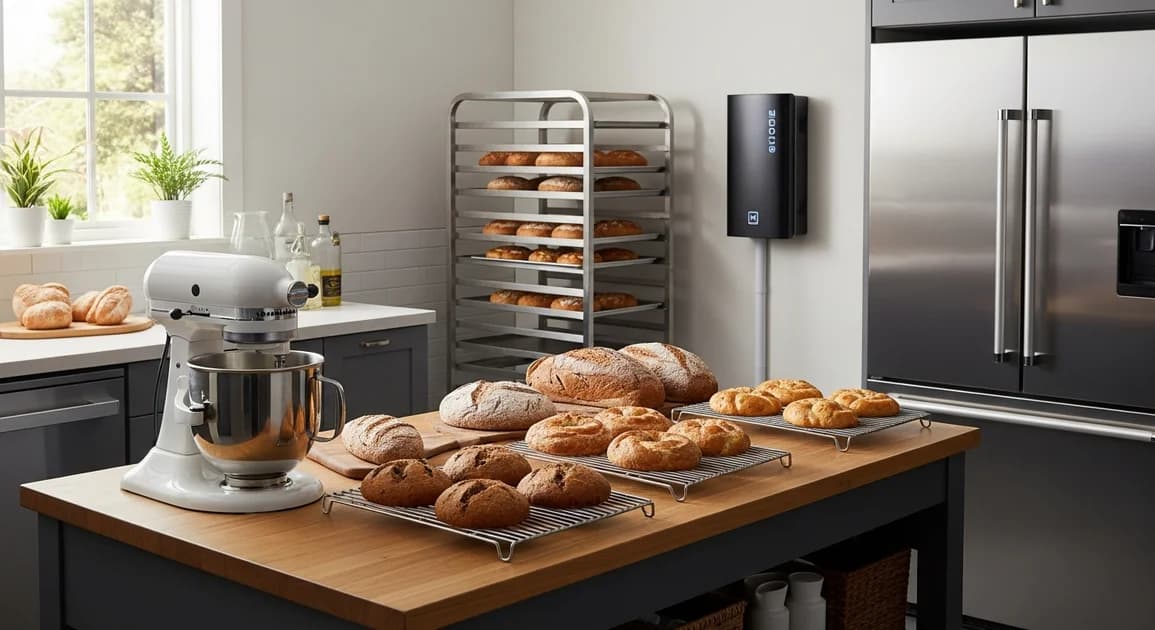
Battery Backup for a Home Bakery or Catering Business in Houston
When you run a food business from home, an outage puts both your income and your inventory on the clock. Refrigerated and frozen product can spoil, and a missed order is revenue you cannot get back. The good news is that the loads that matter most, your refrigeration and small tools, are easy for a home battery to carry. The one heavy load to manage is a full electric oven, which draws far more than everything else combined.
Key Takeaways
- Refrigeration is a light, cycling load. An Energy Star chest freezer uses about 215 kWh a year and an upright about 395 kWh (Energy Star, 2025), so a battery covers it for days.
- A stand mixer is small, about 275 to 325 watts on a KitchenAid (KitchenAid, 2025), easy to run.
- A full electric oven is the heavy load. A single bake element draws 2,585 to 3,100 watts (GE OEM bake element, via Rangekleen, 2025), which drains a battery fast.
- Your refrigerator keeps food safe about 4 hours without power, and a full freezer about 48 hours; a battery removes that clock (FoodSafety.gov, 2025).
- Hurricane Beryl left about 2.2 million Houston-area customers without power in 2024, a serious hit to any home business (Houston Public Media).
[INTERNAL-LINK: protect your home food business from outages → /home-backup-planner?source=blog&slug=battery-backup-home-bakery-catering-business-houston]
Can a home battery keep a home bakery or catering business running in a Houston outage?
Yes, for the parts that protect your business, with one caveat about the oven. A battery easily runs your refrigerators, freezers, stand mixer, proofer, and lights, because those are modest loads that only sip power. That keeps your inventory cold and your prep moving through an outage.
The exception is a full-size electric oven. Its heating element alone draws 2,585 to 3,100 watts while it runs (GE OEM bake element, via Rangekleen, 2025), a large share of any battery, so baking continuously will drain your reserve quickly. The practical approach is to prioritize refrigeration and bake in bursts, or to use a gas oven, which needs only a small igniter that a battery powers with ease.
What is at risk in an outage: inventory and income
Two things are on the line, and both cost money. First, inventory. A refrigerator holds a safe temperature for only about 4 hours without power, and a full freezer for about 48 hours (FoodSafety.gov, 2025). Past that, product held above 40 degrees for two hours has to be discarded, which for a caterer can mean an entire event's worth of food.
Second, income. An outage during a baking day or before a delivery means missed orders and refunds, plus the reputation cost of letting a customer down. For a deeper look at those numbers, see our guide on the [INTERNAL-LINK: real cost of business interruption from outages → /blog/business-interruption-power-outage-cost-texas].
Which equipment does a battery cover easily, and which do you manage?
Most of a home food kitchen is light, cycling load that a battery handles without thinking. The chart below shows why: a refrigerator, freezer, and stand mixer sit far below the electric oven, which towers over everything.
Refrigeration, the mixer, and small tools run for hours on a battery. The oven is the one load you schedule around, or replace with a gas unit.
What size battery do you need for a home food business?
Pro (27 kWh) or Premium (36 kWh) fits most home bakeries and caterers. That capacity keeps your refrigeration, freezers, mixer, and lights running through a multi-day outage, with headroom to bake in bursts on an electric oven or to run kitchen air conditioning in the Houston heat.
When we size a system for a home food business, we put the refrigerators and freezers at the top of the smart panel's priority list, since that inventory is the most expensive thing to lose. The oven goes on a managed circuit so it heats only when there is capacity to spare.
[INTERNAL-LINK: size a Pro system for a home business → /plans/pro]
Keeping orders on track through an outage
The goal is simple: keep making and delivering while your competitors are dark. With refrigeration protected and prep tools running, a home baker can keep pulling orders together during an outage that would shut a grid-only kitchen down. Texas allows many foods to be made and sold from home under its cottage food framework (Texas DSHS, 2025), and reliable power is what keeps that small operation running when the weather turns.
For a sense of how the same math scales up to a storefront, our guide on [INTERNAL-LINK: battery backup for Houston restaurants → /blog/battery-backup-restaurants-houston] covers the commercial side.
[INTERNAL-LINK: get a home battery quote in under 2 minutes → /home-backup-planner?source=blog&slug=battery-backup-home-bakery-catering-business-houston]
Prefer to talk it through? Call Eos at 713-207-2222 for a same-week Houston site survey.
Frequently asked questions
Can a home battery run my electric oven?
It can power it, but an electric oven's element draws 2,585 to 3,100 watts (GE OEM bake element, via Rangekleen, 2025), so baking continuously drains a battery fast. Bake in bursts, prioritize refrigeration, or use a gas oven, which needs only a small igniter.
Will my refrigerated inventory be safe during an outage?
Yes, with a battery. Without one, a fridge holds safe temperatures about 4 hours and a full freezer about 48 hours (FoodSafety.gov, 2025). A battery keeps them cold for the whole outage, protecting your most valuable stock.
How long will a battery last for a home bakery?
For refrigeration and light tools, a Pro or Premium system runs for days, because those loads are small. Runtime shortens sharply if you run an electric oven or air conditioning heavily, which is what the site survey helps you plan.
Does a gas oven work on a home battery?
Yes, easily. A gas oven's burner runs on gas and needs only a small amount of electricity for its igniter and controls, a tiny load a battery powers without meaningfully affecting runtime.
What size Eos system do I need for a catering business at home?
Pro (27 kWh) or Premium (36 kWh) for most home operations, sized to keep refrigeration and prep tools running while leaving headroom for bursts of baking. The exact fit depends on your equipment, confirmed at the free site survey.
This article covers battery backup for a home bakery or catering business in Houston and reflects Eos specifications as of July 2026. It is general information, not legal advice on cottage food operations. Runtime depends on your equipment and is confirmed at the free site survey.