Can a Home Battery Run My Electric Water Heater in Houston?

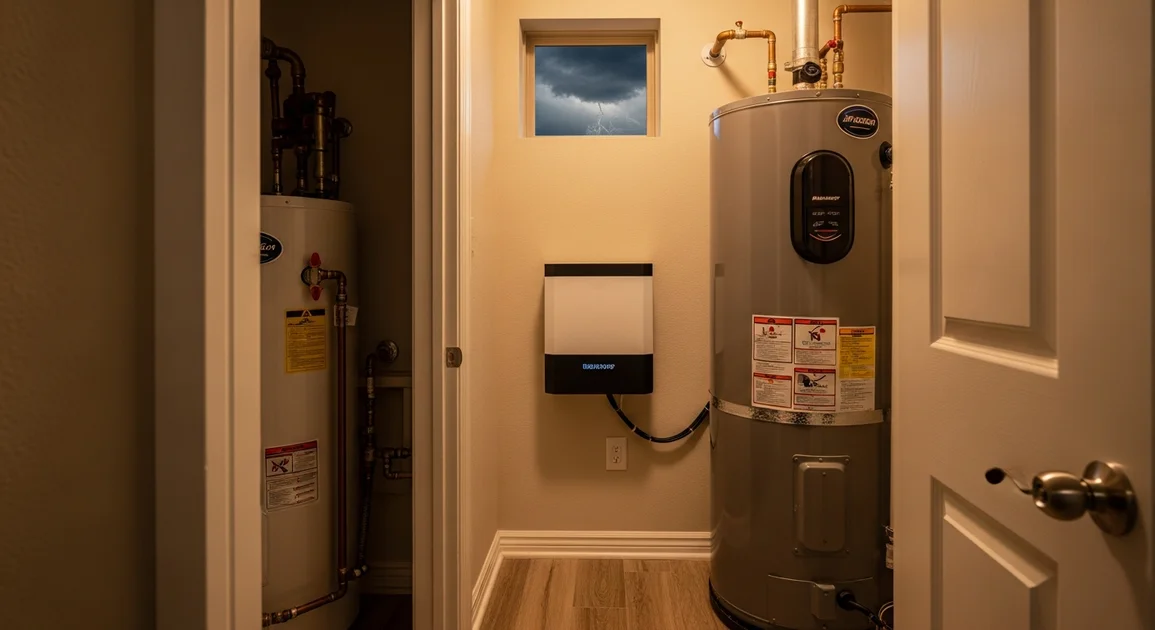
Can a Home Battery Run My Electric Water Heater in Houston?
It depends entirely on which water heater you have, and the honest answer runs from an easy yes to a firm no. A standard electric tank heater draws about 4,500 watts, which a home battery can run in scheduled bursts. A whole-house electric tankless heater can draw 18,000 to 36,000 watts, far more than a home battery's continuous output, so it is not practical to back up. A gas water heater barely uses electricity at all, so a battery runs it with ease.
Key Takeaways
- An electric tank water heater element draws about 4,500 watts at 240 volts (A. O. Smith, 2026), which fits under an Eos system's 11.5 kW continuous output.
- A whole-house electric tankless heater draws 18,000 to 36,000 watts and needs 75 to 150 amps (Stiebel Eltron, 2026), which exceeds what a home battery can supply.
- A gas water heater uses little or no household electricity, so a battery powers its igniter and controls effortlessly (A. O. Smith, 2026).
- Water heating is about 18% of a home's energy use, the second largest expense (U.S. DOE, 2026), so it is a heavy load to back up.
- The smart approach is to heat in short bursts, since a tank holds hot water for hours.
[INTERNAL-LINK: see whole-home options for your Houston home → /home-backup-planner?source=blog&slug=battery-backup-electric-water-heater-houston]
Can a home battery run an electric water heater in Houston?
Yes, if it is an electric tank heater, and the key is how you run it. The element draws about 4,500 watts, well within an Eos system's 11.5 kW continuous output, so the battery can power it. What it cannot do is run that 4,500-watt load around the clock without draining fast, because water heating is a big share of home energy use.
The good news is you do not need to. A tank holds hot water for hours after it heats, so you can heat a full tank in a short burst, then let it coast. Managed that way, hot water is very achievable on a home battery.
How much power does a water heater use?
The answer splits sharply by type. An electric tank element is about 4,500 watts. A whole-house electric tankless unit is a different animal, drawing 18,000 to 36,000 watts and often needing a 150-amp circuit (Stiebel Eltron, 2026). A gas water heater's burner runs on gas, so it needs only tens of watts for its igniter and controls (A. O. Smith, 2026). The chart shows each against a home battery's 11.5 kW ceiling.
What is the smart way to keep hot water in an outage?
The trick is to heat in bursts and let the tank coast. Because a tank holds its heat for hours, you can bring it up to temperature in about an hour of heating, then shut the element off and still have hot showers well into the day. Reheating a tank uses roughly 4 to 5 kWh, a real but manageable slice of a larger battery.
We handle this at the smart panel. When we set up a system for a Houston home that wants hot water, we put the water heater on a managed circuit so it heats when there is capacity to spare and stays off the rest of the time. That keeps showers possible without letting the heater swallow your whole reserve.
[INTERNAL-LINK: size a Premium system for heavier loads → /plans/premium]
Why electric tankless is not practical on a battery
A whole-house electric tankless heater is the one case where the answer is simply no. Heating water instantly, with no tank, takes enormous instantaneous power, 18,000 to 36,000 watts, which is more than double a home battery's 11.5 kW continuous output (Stiebel Eltron, 2026). No home battery, and few home electrical panels, can feed that on demand.
If hot water in an outage is a priority and you have electric tankless, the practical paths are a tank heater on the backup circuits, or a gas water heater. A gas unit needs only its small igniter and controls powered, which any Eos system handles easily.
What size battery do you need if hot water matters?
If you want to keep an electric tank heater running through outages alongside your other essentials, size up to Premium (36 kWh) or Ultimate (45 kWh). Reheating the tank a couple of times a day takes several kWh, so the extra capacity keeps the fridge, lights, and air conditioning covered too.
In our experience sizing Houston homes, hot water is the load that most often pushes a family from a mid-tier system to Premium. To work through the full load list for your home, see our guide on [INTERNAL-LINK: how to size a home battery in Texas → /blog/how-to-size-home-battery-texas].
[INTERNAL-LINK: get a home battery quote in under 2 minutes → /home-backup-planner?source=blog&slug=battery-backup-electric-water-heater-houston]
Prefer to talk it through? Call Eos at 713-207-2222 for a same-week Houston site survey.
Frequently asked questions
Can a home battery run an electric tankless water heater?
Generally no. A whole-house electric tankless heater draws 18,000 to 36,000 watts (Stiebel Eltron, 2026), more than double a home battery's 11.5 kW continuous output. An electric tank heater or a gas heater is the practical route for backup hot water.
How much battery does an electric tank water heater use?
Reheating a tank uses roughly 4 to 5 kWh, drawing about 4,500 watts while the element runs. Because the tank holds heat for hours, you can heat in short bursts rather than continuously, which keeps the total draw reasonable.
Will I run out of hot water during an outage?
Not if you heat in bursts. A tank stays warm for hours after heating, so a home battery can top it up when capacity allows and keep hot water available through most outages, especially on a Premium or Ultimate system.
Does a gas water heater work on a home battery?
Yes, easily. A gas water heater's burner runs on gas and needs only tens of watts for its igniter and controls (A. O. Smith, 2026). A battery powers that tiny load without meaningfully affecting runtime.
Should I leave the water heater off during an outage?
Often yes, at least between uses. Leaving a 4,500-watt element off and heating only when you need hot water stretches your battery much further, which is exactly what the smart panel manages for you.
This article explains running a water heater on a home battery in Houston and reflects Eos specifications as of July 2026. Runtime depends on your water heater type and the other loads you back up, confirmed at the free site survey.