Angleton and West Columbia Battery Backup: Rural Brazoria County Restoration Times

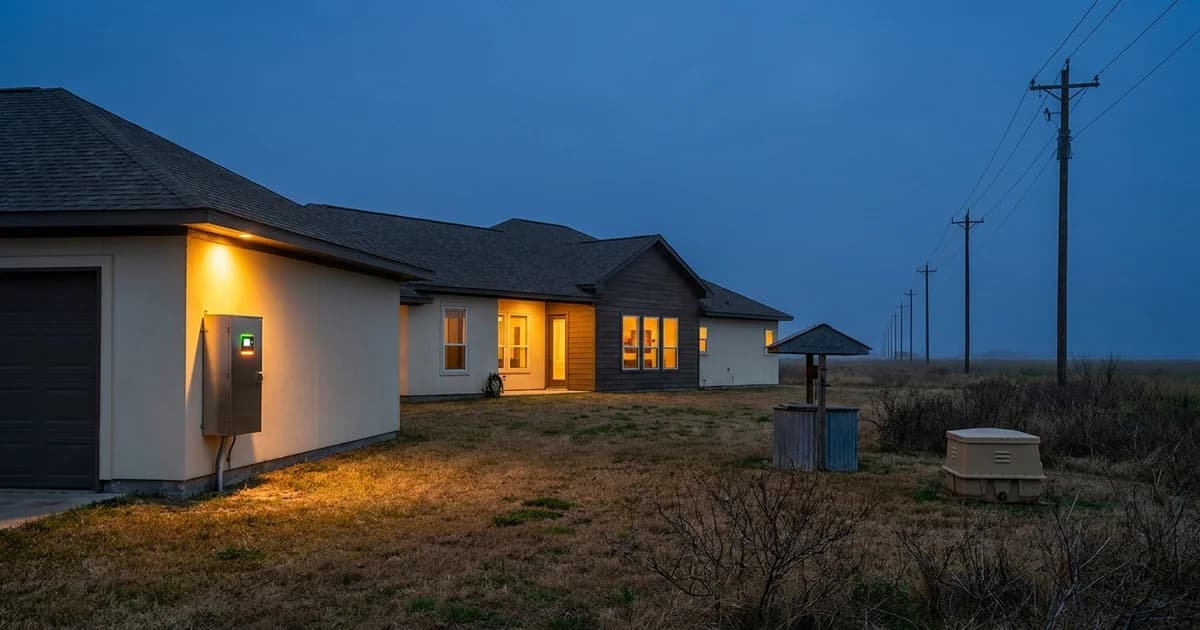
Angleton and West Columbia Battery Backup: Rural Brazoria County Restoration Times
Most backup power advice written for the Houston area assumes your lights come back because a CenterPoint crew is working your street. In Angleton and West Columbia, that assumption is wrong twice over. Your poles belong to a different utility, and your feeder is longer and thinner than anything in the suburbs.
That combination is the whole story out here. Restoration in inland Brazoria County gets measured in days, not because crews are slow, but because somebody has to drive it. Here is who actually owns your wires, why the wait runs long, and what to size a battery for on acreage.
Key Takeaways
- Angleton and West Columbia sit inside the Texas-New Mexico Power certified service area, not CenterPoint (TNMP Tariff for Retail Delivery Service, Chapter 2).
- Low-density distribution lines carry a fraction of the customers per mile that urban lines carry, and they are usually radial with no alternate feed (US Department of Energy, 2017).
- After Hurricane Beryl, TNMP still had about 30,000 customers out on July 12, 2024, and named Angleton among the areas waiting into the following week (ABC13, 2024).
- Nearly half of Brazoria County's 2,538 farms sit on 10 to 49 acres, where a private well and an aerobic septic system are the norm (USDA NASS, 2022).
- One Eos controller delivers 11.5 kW continuous and 17.1 kW surge, which is what lets a well pump and an AC compressor start together.
Who actually restores power in Angleton and West Columbia?
Texas-New Mexico Power, and it is worth getting right before you shop anything. TNMP's tariff on file with the Public Utility Commission of Texas describes its Southeast Texas certified service area as Brazoria, Galveston and Matagorda counties, and names Angleton, West Columbia, Brazoria, Sweeny, Old Ocean, Bailey's Prairie and Holiday Lakes among the municipalities served (TNMP, Chapter 2). These addresses are not CenterPoint, and they are not on an electric cooperative either.
Why does that matter? Two reasons, and neither one is academic.
First, restoration. In the deregulated ERCOT market your retail provider sells you kilowatt-hours and nothing else. The company that owns the pole, hangs the transformer and sends the bucket truck is the transmission and distribution utility. When the power is out in Angleton, calling the 800 number on your electricity plan accomplishes nothing. TNMP is the entity dispatching crews.
Second, interconnection. A battery that will ever push power back onto the grid gets reviewed by the wires company, and TNMP's process and paperwork are its own, separate from CenterPoint's. A backup-only system that stays behind a transfer point is a different conversation from an export-capable one. Your installer should tell you which one you're buying before the deposit, not after.
What we see in the field: homeowners around Angleton routinely tell us they're CenterPoint customers because a previous house in Pearland was. The delivery charges on the bill say otherwise. Check the utility name there before you accept anyone's restoration estimate.
Why do rural Brazoria County feeders take longer to come back?
Because of what a mile of line is worth in customers. The Department of Energy's distribution baseline puts customers per mile of line at about 34 for investor-owned utilities and roughly 48 for municipal systems, against about 7.4 for the cooperative systems that serve the country's most rural territory (US Department of Energy, 2017). Those national figures describe a gradient, and inland Brazoria County sits on the thin end of it even inside an investor-owned territory.
The same report spells out the design consequence. Low customer-density feeders are generally radial in layout and rarely have connections to other feeders, so there's no alternate path to switch you onto while a crew works. It also notes that accessible poles and overhead lines increase distribution outages from vehicle accidents, animal contact, and storm damage from falling limbs and flying debris.
Put those two together and you have the Angleton experience. Your service comes off one long overhead run, that run has fewer meters on it per crew hour than any street in Pearland, and there is nothing to switch you to while it gets rebuilt. Restoration is triaged by customers per repair. The sparse tap waits.
The national numbers show what a bad year costs. In 2024, US electricity customers averaged 11 hours of interruption, nearly twice the annual average of the previous decade, and major events including Hurricanes Beryl, Helene and Milton accounted for 80 percent of those hours (US Energy Information Administration, 2025). Averages hide the tail. Rural feeders live in the tail.
What did Hurricane Beryl actually do to this part of the county?
It proved the wind-versus-water split that defines inland Brazoria. The National Hurricane Center's report on Beryl records landfall near Matagorda, Texas at 0840 UTC on July 8, 2024 with 80-knot maximum winds, a category 1 at 978 millibars, and hurricane conditions across the Texas coastal plain from the landfall area northeastward (NOAA National Hurricane Center, 2024). Surge inundation of 5 to 7 feet above ground level stayed on the immediate coast, from Matagorda to Freeport.
Angleton and West Columbia sit well behind that surge line and squarely inside the wind field. No water in the house, every pole exposed.
The restoration record backs it up. On July 12, four days after landfall, TNMP reported roughly 30,000 customers still without power, and a company spokesperson named Angleton, along with Dickinson and Holiday Lakes, among the heavily treed areas that would wait until early the following week, with roads still covered in trees and debris (ABC13, 2024). Statewide, Beryl left 2.6 million customers dark in Texas (EIA, 2025).
Notice the mechanism in that quote. The delay wasn't a missing part. It was access. A crew can't reach a pole down a debris-covered county road, and you can't drive out to a hotel either.
What loads does an acreage home here carry that a suburban home doesn't?
Its own water and its own wastewater. Brazoria County counted 2,538 farms across 419,260 acres in the 2022 Census of Agriculture, at an average farm size of 165 acres, and 1,253 of those operations, right around half, sit on 10 to 49 acres (USDA National Agricultural Statistics Service, 2022). That size band is the small-acreage homestead, and it's the shape of the ground between Angleton, West Columbia and the county line.
Groundwater is the local supply. The Gulf Coast Aquifer underlies 56 Texas counties and is managed in this one by the Brazoria County Groundwater Conservation District (Texas Water Development Board). A domestic well is an electric pump. When the feeder drops, you have whatever the pressure tank is holding, and that's hours, not days.
Wastewater is stricter than most buyers expect. Aerobic treatment units in Texas fall under TCEQ rules at 30 TAC 285, require a maintenance contract with a licensed provider, and that provider has to file reports at least once every four months (TCEQ). The aerator is a small motor meant to run continuously. A week of silence is a treatment failure, not a delayed chore.
Both loads have their own deep dives: battery backup for a Houston-area well pump and keeping an aerobic septic aerator alive in an outage.
How do you size backup for an Angleton or West Columbia property?
Size the simultaneous motor starts first, then the hours. Two numbers do different jobs. Usable kilowatt-hours decide how long you last, and controller output in kilowatts decides what can run in the same second. On acreage, the second number is the one that trips people up.
| Load | Type | Why it matters here |
|---|---|---|
| Well pump | Motor, high inrush | No pump, no water, no flush |
| Aerobic septic aerator | Small motor, near continuous | TCEQ maintenance rules apply |
| AC compressor | Motor, high inrush | July restoration runs into the heat |
| Refrigeration and freezers | Cycling compressors | Deep freezers on acreage hold real value |
| Lights, Wi-Fi, medical devices | Electronic, low draw | Small load, always on |
Every Eos controller carries 11.5 kW continuous with 17.1 kW of surge headroom, which is the specification that lets a well pump kick on while the AC is already running. Capacity is where the tiers separate. The Plus plan pairs two battery modules with one controller for full-day coverage, and homes carrying a well plus an aerator plus summer cooling usually step up from there.
Our Alvin and Manvel guide covers the same load stack on the county's suburban northern edge, and the Lake Jackson and Clute guide covers the industrial south. Angleton and West Columbia differ from both in one respect that shows up on day three: the drive time to your pole.
Eos installs across the Houston metro, including Houston and nearby Pearland, and inland Brazoria County is a regular route.
Or call Eos at 833-989-3737 to talk through your setup with an installer.
Frequently asked questions
Is Angleton served by CenterPoint or TNMP?
TNMP. Texas-New Mexico Power's tariff on file with the Public Utility Commission of Texas lists Angleton, West Columbia, Brazoria and Sweeny inside its Southeast Texas certified service area, covering Brazoria, Galveston and Matagorda counties (TNMP, Chapter 2). Your retail electricity plan is a separate matter from who restores your line.
How long did Angleton stay dark after Hurricane Beryl?
Into the week after landfall. TNMP reported about 30,000 customers still out on July 12, 2024, four days after Beryl came ashore, and named Angleton among the tree-heavy areas expected to wait until early the following week (ABC13, 2024).
Can a battery run a well pump in West Columbia?
Yes, when the controller has surge headroom. A submersible pump draws a brief multiple of its running current at start. Eos controllers are rated at 11.5 kW continuous and 17.1 kW surge, which covers a typical residential pump starting alongside other motor loads. Exact sizing depends on pump horsepower and well depth.
Is West Columbia at risk from storm surge?
Not meaningfully. The National Hurricane Center measured Beryl's 5 to 7 foot surge along the immediate coast from Matagorda to Freeport, not inland (NOAA NHC, 2024). West Columbia, which briefly served as capital of the Republic of Texas in 1836 (Texas State Historical Association), sits far enough inland that wind and outage duration, not water, are the planning problem.
Why does rural restoration take longer than in Houston?
Fewer customers per mile of line, and no alternate feed. Federal analysis puts customers per mile at roughly 34 for investor-owned systems against about 7.4 in the most rural territory, and notes that low-density feeders are radial and rarely connected to other feeders (US Department of Energy, 2017). Crews restore the densest repairs first.
Angleton has been the Brazoria County seat since 1896 (Texas State Historical Association), and the country around it was farmed long before it was wired. The grid reached it last, and in a bad storm it comes back last. A battery is how you stop treating that as your problem.