Battery Backup for Houston Area Marinas and Boat Storage

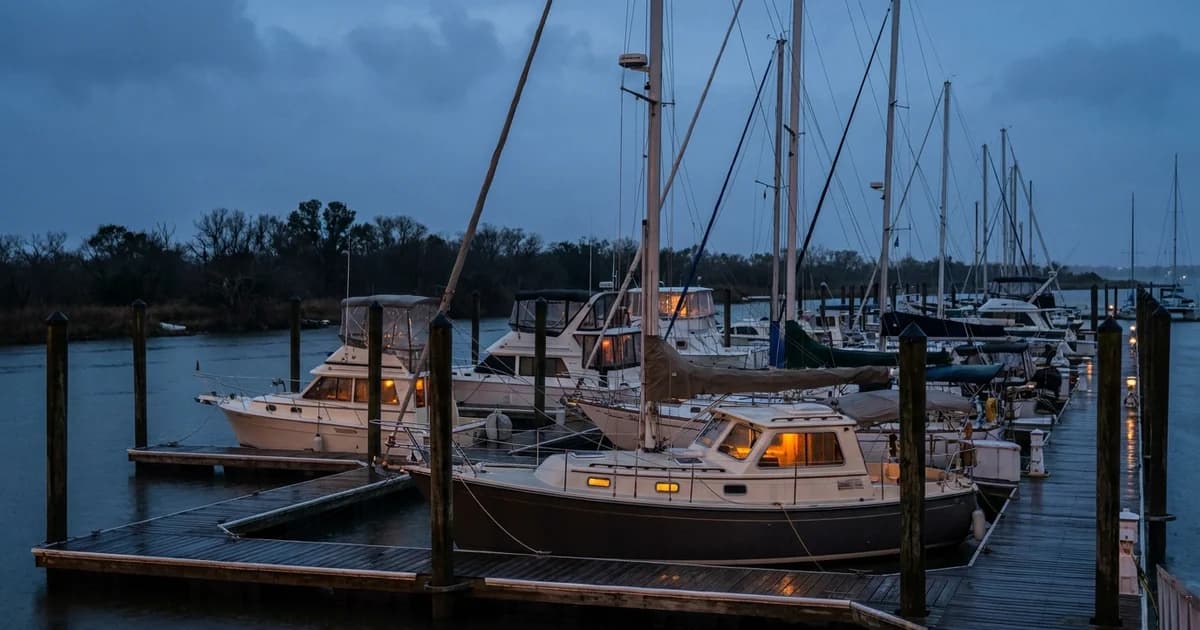
Most commercial backup arguments are about revenue. A marina is different. The weather that drops the feeder to your docks is the same weather filling the bilges on every boat tied to it. The outage and the emergency arrive in the same hour, from the same cause. So a marina backup plan is asset protection for property the operator does not own but must look after.
The marina below is a composite, built from typical Galveston Bay facility parameters and public storm records. It is not a client engagement, and no real facility, slip count, or owner is being described. The decision framework is the point.
Key Takeaways
- The outage and the threat to the asset arrive in one weather system, so backup power is asset protection.
- About 69 percent of boat sinking claims happen at the dock with nobody aboard (BoatUS claims files, via Soundings).
- Hurricane Ike damaged or destroyed close to 15,000 boats in September 2008, and Kemah's Watergate Yachting Center lost 430 of 1,147 slips (Trade Only Today, 2008).
- A pedestal field of shore power outlets is not a battery load. Gates, cameras, dock lighting, the office and one pumping circuit are.
- Salt air is a siting constraint, not a disqualifier: landside, above flood elevation, corrosion rated enclosure.
Why is a marina outage different from any other commercial outage?
Because most boats are lost while nobody is watching them. About 69 percent of boat sinking claims occur at the dock or mooring, and only 31 percent under way, per the BoatUS Marine Insurance claims files (Soundings, 2015). The dock is where the risk concentrates, and where power goes first.
Houston supplies the outages. In July 2024, Hurricane Beryl cut roughly 2.2 million CenterPoint customers at peak, more than a million were still dark days later, and National Weather Service heat indices ran 100 to 106 F through the restoration. Kemah Boardwalk businesses did not reopen until July 10 (Community Impact).
The longer record is harsher. In September 2008, Hurricane Ike damaged or destroyed close to 15,000 boats, and Watergate Yachting Center in Kemah lost 430 of its 1,147 slips, while enclosed Clear Lake marinas on floating docks fared comparatively well (Trade Only Today, 2008). One honest distinction: power loss rarely destroys a boat in a named storm. Surge and wind do that. It removes the tools for limiting damage and documenting it.
In 2024 the average US customer lost about 11 hours of service, nearly double the prior decade average, and Beryl, Helene and Milton drove 80 percent of it (EIA, 2025). Two routine hours is an annoyance. Nine storm hours is a week of unattended boats.
What does a dark marina lose, hour by hour?
Take a composite Clear Lake area facility: roughly 300 wet slips on floating docks, a covered dry stack building, a fuel dock, a travel lift and yard, a small office, and a card access gate.
At minute zero the pedestals and the office go dark. At minute five the gate has picked its failure mode: locked shut against tenants who want to check their lines, or drifting open on an unlit waterfront. By hour one the camera recorder is down, so nothing that happens next is on video. By hour three the fuel dock cannot dispense and the travel lift cannot pull a hull out, the two things an operator would do with warning.
By hour twelve the quiet failure has started. Every unattended boat is running its house bank down with no charger behind it while the rain keeps arriving, and nobody is aboard to notice. Our
covers the framework behind this.What actually stops working on a dark dock?
Four systems, in descending order of how badly they hurt.
Shore power, chargers, and the bilge pump chain
Follow the chain: shore power stops, the onboard charger stops, the house bank drains unwatched, the automatic bilge pump runs until the bank cannot turn it, and the water gains. Rain is a leading cause of dockside sinkings. Marine trade coverage of the BoatUS claims work puts weather accumulation at nearly a third of them, and underwater fittings at about half (The Log, 2025).
The uncomfortable part: a working bilge pump hides a leak rather than fixing it. A boat can float for months on a pump that is quietly keeping up, right until it fails. An outage ends that for every such boat at once.
Now the honest limit. A pedestal field of 30 A and 50 A outlets across several hundred slips is not a battery backup load, and any vendor implying otherwise is selling something. There is a code reason too. NEC 555.35 requires listed ground fault protection of equipment rated not more than 100 milliamperes on dock feeders and 30 milliamperes at shore power receptacles (NFPA 70), and NFPA 303 covers leakage testing before a vessel connects.
Those thresholds do not relax because the source is a battery. A soaked dock full of wet vessels is exactly what produces leakage and nuisance trips, so re-energizing dock circuits after a storm is an electrician's walk down the pier, not a one touch restart. Decide in advance which circuits you will try to bring back. From January 1, 2026, NEC 555.35(D) also requires a listed leakage current measurement device where more than three shore power receptacles are installed, which gives the dockmaster an instrument for that call.
Gates, cameras, and an unattended field of assets
A gate controller, a video recorder and a run of dock lighting draw almost nothing. They are also the whole difference between a secured waterfront and an open, unlit, undocumented one holding several hundred boats. That ratio of consequence to draw is more lopsided here than at any property type we work on. Same logic as
, harder assets.Dock lighting earns its place twice over. An unlit finger pier with a drop into black water is how people get hurt, and most recorded electric shock drowning deaths happened at marinas and docks (ESD Prevention Association).
The fuel dock
A marina fuel dock has the same electric dispenser dependency a road station does, plus a wrinkle: after a storm it may be the only fuel reachable by water for miles. Read
rather than a second version here.Lifts, hoists, and travel lifts
Boat lifts, davits and travel lifts are motor loads, defined by their starting behavior rather than their running draw. Ordinary NEMA Design B induction motors pull a brief inrush well above running current on every start. Surge headroom sizes any system that moves hulls.
Where can the equipment actually live in salt air?
Landside, raised, in a corrosion rated enclosure. A working waterfront sits in the most aggressive atmospheric class there is: ISO 12944-2 puts high salinity coastal areas in category C5, and the 2018 revision added CX for offshore exposure (ISO 12944-2).
Distance is the cheapest variable you control. Airborne chloride deposition and the corrosion rate that follows it fall off roughly exponentially within the first few hundred meters inland, so a modest landside setback measurably reduces the load (CORROSION, AMPP). Four rules we hold to:
- Mount on the landside building or in the equipment yard, never on a floating dock.
- Specify corrosion resistant outdoor protection, NEMA Type 4X as the reference class (NEMA 250) and salt fog qualification behind it (ASTM B117).
- Set the pad above the flood elevation every waterfront property has mapped at the FEMA Flood Map Service Center.
- Use stainless or coated hardware at every penetration, and put a rinse and inspection cadence on the calendar.
On Bay Area waterfront sites after Beryl, what our crews kept finding was not failed equipment. It was equipment mounted where nobody could reach it to inspect it. Salt air shortens the inspection interval. It does not make the install impossible, and pretending either extreme helps nobody. The homeowner version is in
.How much backup does a marina honestly need?
One controller delivers 11.5 kW continuous and 17.1 kW of surge, and each battery holds 9 kWh nominal with 8.76 kWh usable. That covers the card access gate, the camera recorder and network closet, the office and its point of sale system, dock and pier lighting, and one circuit reserved for critical pumping. The marina stays secure, lit, documented and reachable through a multi day outage, on the loads with the worst consequence and the smallest draw.
What it does not cover is the fuel dock plus the travel lift plus any share of the pedestal field, all at once. Lift motors break the arithmetic, because surge headroom sets the ceiling long before average draw does. A site that intends to fuel boats and haul hulls through a long outage needs multiple controllers, or a battery paired with a generator sized for the yard.
That pairing deserves a fair hearing. A generator is a reasonable partner for heavy, intermittent yard loads. What it is poor at is running a small gate controller silently for three days without refueling, which is the battery's job. So protect the low draw, high consequence core first, then decide separately, with your electrician and insurer, whether haul out capability justifies a second tier.
Frequently asked questions
What happens to boats in a marina during a power outage?
Shore power stops, so every onboard charger stops with it. Each unattended vessel starts draining its house bank while rain fills bilges. About 69 percent of sinking claims already happen at the dock with nobody aboard (Soundings, 2015), so that is the risky window.
Do bilge pumps work when marina power goes out?
Yes, until the boat's own battery runs down. The pump was always battery powered, and shore power kept it charged. Trade coverage of the BoatUS claims work notes a pump often masks a slow leak, so the pump quitting is when the problem shows.
Can a marina fuel dock pump fuel without electricity?
No. Marine dispensers depend on electric pumps and electronic controls the same way road station dispensers do, so the fuel dock stops the moment the grid does. Backing up dispensing is a separate, larger job.
Do marinas have backup generators?
Many have none. Those that do usually cover the office and part of the yard rather than the docks, because ground fault requirements on dock feeders under NEC 555.35 make blanket re-energization a poor idea after a storm.
How big a battery does a marina need?
One controller at 11.5 kW continuous and 17.1 kW surge covers the gate, cameras, office, dock lighting and one pumping circuit at a typical Galveston Bay facility. Fuel dispensing and travel lifts push it toward multiple controllers or a generator pair.
The plan and the storm are the same document
At a marina the storm and the outage are one event, so the backup plan and the asset protection plan are one document. Three things follow.
- The cheapest loads carry the highest stakes. A gate controller, a recorder and dock lights stand between a field of six figure assets and an open, unlit site.
- Some things are out of reach. A pedestal field is not a battery load, and ground fault thresholds make re-energizing wet circuits an electrician's decision.
- Salt air sets the siting, not the verdict. Landside, raised, corrosion rated, inspected.
Or call Eos at 833-989-3737 to talk through your setup with an installer.