Battery Backup for Houston Dry Cleaners: The Counter Cannot Go Dark

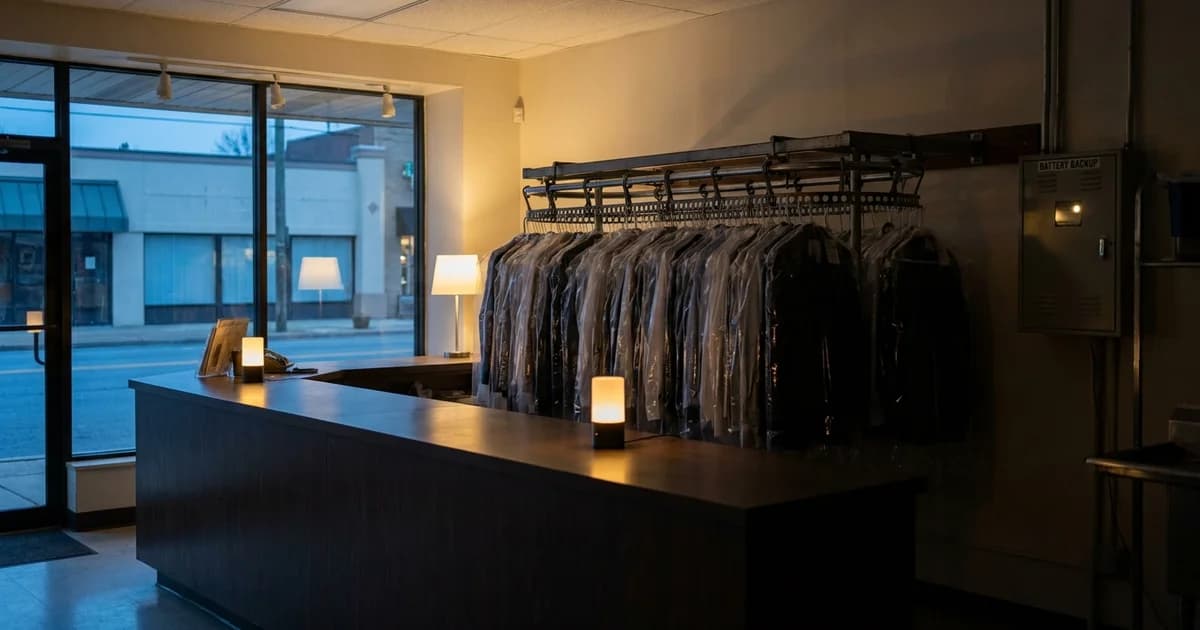
A customer walks in Monday morning for the suit he needs at two o'clock. The store is dark. His suit is twenty feet away, pressed and bagged, on a rail that will not turn, under a ticket number nobody can look up. He is not angry about the weather. He is angry that you are holding his clothes and cannot hand them back.
That is the outage problem specific to dry cleaning, and almost nobody plans for it. The store described here is a composite, built from public benchmarks, Texas regulatory records, and Houston outage data. It is not a real customer. The loads, the failure modes, and the sizing ranges are real.
Key Takeaways
- The boiler and the presses may burn natural gas, but ignition, controls, and safety circuits are electric, so gas equipment stops when the grid does.
- A dry cleaner holds customer property. Automated plants track each garment by barcode on an electric conveyor tied to order records (USPTO Patent 7,886,971, 2011), so when both go dark, staff cannot locate a finished order.
- U.S. customers averaged 11 hours without electricity in 2024, and major events accounted for 80% of those hours (U.S. Energy Information Administration, 2025).
- Hurricane Beryl knocked out roughly 2.2 million CenterPoint customers at peak, more than a million were still out days later, and NWS heat indices ran 100 to 106 F through the restoration.
- Honest sizing: one controller at 11.5 kW continuous and 17.1 kW surge covers the counter, tracking, conveyor, controls, lighting, and security. The full plant needs a multi-controller design or a generator.
Can a Houston dry cleaner stay open during a power outage?
Partially, and the part that matters most is the cheapest to protect. In 2024, U.S. electricity customers averaged 11 hours of interruptions, nearly nine of them from major events like Hurricane Beryl (U.S. Energy Information Administration, Today in Energy, 2025). A battery keeps the counter transacting, the tracking database live, the conveyor rotating, control circuits energized, and the lights and cameras on.
What one small system will not do is run the plant: the boiler at load plus every press and tumbler at once. So the priority order here is simple. Release the garments first. Take money second. Produce third.
The gas paradox: why the boiler stops even though it burns gas
Because gas is the fuel, not the switch. Modern gas-fired boilers and furnaces use electronic ignition instead of a standing pilot (ENERGY STAR, U.S. EPA and U.S. Department of Energy), and electronic ignition runs on electricity. You can have full pressure at the meter and a cold, silent boiler.
The dependency does not stop at ignition. Safety interlocks, the control board, feedwater and circulation pumps, and the blower all sit on the electrical side. A press with a gas-heated head still needs its controls, solenoids, and vacuum blower to do anything but sit there hot.
[UNIQUE INSIGHT] In post-Beryl assessments across Houston strip centers, owners with gas equipment were the most confident group we met and the most exposed. They had reasoned that a gas plant is an outage-proof plant. The gas is the easy part. The electricity is the gate.
The load nobody plans for: the conveyor and the garment tracking system
The automated conveyor and the barcode database are what turn a rail of finished clothes back into one customer's order, and both are electric. The mechanism is documented in the patent record, not just vendor brochures: a scanner reads the barcode on each order, the system matches it against stored order and customer records, and an electric storage conveyor rotates to bring that order to the retrieval position (USPTO Patent 7,886,971, Automated dry cleaning delivery system, granted 2011).
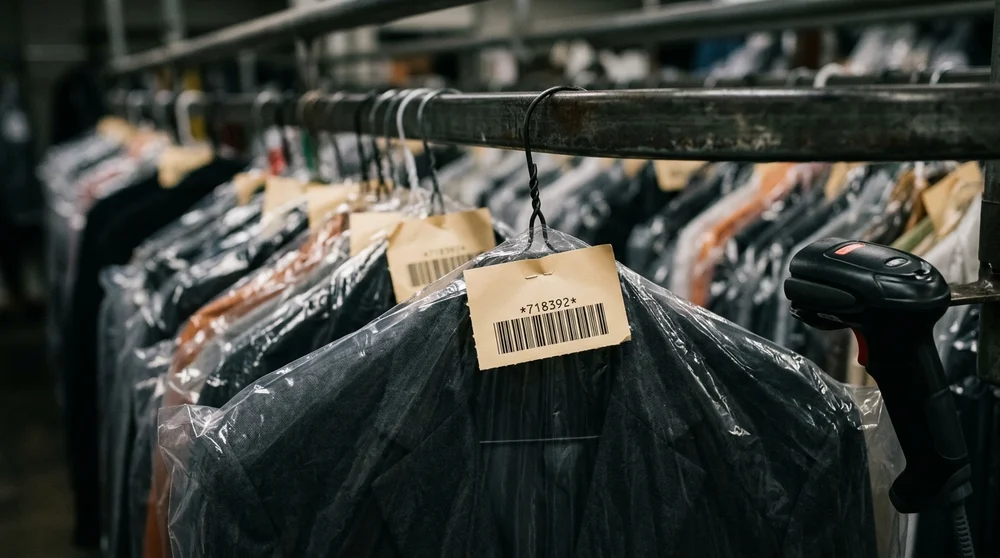
Kill the power and you break both halves at once. No rotation, no lookup. Staff hand-search hundreds of near-identical clear bags, in the dark, for a ticket number they cannot read off a screen. Ask any manager how long that takes with three customers waiting.
The conveyor is also a motor load, and it starts a fully loaded rail from a dead stop. Under NEMA MG 1, standard Design B induction motors are classified by locked-rotor current, which runs several times full-load current at the moment of starting. That is why surge headroom matters more here than continuous rating. A controller rated 17.1 kW surge against 11.5 kW continuous exists to absorb a start like that without dropping the register and the network switch with it.
[PERSONAL EXPERIENCE] The recurring question on our site surveys is which motors start free and which start under load. Owners almost always name the boiler first and the conveyor last. The conveyor is the one that ends the argument at the counter.
Custody: your customers' clothes are locked inside your store
This is what separates a dry cleaner from nearly every other retail outage. A restaurant that loses power loses today's sales. You are holding property that is not yours, some of it with a deadline: an interview suit, a funeral dress, a wedding gown, a uniform needed Monday.
Texas treats these as registered businesses. Every dry cleaning facility and drop station must register with the TCEQ under 30 Texas Administrative Code 337.10, renew by August 1 each year, and publicly display the certificate (TCEQ), under Texas Health and Safety Code Chapter 374. Those rules cover solvents, not power, but the storefront on that certificate is accountable for what is inside it.
Then there is the July problem. Garments still in process sit wet in a warm building, and a store without ventilation goes musty fast. Meanwhile the sentence your staff has to say is the most expensive one in the business: we cannot find your order.
One insurance note. Business interruption coverage generally responds to income lost from direct physical loss or damage covered by the policy (National Association of Insurance Commissioners). A grid outage with no damage to your suite is a different conversation, so ask your agent before you assume.
A composite Houston dry cleaner through the Beryl week
Picture a single-store cleaner in a Houston strip center: staffed counter, automated conveyor holding several hundred finished pieces, POS and card terminal, gas boiler, gas presses. Again, composite, not a real client.
Beryl made landfall on a Monday in July 2024 and knocked out roughly 2.2 million CenterPoint customers at peak (Houston Public Media, 2024), with more than a million still dark days later (Texas Tribune, 2024). Heat indices ran 100 to 106 F through the restoration (National Weather Service Houston). Statewide, EIA counted 2.6 million Texas customers out across all utilities (U.S. Energy Information Administration, 2025).
Inside the composite store, Friday's finished work is on the rail. Customers show up anyway, because a dark storefront still has their clothes in it. Staff cannot pull tickets. The gas meter is fine and the boiler will not light.
Now the counterfactual. With one controller live, the counter opens on a limited schedule, the conveyor turns, orders get released, cards get processed, and the cameras stay up. Production is paused for the week. The relationship is not.
How much battery does a Houston dry cleaner actually need?
Less than owners expect, because the right target is the front of the house. One controller rated 11.5 kW continuous with 17.1 kW surge is scoped to the point of sale and card terminal, the garment tracking system and its network hardware, the conveyor, boiler and press control circuits, lighting, and security. Capacity is added in 9 kWh nominal blocks, 8.76 kWh usable each, based on how many counter hours you want.
The limit deserves naming plainly. The boiler at load plus multiple presses and tumblers together is a multi-controller commercial design, and for a multi-day regional event the honest answer is a battery paired with a generator. Anyone promising whole-plant backup off one small system is selling you a disappointment.
The design work happens at the panel. An electrician separates the release-and-transact circuits from the production circuits, so the small system never sees the plant load. Pricing is quoted per address after a site survey. Our guide on
walks through that load-priority process.Battery or generator for a strip-center dry cleaner?
For a leased suite, a battery clears the three obstacles that kill most generator projects: no exterior slab or gas line your landlord must approve, no exhaust and noise clearance beside the next tenant, and no fuel run during a regional outage when the stations are dark too.
Switchover is the underrated part here. A generator's transfer gap reboots the POS and the tracking server, and a garment database that comes back mid-write is a worse problem than one that never went down. Battery switchover is instantaneous, so the lookup stays clean.
The honest counterpoint: if your goal is a boiler at load for days, a generator or a battery-and-generator pair is the right answer, and we will tell you so. The neighboring problem in
is genuinely different, unattended and heat-dominated, and worth reading if you run both formats. For the money side, see .Or call Eos at 833-989-3737 to talk through your setup with an installer.
Frequently asked questions
Can a dry cleaner stay open during a power outage?
Partially. Counter transactions, ticket lookup, the conveyor, lighting, and security run on a battery, so you can release finished orders and take payment. Full plant production cannot. In 2024, major events drove 80% of U.S. outage hours (EIA, 2025).
Why does my boiler stop if it runs on natural gas?
Because ignition and controls are electric. Modern gas-fired boilers use electronic ignition rather than a standing pilot (ENERGY STAR), and interlocks, the control board, and pumps all need power. Full gas pressure at the meter does not light the burner.
What happens to customers' clothes when the power goes out?
They stay in your store, and you lose the ability to find them. The conveyor will not rotate and the barcode lookup is offline, so staff hand-search a rail of identical bags (USPTO Patent 7,886,971, 2011). Deadline garments cost you the customer.
How big a battery does a dry cleaner need?
One controller at 11.5 kW continuous and 17.1 kW surge covers the front of house, with capacity added in 9 kWh nominal blocks, 8.76 kWh usable each, sized to the counter hours you want. The boiler at load plus multiple presses needs a multi-controller design or generator pairing.
Is a battery better than a generator for a leased dry cleaning suite?
For counter continuity, yes. No landlord slab, no gas line, no exhaust clearance, no fuel run mid-storm, and no transfer gap to reboot your tracking server. For sustained full-plant production, a generator or a battery-and-generator pair fits better.
The point is the handoff, not the plant
To restate it once: the store above is a composite, not a real business. The failure modes and the sizing ranges are real, and they repeat every storm season in Harris County.
Four things to carry out. The gas does not save you, because ignition and controls are electric. The conveyor and the database together are your release mechanism, and both die with the grid. Custody is your real exposure, not lost production hours. And one controller covers the front of the house honestly, while the plant is a bigger conversation.
The goal is not to run a dry cleaning plant through a hurricane. It is to make sure that when a customer walks up to your counter, you can hand back what is theirs.
General information for Houston dry cleaning operators, reflecting Eos specifications as of August 2026. The store described is a composite illustration, not a client, and no runtime or business outcome is promised. Confirm equipment loads, electrical code, and permitting with the appropriate professionals.