Battery Backup for Houston Families with Newborns and Young Children

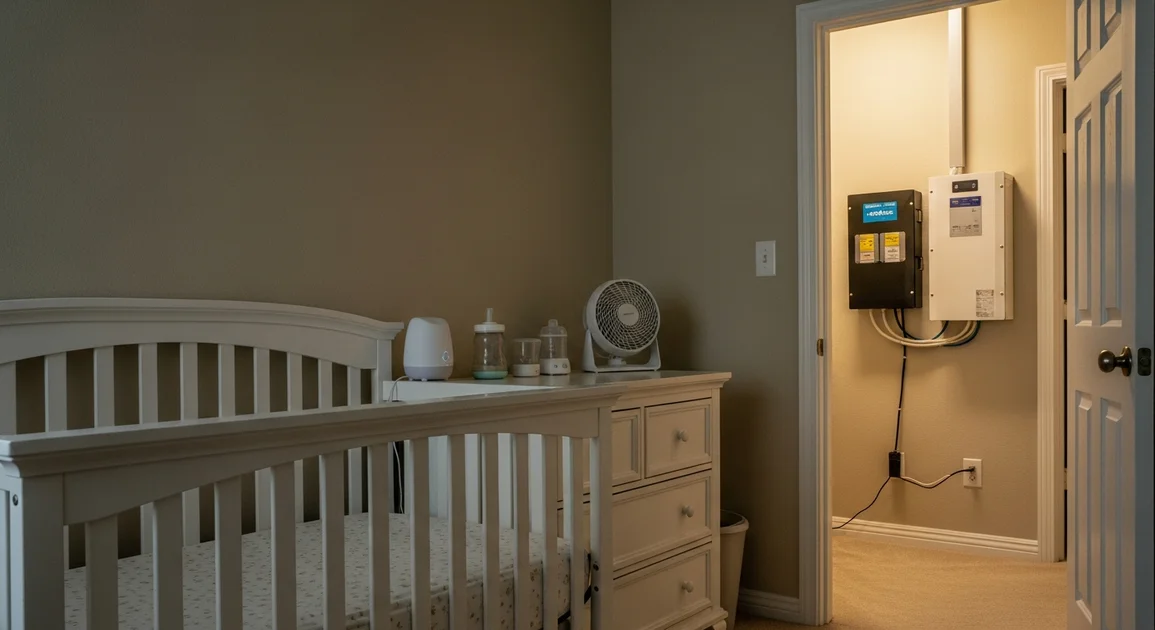
The American Academy of Pediatrics recommends a safe-sleep room temperature of 68 to 72F for infants, because newborns cannot regulate body heat the way adults can. In a Houston summer outage, an indoor temperature can climb past 80F within a few hours. Hurricane Beryl left 2.26 million CenterPoint customers without power, many for multiple days (CenterPoint Energy, 2024). This guide walks new and expecting parents through the right home battery backup setup to keep a Houston nursery safe.
[INTERNAL-LINK: get a Houston battery backup quote in under 2 minutes -> /home-backup-planner?source=blog&slug=battery-backup-families-newborns-houston]
Key Takeaways
- Newborns sleep safest at 68 to 72F, with risk rising above 78F and below 68F (AAP safe sleep guidance).
- Most newborn households need 18 to 27 kWh of home battery backup to cover one cooled nursery zone plus fridge and care devices.
- Fresh breast milk is safe 4 hours at room temperature, 4 days in the fridge, 6 months frozen (CDC, breastfeeding storage).
- Houston summer heat index routinely tops 100F, so indoor temps can rise 5 to 10F per hour without AC (NWS Houston climate data).
- If the nursery stays above 82F for more than four hours, leave for a cooling center or a relative's home.
General safety information, not medical advice. Coordinate any infant care plan with your pediatrician.
Why are newborns at higher risk during a Houston outage?
Newborns cannot regulate body temperature efficiently, and the American Academy of Pediatrics warns that infants are at higher risk of heat illness, dehydration, and feeding disruption during power outages. Their surface-area-to-mass ratio runs higher than adults, so they heat up and cool down faster, and their sweat response is not fully developed.
A Houston summer outage stacks three risks at once. Indoor heat climbs quickly without AC. Refrigerated breast milk and prepared formula lose their safety window. Bottle warmers, electric pumps, monitors, and sound machines all go dark.
[PERSONAL EXPERIENCE] On our post-Beryl service calls in 2024, the most common question from new parents was not about lights or wifi. It was whether a battery could keep the nursery cool and the milk cold until power came back. Heat plus a feeding-supply dependency is the combination that scares families with infants.
Winter brings the inverse risk. Newborns lose core heat fast in unheated rooms, and Uri 2021 produced several cold-related infant emergency visits in Texas (Texas DSHS, 2021 mortality report). Either extreme is dangerous when the baby is under 12 months.
[INTERNAL-LINK: full guide to keeping a Houston house cool during a power outage -> /blog/keep-house-cool-houston-power-outage]
What needs to keep running for a newborn?
A typical Houston newborn household runs five to seven care-related loads at once, and the total continuous draw before HVAC usually lands between 150W and 300W. Add a nursery AC zone, and the household budget jumps to 2 to 3 kW, based on appliance specs from Medela, Spectra, and the DOE Energy Saver database.
Nursery cooling zone
A single ductless mini-split sized for one nursery (9,000 to 12,000 BTU) pulls 600 to 900W continuous. A window unit pulls 700 to 1,200W. A central AC compressor zoned to the bedroom runs 3 to 5 kW. Cooling is the largest line item by a wide margin.
Feeding equipment
Electric bottle warmers draw about 70W during a warm cycle, only for a few minutes per feed. Electric breast pumps draw 25 to 35W (Medela, Spectra). Both run intermittently, so daily energy use is small.
Milk and formula storage
The fridge averages 80 to 150W continuous when cycling normally, which adds up to 2 to 4 kWh per day. This is the load you cannot let drop, because the cold chain protects breast milk and prepared formula.
Monitors, sound, and humidity
Baby monitors draw 3 to 8W. White noise machines draw 2 to 5W. Cool-mist humidifiers run 30 to 50W. Combined, this cluster is under 75W and easy to keep on indefinitely.
[CHART: bar chart titled "Power Draw for a Houston Newborn Household During an Outage (Watts continuous)" with data Nursery AC zone 2500W, Bottle warmer 70W, Breast pump 35W, Baby monitor 5W, Milk and formula fridge 80W, Sound machine 3W.]
What size home battery for a family with a newborn?
For a Houston household with a newborn, plan on 18 to 27 kWh of usable home battery backup, depending on whether you cool a single nursery zone or the whole home. A Tesla Powerwall 3 provides 13.5 kWh usable at 11.5 kW continuous, so most newborn-care setups end up at two or three units.
When 18 kWh (Plus) fits
The Plus tier (about 18 kWh) covers the fridge, lights, internet, monitor, pump and warmer cycles, plus a single mini-split or window AC for the nursery. Runtime is roughly 14 to 18 hours under that load. We've found this is the right choice when the nursery is the only zone that must stay cool and the rest of the family can tolerate warmer interior temperatures.
When 27 kWh (Pro) fits
The Pro tier (about 27 kWh) covers everything above plus the central AC compressor for the whole house. Runtime under whole-home cooling load runs 12 to 16 hours, longer if you cycle the thermostat. Choose this when the home is two stories, when there are older siblings whose rooms also need cooling, or when central AC is the only way to dehumidify the home efficiently.
| Load profile | Recommended capacity | Typical runtime |
|---|---|---|
| Fridge + monitor + lights + small loads | 9 kWh | 24 to 36 hours |
| Fridge + nursery mini-split | 18 kWh (Plus) | 14 to 18 hours |
| Whole home + central AC + nursery | 27 kWh (Pro) | 12 to 16 hours |
[UNIQUE INSIGHT] New parents almost always overestimate small electronics ("the monitor, the wipe warmer, the pump") and underestimate AC. In Houston summers, the AC is the safety device for an infant. Size the battery around the cooling load first, every other load is a rounding error.
[INTERNAL-LINK: see the Plus plan for nursery essentials -> /plans/plus]
[INTERNAL-LINK: see the Pro plan for whole-home plus AC -> /plans/pro]
[INTERNAL-LINK: deep dive on home battery sizing in Texas -> /blog/how-to-size-home-battery-texas]
How does Houston summer heat compound the risk?
NWS Houston climate data shows that summer heat index values frequently exceed 100F from June through September, with overnight lows often above 78F. Those numbers matter because indoor temperatures in a Houston home climb 5 to 10F per hour without AC during a July afternoon outage.
Indoor temperature rise without AC
A standard 2,000 sq ft Houston home with attic insulation at code minimum gains about 1 to 2F per hour during midday sun in July, faster in poorly insulated rooms. By hour six, the interior matches the outdoor temperature, often in the high 90s. A second-floor nursery heats fastest.
Infant heat illness thresholds
The CDC flags indoor temperatures above 80F as a heat-illness risk for infants, especially under 6 months. Signs of infant heat stress include flushed skin, rapid breathing, fewer wet diapers, and lethargy. These appear faster than in adults, sometimes within an hour of exposure.
Why fans alone are not enough
Fans move air but do not cool it. The AAP advises against pointing fans directly at infants under 1 year, both because of cooling-load imbalance and because fans alone cannot prevent heat illness above 90F. Active cooling, a mini-split or window AC powered by a home battery backup, is the only reliable solution during a Houston summer outage.
What about breast milk storage during an outage?
The CDC breastfeeding storage guidance allows fresh breast milk to sit at room temperature for 4 hours, refrigerated for 4 days, and frozen for 6 months. A standard closed fridge holds safe temperature about 4 hours without power, per USDA Food Safety guidelines.
Once the fridge crosses 4 hours without power, the safety window for milk starts to close. A freezer stocked with a few days of pumped milk loses that store first, because frozen milk thawed to fridge temperature must be used within 24 hours per CDC guidance. Formula has a tighter window: prepared formula is safe only 1 hour at room temperature and 24 hours refrigerated, per USDA and FDA infant formula guidance.
A home battery backup keeps the fridge and freezer cycling normally. That preserves multi-day milk stores intact, protects open formula bottles, and removes the panic decision of "do we toss the freezer." This is the single highest-value load in a newborn household after AC.
Citation capsule
Fresh breast milk is safe 4 hours at room temperature, 4 days in the fridge, and 6 months frozen (CDC, breastfeeding storage). A standard closed fridge holds safe temperature only 4 hours without power (USDA Food Safety). A home battery backup keeps the cold chain unbroken, which protects multi-day milk stores during a Houston outage.
[INTERNAL-LINK: how long food and milk last in the fridge without power -> /blog/how-long-does-food-last-in-fridge-without-power]
[INTERNAL-LINK: book a free Houston home assessment for a nursery -> /home-backup-planner?source=blog&slug=battery-backup-families-newborns-houston]
Or call our Houston team during business hours to plan a nursery-priority backup.
When should a family with a newborn evacuate vs stay?
Decide the trigger before the outage starts, not during it. The framework we use with new-parent households: if the nursery cannot stay below 82F and the outage projects past four hours, leave. Move to a cooling center, a relative's home, a hotel, or a hospital lobby if you have no other option.
Backup buys time to make a good decision. It does not replace one. Pack a go-bag with 24 hours of formula, bottled water, diapers, a thermometer, prescription medications, and the pediatrician's after-hours contact. Keep that bag accessible in under two minutes, because Houston outages can begin without warning.
FAQ
Can a home battery run a nursery AC overnight?
Yes. A single ductless mini-split at 800W continuous uses about 9 to 10 kWh over 12 hours. A 13.5 kWh Tesla Powerwall 3 covers one overnight cycle of nursery cooling plus the fridge and small loads. Most Houston newborn households install two units for safety margin during multi-day outages like Beryl.
Does a baby monitor need to stay on during a battery outage?
Yes, monitors should stay live, but they are a tiny load. Most wifi monitors draw 3 to 8W continuous, per manufacturer specs from Nanit and Owlet. Across 24 hours that is under 0.2 kWh, well within any home battery backup budget. The bigger concern is the wifi router, which also stays on with the same backup.
How long does breast milk last in a powered-down fridge?
A closed full fridge holds safe temperature about 4 hours without power, per USDA Food Safety guidance. After that, the CDC breast milk storage rules shift to the room-temp window. A home battery backup keeps the fridge cycling normally, which preserves the standard 4-day refrigerated milk window through multi-day outages.
What if my newborn is in the NICU at home with medical equipment?
Coordinate with your pediatrician and durable medical equipment provider. Many home apnea monitors, pulse oximeters, and feeding pumps draw under 50W continuous, easily covered by an 18 kWh system. Register the equipment with the CenterPoint Critical Care Residential Program for priority restoration tier and advance outage notifications.
Should I buy a portable power station instead?
For monitors and a single bottle warmer cycle, yes. For nursery AC, no. A 2 kWh portable runs a monitor and a single feed for a day or two, but a nursery mini-split drains a portable station in 2 to 3 hours. For an infant in a Houston summer, a fixed home battery backup is the only setup that buys real overnight runtime.
The bottom line
Newborns face two stacked risks during a Houston outage: heat stress and a broken milk-and-formula cold chain. A right-sized home battery backup, 18 kWh for a single nursery zone or 27 kWh for whole-home cooling, addresses both. Pair it with a pre-decided evacuation trigger at 82F or four hours, a packed go-bag, and your pediatrician's after-hours line. The technology buys time. The plan keeps your baby safe.
[INTERNAL-LINK: get your newborn-ready backup plan started today -> /home-backup-planner?source=blog&slug=battery-backup-families-newborns-houston]