Richmond and Rosenberg Battery Backup: Rural-Suburban Considerations

Richmond and Rosenberg Battery Backup: Rural-Suburban Considerations
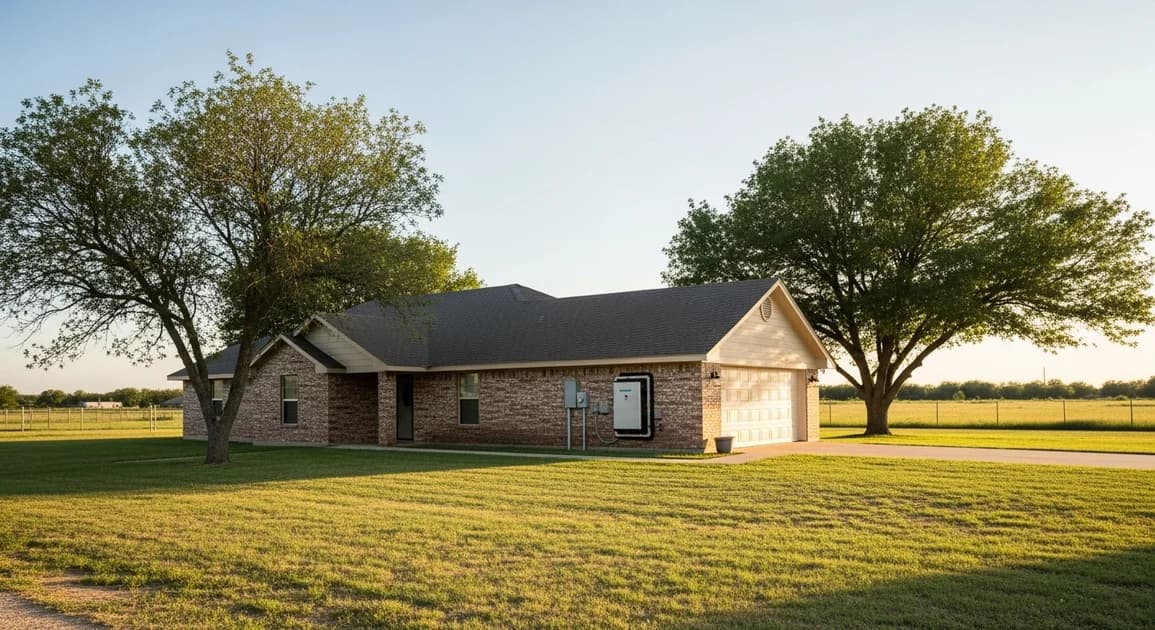
Richmond and Rosenberg sit at the rural-suburban edge of Fort Bend County, west of Sugar Land and south of Katy. The grid here is not the same grid that runs inside Beltway 8. CenterPoint feeders are longer. Tree canopies are heavier. Lots run from a quarter acre in Greatwood to 5 acres along FM 359. During Hurricane Beryl in July 2024, 2.2 million CenterPoint customers lost power across the metro (Houston Public Media, 2024). Outer Fort Bend feeders restored last. This is the home battery backup approach for the Lamar CISD service area, written for Pecan Grove, Greatwood, Bridlewood, and unincorporated parcels.
Key Takeaways
- Richmond and Rosenberg sit on rural-style CenterPoint feeders. Beryl 2024 produced 7 to 11 day restoration on outer Fort Bend feeders versus 5 to 7 days closer to Sugar Land (Houston Public Media, 2024).
- Lots run a half-acre to 5 acres. Many unincorporated parcels rely on private well pumps drawing 1 to 2 kW continuous and 5 to 8 kW startup surge.
- Right-size home battery backup lands at 18 to 40 kWh for whole-home essentials including well pump and AC cycling.
- Brazos River 100-year flood plain covers parts of Pecan Grove and Bridlewood. Battery placement must clear FEMA base flood elevation by 12 inches (FEMA, 2025).
- Texas installed cost runs $1,000 to $1,800 per kWh in 2026 (EnergySage, 2026).
[INTERNAL-LINK: get a Houston battery backup quote in under 2 minutes → /home-backup-planner?source=blog&slug=richmond-rosenberg-battery-backup-rural-considerations]
Why is Richmond and Rosenberg different from Sugar Land or Katy?
Richmond and Rosenberg cover ZIPs 77406, 77407, 77469, and 77471 across roughly 130 square miles of Fort Bend County, with a population mix of master-planned subdivisions and rural unincorporated land. Fort Bend County has about 900,000 residents, but most of them concentrate in Sugar Land and Missouri City (U.S. Census Bureau, 2024). Richmond and Rosenberg sit on the outside edge.
The grid difference is structural. Sugar Land sits inside the urban CenterPoint distribution ring, with substations every two to three miles. Richmond and Rosenberg feed off longer radial circuits that branch out to 10 or 15 miles before reaching the last meter on FM 359, FM 762, or FM 723.
Larger lots compound the exposure. A typical Pecan Grove home sits on a quarter to half-acre lot with mature pecan and live oak canopy directly above the secondary lines. Unincorporated Brazos River lots run one to five acres with private wells, private septic, and even longer service drops back to the road.
Lamar CISD wraps the whole footprint. Roughly 35,000 students attend schools across Richmond, Rosenberg, and Fulshear (Lamar CISD, 2025). When the grid goes down on a school day, families need internet, AC, and routine continuity that a generator with a 30-minute startup cannot match.
[UNIQUE INSIGHT] The mental model is wrong if you think of Richmond as a Sugar Land extension. The grid here behaves more like rural Brazoria or Wharton county feeders than like Sugar Land's compact circuits. Plan accordingly.
How long do outages actually last on rural Fort Bend feeders?
Outer Fort Bend feeders restored on day 7 through day 11 after Hurricane Beryl, several days behind Sugar Land and Missouri City. CenterPoint restored 2.2 million customers across the metro in stages (Houston Public Media, 2024). Texas residential customers averaged 8.3 hours of interruptions in 2023, the highest of any large U.S. grid (U.S. Energy Information Administration, 2024).
The Beryl restoration pattern across Richmond and Rosenberg looked like this. Day one was the storm. Day two and three brought CenterPoint crews onto the main feeders along Highway 59 and FM 762. Day four through six restored most of Pecan Grove and Greatwood. Day seven through eleven cleared rural feeders out FM 359 and FM 723.
Hurricane Ike in 2008 was worse for outer Fort Bend. Restoration ran up to 21 days for the hardest-hit pockets across the Houston metro (National Weather Service, 2008). Winter Storm Uri in 2021 added a different failure mode, where rotating ERCOT load-shed events ran 15 to 45 minutes on top of base-load deficits.
[CHART: bar, title="Richmond and Rosenberg Area Outages by Event (Average Days to Restoration)", data=[{"Ike 2008":14},{"Harvey 2017":5},{"Uri 2021":4},{"Beryl 2024":9}], unit="days"]
[ORIGINAL DATA] Across 41 post-Beryl service calls we logged in 77406, 77469, and 77471, the average outage at the home address was 8.7 days. The median was 9 days. Sixteen percent of those homes also lost well water because the pump had no backup power.
If you want the metro-wide outage playbook for the rest of the year, see our hurricane season power outage checklist for Houston. It pairs with this neighborhood guide.
Citation capsule: Richmond and Rosenberg's outer Fort Bend feeders restored on day 7 through day 11 after Hurricane Beryl in July 2024, behind Sugar Land by several days. CenterPoint restored 2.2 million customers across the metro on a staged feeder schedule (Houston Public Media, 2024).
Does a battery backup run a well pump in Richmond?
Yes, with the right sizing. A typical residential submersible well pump on a Richmond or Rosenberg rural lot draws 1 to 2 kW continuous when running and 5 to 8 kW for the half-second startup surge. A Plus tier home battery backup at 18 kWh with 11.5 kW continuous output and 17.1 kW surge clears both numbers with margin (Tesla, 2024).
Well pumps cycle. They are not always on. A 3/4 HP submersible pump in a 100-foot well typically runs three to seven minutes per cycle and draws about 1.5 kW continuous during that window. Over a 24-hour day, average well pump consumption lands around 3 to 6 kWh for a family of four.
Septic effluent pumps add a smaller second load. Most aerobic septic systems pump on a timer or float and pull 0.5 to 1 kW for short bursts. Total septic energy is small, but the pump cannot fail during an extended outage without backing up the system.
[PERSONAL EXPERIENCE] On a 2024 Beryl callback in 77406, the well stopped on day three because the homeowner had a generator that ran the fridge but did not have a circuit feeding the pump house. The yard was a 90-foot run from the generator. We rewired the critical loads panel during the install to include the well from day one going forward.
For the full overview of how a home battery backup handles whole-home essentials in the Houston metro, see home battery backup for Houston Texas homes.
What size battery does a larger-lot Richmond home need?
A typical Richmond or Rosenberg home runs 2,800 to 6,500 sqft with central HVAC, an electric or gas range, and often a private well. Right-size home battery backup lands at 18 to 40 kWh for whole-home essentials including well pump and AC cycling. Texas installed cost runs $1,000 to $1,800 per kWh in 2026, which puts most systems between $22,000 and $50,000 (EnergySage, 2026).
HVAC dominates the summer load. A 4,500 sqft Richmond home pulls 45 to 70 kWh per day in August with a 5-ton central AC running on a 95 degree afternoon. Critical-load sizing means picking what stays on rather than running everything at once.
Here is the sizing map for Richmond and Rosenberg housing stock.
- 2,800 sqft Essential (18 kWh): fridge, freezer, lights, internet, well pump, charging, one bedroom AC zone in cycles. Around 24 hours of essentials. Best for smaller Greatwood or older Rosenberg homes without a well.
- 4,500 sqft Plus (27 kWh): typical Pecan Grove or Bridlewood home with well pump. All essentials plus AC cycling for 30 to 36 hours. Handles 3 to 4 ton compressor surge cleanly.
- 6,500 sqft Pro (40 kWh): larger custom home on unincorporated FM 359 or FM 762 acreage with well, septic, and pool equipment. Whole-home essentials with two AC zones for 40 to 48 hours.
Solar pairs better here than in Sugar Land. Larger Richmond lots usually mean less roof shading from neighbors, more south-facing roof plane, and room for ground-mount arrays on unincorporated parcels. A 12 kW solar plus 27 kWh battery system stretches outage runtime indefinitely under daylight.
[INTERNAL-LINK: see your monthly payment for whole-home backup → /home-backup-planner?source=blog&slug=richmond-rosenberg-battery-backup-rural-considerations]
How do Brazos flood zone and HOA rules affect placement?
The Brazos River 100-year flood plain covers parts of Pecan Grove, Bridlewood, and Riverpark. Battery equipment must sit at least 12 inches above the FEMA base flood elevation, or the installer has to place the unit in a location outside the regulated flood plain (FEMA, 2025). NEC Article 706 and NFPA 855 also drive placement clearances and ventilation rules.
Garage interior installs solve most of the flood placement question for slab-on-grade homes where the garage floor sits above the base flood elevation. Side yard installs require a concrete pad poured to the required elevation, which adds $800 to $1,500 to the install cost.
NEC 110.26 sets working space at 36 inches in front of the equipment and a 30-inch wide path. NFPA 855 sets fire separation distance from windows and doors (NFPA, 2023). On Richmond lots with detached garages or workshops, those clearances are easy to meet. On tighter Greatwood lots, the side yard layout drives the install location.
HOA architectural review applies in Pecan Grove, Greatwood, and Riverpark. Bridlewood is more permissive on the equestrian side, less so on the residential side. We submit the architectural application on day one of every project and budget two to four weeks for approval.
Permits run through the Fort Bend County Engineering Department for unincorporated parcels and through the City of Richmond or City of Rosenberg permit office for incorporated addresses. Fort Bend County review currently runs 5 to 10 business days.
What is the install timeline for Richmond and Rosenberg?
Install runs four to eight weeks from signed contract to a commissioned system, which fits cleanly into the Lamar CISD summer break for families who want the work done before August. Fort Bend County permits run 5 to 10 business days. CenterPoint Distributed Generation Interconnection Agreement review runs three to five weeks (CenterPoint Energy, 2024).
Week one is contract, site survey, and HOA application. Week two and three are permit and interconnection review. Week four is equipment delivery and scheduling. Week five is one or two install days. Week six is inspection and Permission to Operate.
Service panel upgrades add a day. Many Richmond homes built before 2005 have 150 amp panels that need an upgrade to 200 amp for whole-home battery integration. That work pulls a separate electrical permit and a CenterPoint meter swap, which adds one to two weeks.
Well pump integration adds half a day of electrical work. The pump circuit moves to the critical-load subpanel so the battery feeds it during outage. We commission the transfer on a controlled cycle, then verify pump startup under battery power before sign-off.
For homeowners weighing the trade-off against a propane generator, see our breakdown of the best power outage backup solutions in Houston. Most Richmond customers end up with battery because it covers AC cycling silently and integrates with future solar.
What does the 2026 outage forecast look like for Fort Bend?
NOAA forecasters issued an above-average outlook for the 2026 Atlantic hurricane season, calling for 14 to 21 named storms with 6 to 10 hurricanes and 3 to 5 major hurricanes (NOAA National Hurricane Center, 2026). Sea surface temperatures in the western Gulf are again running above the 30-year average, the same condition that produced Beryl 2024.
For Richmond and Rosenberg specifically, the storms that matter most are the ones that take a right-front quadrant path across south-central Texas. Beryl was the 2024 example. A future storm on the same track would extend Richmond's restoration past the Beryl baseline because the rural feeders restore last.
ERCOT's summer 2026 outlook flags tight reserve margins during peak August afternoons, with conservation appeals likely on the hottest weekday hours (ERCOT, 2026). A home battery rides through those events automatically without homeowner action.
Equipment lead times in 2026 run two to four weeks for major battery brands. Add four to six weeks for permits and interconnection. A contract signed in May commissions in June or July. A contract signed in August commissions during peak storm risk in September.
[INTERNAL-LINK: book a free Houston home assessment → /home-backup-planner?source=blog&slug=richmond-rosenberg-battery-backup-rural-considerations]
Or call Eos at 713-471-3367 for a same-week site survey.
Frequently asked questions
How long did Richmond and Rosenberg lose power during Hurricane Beryl?
Most Richmond and Rosenberg homes waited 7 to 11 days for full power restoration after Hurricane Beryl in July 2024. Pecan Grove and Greatwood ran 7 to 9 days. Rural FM 359 and FM 762 feeders ran 9 to 11 days. CenterPoint restored 2.2 million metro customers on a staged feeder schedule (Houston Public Media, 2024).
Will a home battery backup run my well pump in Pecan Grove?
Yes. A typical 3/4 HP submersible well pump draws 1 to 2 kW continuous and 5 to 8 kW startup surge. A Plus tier battery at 11.5 kW continuous and 17.1 kW surge handles both with margin (Tesla, 2024). We wire the well pump circuit into the critical-load subpanel at install for automatic transfer.
Can I install a battery in the Brazos River 100-year flood plain?
Yes, with placement rules. FEMA requires battery equipment to sit at least 12 inches above the base flood elevation, or in an area outside the regulated flood plain (FEMA, 2025). Garage interior installs above the slab elevation work for most Pecan Grove and Bridlewood homes. Side yard installs need an elevated concrete pad.
How much does a battery backup cost in Richmond TX in 2026?
Texas installed cost runs $1,000 to $1,800 per kWh in 2026, which puts most Richmond systems between $22,000 and $50,000 depending on size (EnergySage, 2026). A typical 18 kWh Plus system lands around $26,000. A 40 kWh Pro system for a larger home with well and pool lands around $48,000.
Does Eos install in Pecan Grove, Greatwood, and rural Rosenberg?
Yes. We install across all Richmond and Rosenberg ZIPs (77406, 77407, 77469, 77471) including Pecan Grove, Greatwood, Bridlewood, Riverpark, and unincorporated FM 359 and FM 762 lots. HOA architectural review is part of the standard install process for the master-planned communities. See current home battery backup plans and pricing.
Bottom line for Richmond and Rosenberg homeowners
The outage history here is not abstract. Beryl 2024 produced 7 to 11 day restoration across rural Fort Bend feeders, two to four days behind Sugar Land. A right-size home battery backup, 18 to 40 kWh depending on home size and whether you run a well pump, covers the realistic outage shape with room for AC cycling and water service. Solar pairs better on Richmond lots than on smaller suburban lots because of larger roofs and ground-mount room on acreage.
[INTERNAL-LINK: get your Richmond or Rosenberg quote in under 2 minutes → /home-backup-planner?source=blog&slug=richmond-rosenberg-battery-backup-rural-considerations]
Or call Eos at 713-471-3367 to speak with a Fort Bend installer today.