Nissan Leaf V2H: Does It Work for Home Backup in Texas?

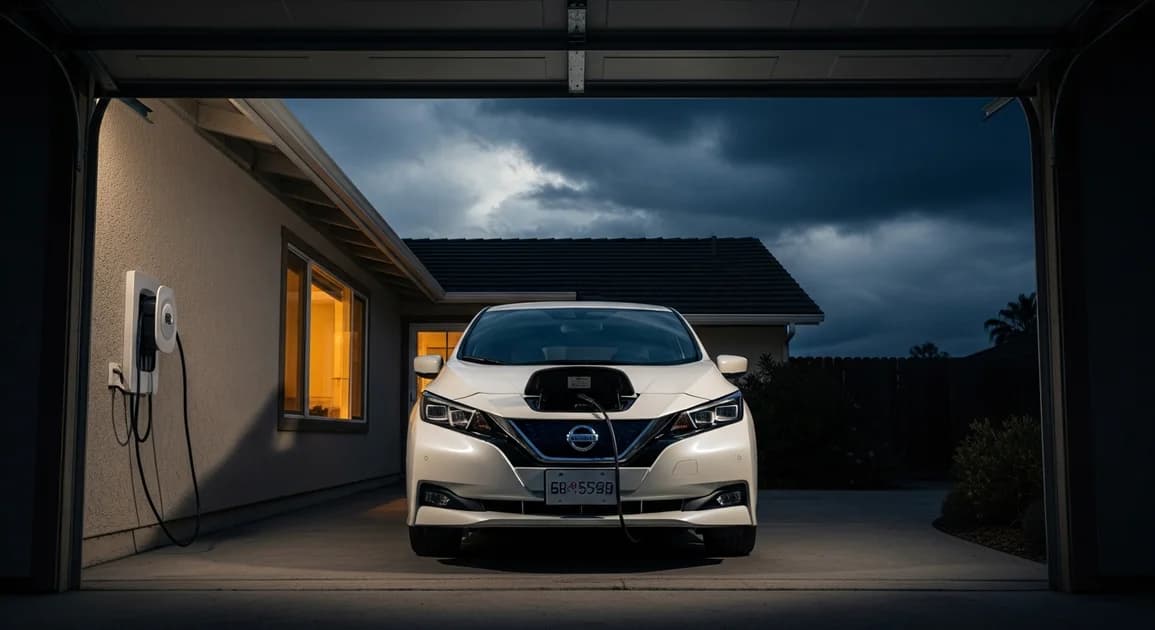
Texas averaged 1.956 power interruptions per customer in 2022, one of the worst outage rates in the country (PUCT / txses.org, 2022). For Nissan Leaf owners, the appeal of a car that doubles as a home backup system is obvious. You've already paid for 40 or 62 kWh of battery storage sitting in your driveway. Why not use it?
The problem: millions of Leaf owners have a V2H-capable port and can't figure out why it doesn't work in practice. The technology is real. The US residential equipment to use it simply doesn't exist yet.
This article covers what the Leaf can and can't do for home backup, what equipment actually works, what it all costs in Texas, and whether any of it makes sense for you right now.
Key Takeaways
- The Nissan Leaf Gen 2 (2018-2025) supports V2H via its CHAdeMO port. Gen 1 (2011-2017) has CHAdeMO but is not bidirectional for V2H. Usable storage: 39 kWh (40 kWh pack) or 59 kWh (62 kWh e+).
- No residential CHAdeMO V2H inverter is sold in the US as of 2025. The only Nissan-approved unit (Fermata FE-20) requires 3-phase commercial power and is not available to homeowners.
- CHAdeMO-to-CCS adapters (~$999, A2Z brand) enable CCS fast charging only. They cannot send power back to a home. (InsideEVs, 2024)
- For most Texas homeowners who need backup power today, a dedicated home battery is the practical alternative.
What Is Nissan Leaf V2H, and How Does It Work?
The 2nd generation Nissan Leaf (2018-2025) supports Vehicle-to-Home through its CHAdeMO DC charging port. A bidirectional inverter sits between the car and the home's electrical panel, converting the battery's DC power to the AC your home uses. The Leaf typically delivers 4-6 kW of continuous AC output in real-world conditions, enough to run refrigerators, fans, lights, and most medical devices.
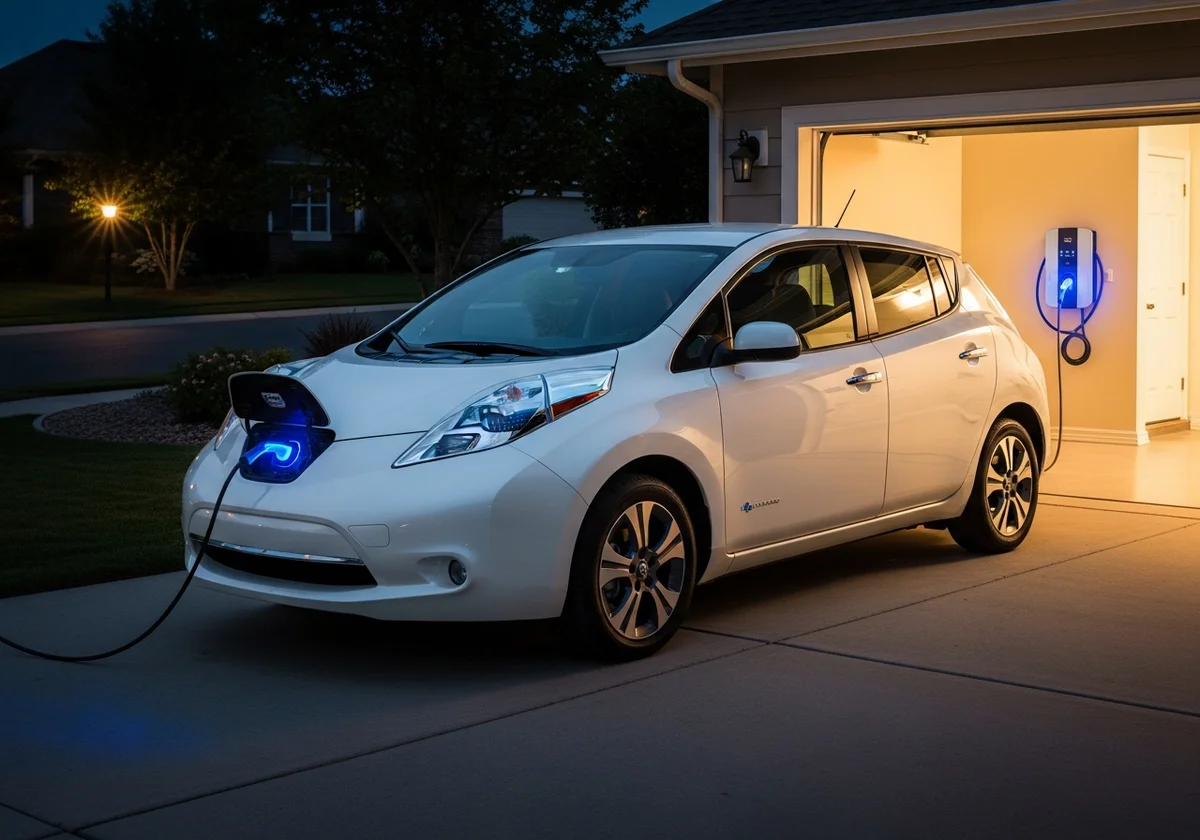
One clarification that trips up a lot of owners: V2H support applies to Gen 2 only (2018-2025). The Gen 1 Leaf (2011-2017) also has a CHAdeMO port, but it is not configured for bidirectional V2H discharge. If you own a 2017 or earlier model, V2H is not available on your vehicle regardless of inverter.
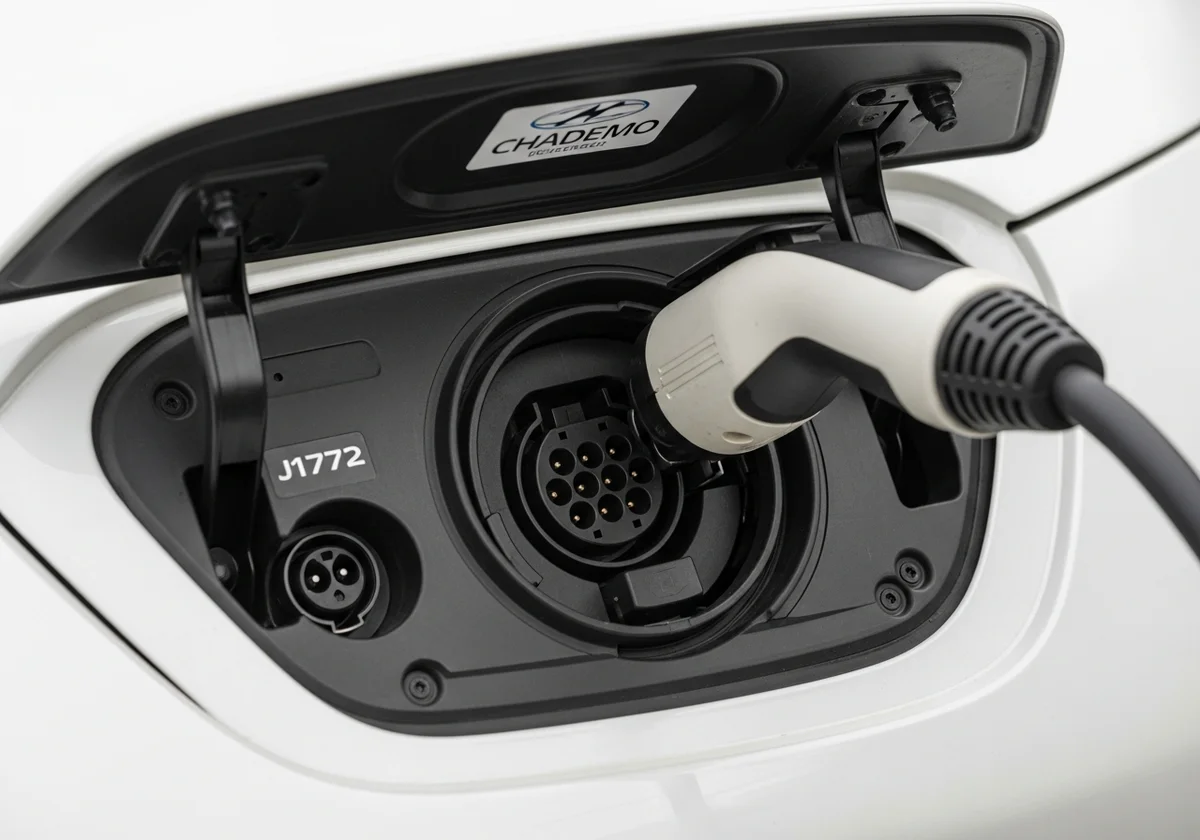
The key detail many owners miss: it's the CHAdeMO port that supports V2H, not the standard J1772 AC inlet. CHAdeMO is the larger, rounder port on the car's nose. The smaller J1772 connector handles normal Level 2 charging only. Power cannot flow in reverse through it.
The inverter is the missing piece. It connects the CHAdeMO port to your electrical panel, handles the DC-to-AC conversion, and manages automatic transfer when the grid fails. Japan has had commercial residential V2H units available since 2012, through a Nissan and Nichicon partnership (Green Car Congress, 2012). The US never got a matching residential product.
Battery specs matter here. The standard Leaf holds approximately 39 kWh of usable energy, while the Leaf e+ (62 kWh) holds around 59 kWh usable, according to Recurrent Auto (2024) fleet data.
Citation capsule: The Nissan Leaf Gen 2 (2018-2025) uses CHAdeMO bidirectional charging to support Vehicle-to-Home power transfer. Its standard 40 kWh pack holds approximately 39 kWh of usable energy, while the Leaf e+ (62 kWh) holds around 59 kWh usable, according to Recurrent Auto's 2024 fleet data. Real-world V2H output is typically 4-6 kW continuous. Nissan pioneered residential V2H in Japan in 2012 with the Nichicon EV Power Station (Green Car Congress, 2012).
How Long Can a Nissan Leaf Power a Texas Home?
Texas homes consume an average of 1,096 kWh per month, which works out to about 36.5 kWh per day, according to the U.S. Energy Information Administration (EIA, 2024). At that rate, a fully charged 40 kWh Leaf provides roughly 21 hours of whole-home power. Limit yourself to essential loads only (refrigerator, fans, lights, phone charging: about 12 kWh per day) and that stretches to 2-3 days.
Here's the math, laid out clearly. A 40 kWh Leaf with a 20% safety buffer leaves you 32 kWh of usable energy: 32 divided by 36.5 kWh per day equals about 0.88 days, or 21 hours. The 62 kWh Leaf e+ gives you 59 kWh usable, which covers 1.6 days (roughly 38-41 hours) at average Texas load.
Essential loads paint a better picture. Applying the same 20% buffer: the 40 kWh Leaf yields 32 kWh usable, which at 12 kWh per day lasts about 2.7 days (65 hours). The 62 kWh e+ yields roughly 50 kWh usable, stretching to about 4.1 days. Those numbers are real, but they assume your battery is full, your loads stay low, and you keep the car parked and plugged in the entire time.
Summer complicates things. Texas homes can hit 1,400+ kWh per month during peak cooling months, about 46 kWh per day (EIA, 2024). At that rate, a 40 kWh Leaf drops to about 16 hours of runtime. The 62 kWh e+ manages about 31 hours.
One more wrinkle: Nissan's "4 days" marketing figure is based on Japanese homes averaging roughly 10 kWh per day. Texas isn't Japan. Don't plan around that number.
Battery age matters too. Recurrent Auto (2024) data shows Leaf packs can lose 10-20% of capacity in hot climates over 5-7 years. An older Leaf with a degraded pack has meaningfully less runtime than a new one.
Citation capsule: Based on EIA 2024 data showing Texas homes average 36.5 kWh of electricity per day, a fully charged 40 kWh Nissan Leaf can theoretically power a Texas home for approximately 21 hours at full load, or about 2-3 days on essential circuits only. The 62 kWh Leaf e+ extends those figures to roughly 39 hours and 4 days respectively.
The CHAdeMO Adapter Question: Does It Enable V2H?
No. The A2Z CHAdeMO-to-CCS1 adapter, priced at roughly $999, lets a Nissan Leaf charge at CCS fast-charging stations. That's the entire extent of what it does. The adapter is one-directional. It cannot send power from the Leaf's battery back to a home, and no adapter currently on the market can.
Here's why that matters. The adapter lets electricity flow from a CCS charging station into the car. The physical and protocol connection only carries power in one direction. The CHAdeMO V2H communication handshake, which tells a home inverter that the car is ready to supply power, never reaches anything on the other side. The adapter simply doesn't carry that signal.
InsideEVs (2024) confirmed this in their unboxing and testing of the A2Z unit. Recharged's 2025 CHAdeMO adapter guide states explicitly that the adapter "does not address V2H or V2G." This isn't a firmware limitation that a software update could fix. It's a fundamental protocol gap.
There's also widespread confusion about the Wallbox Quasar. The original Wallbox Quasar (Gen 1) used CHAdeMO and could have worked with the Leaf for V2H. It's discontinued and no longer sold. The Wallbox Quasar 2, the version currently in production and priced at $6,440, uses CCS1 only. It does not support the Leaf's CHAdeMO port at all. Many forum posts from 2022-2023 conflate these two products.
Our finding: This CHAdeMO adapter question is the single most-searched topic on Nissan Leaf ownership forums, and the answer is poorly documented online. Most threads from 2022 and 2023 are speculative: people wondering whether an adapter might eventually enable V2H, not reporting confirmed hardware. As of early 2026, no adapter exists anywhere in the market that enables Leaf V2H. That hasn't changed.
Citation capsule: CHAdeMO-to-CCS1 adapters, such as the A2Z model priced at approximately $999, allow Nissan Leaf owners to charge at CCS fast-charging stations. They do not enable Vehicle-to-Home or Vehicle-to-Grid functionality. The adapter's communication protocol is one-directional, and no bidirectional V2H signaling can pass through it. (InsideEVs, 2024)
What V2H Equipment Actually Works with the Nissan Leaf?
In 2025, one piece of V2H equipment carries Nissan's formal approval for the US market: the Fermata Energy FE-20. It works. It won't void your warranty. It also requires 3-phase commercial power and is not sold to residential homeowners. For the average Texas homeowner, no purchasable residential path exists in 2025.
Here's the full equipment landscape:
Fermata Energy FE-20 (Nissan-approved, US)
Nissan officially approved the FE-20 in August 2024 (Green Car Reports, 2024). At 20 kW bidirectional, it's a powerful unit, and it's the only US charger confirmed not to void Nissan's 8-year/100,000-mile battery warranty. The catch: it requires 3-phase commercial electrical service. Standard homes run on single-phase 240V. Three-phase power is found in commercial buildings, not residential properties. The FE-20 is commercial-only.
An earlier Fermata pilot (the FE-15) at Nissan's US headquarters saved approximately $9,450 in electricity costs over four years, roughly $2,000-plus per year (Fermata Energy, 2022). That's compelling for a fleet operator. It's not accessible to a homeowner.
Original Wallbox Quasar (CHAdeMO, discontinued)
The first-generation Quasar used CHAdeMO at 7.4 kW on single-phase power. It would have worked with the Leaf for residential V2H. It's discontinued and no longer sold. No direct replacement using CHAdeMO exists from Wallbox.
Wallbox Quasar 2 (CCS1, current, $6,440)
This is what Wallbox sells today. It uses CCS1 and delivers 12 kW. It does not support the Leaf's CHAdeMO port. Buying the Quasar 2 for a Leaf V2H setup would be a $6,440 mistake.
Delta V2H (CHAdeMO, special order)
Listed on the CHAdeMO Association's equipment registry. Estimated cost is $10,000-$12,000, and availability in the US requires special import or ordering. It's not available through standard residential channels.
DIY setups
DIYSolarForum has documented some experimental configurations using off-the-shelf inverter components. These are technically possible in limited configurations, but they void Nissan's battery warranty and create electrical code and permitting issues in Texas. Not recommended.
Citation capsule: As of 2025, the only Nissan-approved bidirectional charger for the US Leaf market is the Fermata Energy FE-20 (20 kW), approved by Nissan in August 2024. However, the FE-20 requires 3-phase commercial power and is not available to residential homeowners. No consumer-grade CHAdeMO V2H inverter is sold through US residential channels. (Green Car Reports, 2024)
Nissan Leaf V2H vs. a Dedicated Home Battery: What Makes More Sense for Texas?
If home backup is the goal, a dedicated battery wins on practicality today. A Tesla Powerwall 3 (13.5 kWh) installs in Texas for $15,300-$16,200 (EnergySage, 2025-2026) and works immediately, no additional equipment barriers required. A Nissan Leaf V2H setup has more potential storage capacity, but the residential equipment to access it doesn't exist in the US.
The per-kWh math looks interesting at first glance. A new 2025 Leaf at a discounted $22,500 works out to $562 per kWh of theoretical storage. Used 2018-2023 Gen 2 models are available in Texas for $12,000-$20,000, which makes the storage cost look even better on paper, at $308-$513 per kWh. A Tesla Powerwall 3 runs about $1,140 per kWh installed. The Leaf looks cheaper. But cheaper-per-kWh storage you can't actually access for home backup isn't a deal.
There's also an output ceiling to consider. At 4-6 kW continuous, the Leaf can run essential circuits comfortably: fridge, fans, lights, router, phone charging. It can't run a 5-ton central AC system and kitchen appliances at the same time. The F-150 Lightning delivers 9.6 kW and the GMC Hummer EV hits 19.2 kW (CarBuzz, 2025). If whole-home load coverage matters, those vehicles have more headroom.
If you want an EV that does V2H today, your US options are real but pricier. The Ford F-150 Lightning uses Ford's Intelligent Backup Power system at roughly $3,700 plus installation. The Kia EV9 and Hyundai Ioniq 5/6 work with the Wallbox Quasar 2 ($6,440) via CCS1. Both paths work today, without workarounds.
Our Houston-area team modeled the total installed cost for each V2H path. A 2025 Leaf at $29,280 base MSRP (KBB, 2025) plus a theoretical residential CHAdeMO V2H unit (estimated at $10,000-$12,000 for a Delta-type unit plus $2,000-$3,000 installation) lands at roughly $42,000-$44,000. That's for a setup with no confirmed residential product behind it.
A Ford F-150 Lightning at around $55,000 entry MSRP with the Intelligent Backup Power system ($3,700 plus roughly $2,000 installation) totals about $61,000. A real, working system you can order and install today.
A standalone Tesla Powerwall 3 averages about $15,750 installed, gives you 13.5 kWh of storage, and works without buying any vehicle at all. For most Texas homeowners who primarily want backup power, that's the clearest path.
Citation capsule: A Tesla Powerwall 3, the leading residential home battery, installs in Texas for approximately $15,300-$16,200 (13.5 kWh capacity, up to 11.5 kW output), according to EnergySage 2025-2026 market data. By comparison, a 40 kWh Nissan Leaf at a discounted $22,500 represents $562 per kWh of potential V2H storage, cheaper per kWh on paper, but without a purchasable residential charger to access that energy.
What About the 2026 Nissan Leaf? Will V2H Finally Work in the US?
The 2026 Nissan Leaf (3rd generation) switches from CHAdeMO to CCS/NACS, aligning with the broader direction of the US EV market. Nissan has confirmed V2H for Japan and V2G for European markets. As of April 2026, Nissan has not confirmed residential V2H capability for the US version of the 2026 Leaf.
The 2025 model year is the last for the 2nd generation CHAdeMO Leaf. If you're a current 2nd gen owner, no firmware update or future CHAdeMO adapter will bring V2H to your car. The platform is being retired.
The port change matters for equipment too. Existing CHAdeMO V2H hardware, the Delta units and the discontinued Wallbox Quasar Gen 1, won't help 2026 Leaf owners. But a CCS-based future could eventually open the door to the Wallbox Quasar 2 or similar residential CCS bidirectional chargers.
There's a Texas precedent worth watching. Tesla's Cybertruck V2G Powershare program went live in Oncor and CenterPoint service areas in Texas in February 2026 (Electrek, 2026). That shows Texas utilities can handle bidirectional vehicle power when a manufacturer commits to it. The 2026 Leaf could follow a similar path, but Nissan hasn't made that commitment for the US market yet.
Don't buy the 2026 Leaf specifically for home backup. Watch Nissan's US press releases before making that decision.
Is Nissan Leaf V2H Worth It for Texas Homeowners? The Verdict
What works:
- Proven technology: CHAdeMO V2H has been deployed in Japan since 2012. Over a decade of real-world residential use.
- Large storage capacity: 39-59 kWh usable far exceeds a typical 10-13.5 kWh home battery.
- Used-market value: 2018-2023 Gen 2 Leaf models sell for $12,000-$20,000 in Texas. Low cost per kWh of potential storage.
- Fermata FE-20 is Nissan-approved and warranty-safe for commercial properties with 3-phase power.
What doesn't:
- No residential path in the US: the only approved unit (Fermata FE-20) requires commercial 3-phase power.
- Output ceiling: 4-6 kW continuous. Can't run central AC and appliances simultaneously.
- CHAdeMO adapters don't help: the A2Z adapter (~$999) is one-directional for charging only, not V2H.
- Backup ties up the vehicle: three days of critical-load backup largely depletes the battery for driving.
- Gen 1 Leaf (2011-2017) is not V2H-capable despite having a CHAdeMO port.
- 2025 is the last Gen 2 model year. CHAdeMO is a retiring standard.
| Your situation | Verdict |
|---|---|
| Already own a 2nd gen Leaf, want V2H | Not viable for residential US in 2025 |
| Shopping for an EV partly for V2H | Buy Ford F-150 Lightning or Kia EV9 instead |
| Want home backup, no interest in a new EV | Dedicated battery is faster and simpler |
| Commercial property with 3-phase power | Fermata FE-20 + Leaf is Nissan-approved and works |
| Considering the 2026 Leaf for V2H | US residential V2H not confirmed; wait for Nissan's announcement |
The Nissan Leaf has the battery. It has the port. The US residential market simply doesn't have the charger yet, and that situation is unlikely to change for 2nd gen CHAdeMO owners. The platform is being retired. The window for a residential CHAdeMO product has effectively closed.
For Texas homeowners who want backup power now, a dedicated home battery delivers exactly what Leaf V2H promises in theory: automatic switchover when the grid goes down, no fuel, no exhaust, no HOA issues, no need to keep a car parked and plugged in for days. It's a simpler, more reliable path to the same goal.
The Leaf remains an excellent affordable EV. Buy it for transportation. If you already own one, keep driving it. Just don't count on it for home backup until Nissan makes a formal US residential V2H announcement.
Here's a quick summary of what we know for certain:
- The 40-62 kWh battery can run a Texas home for 21-41 hours at full load, or 2-4 days on essential circuits only
- CHAdeMO-to-CCS adapters do not enable V2H. They're one-directional
- No residential V2H inverter is sold in the US for CHAdeMO vehicles as of 2025
- The Fermata FE-20 is Nissan-approved but requires commercial 3-phase power
- The 2026 Leaf moves to CCS/NACS; US residential V2H is not yet confirmed
- Texas homeowners who need backup power now have practical alternatives that work today
Frequently Asked Questions
Can a Nissan Leaf power a house during a power outage?
In theory, yes. The Gen 2 Leaf (2018-2025) has a CHAdeMO bidirectional port capable of sending power to a home. In practice, no residential CHAdeMO V2H inverter is available to buy in the US as of 2025. The only Nissan-approved unit (Fermata FE-20) requires 3-phase commercial power and isn't sold to homeowners. Note: Gen 1 Leaf (2011-2017) has CHAdeMO but does not support V2H discharge.
Does a CHAdeMO to CCS adapter enable V2H?
No. Adapters like the A2Z CHAdeMO-to-CCS1 (~$999) let the Leaf charge at CCS stations, with power flowing into the car only. The adapter's protocol doesn't carry the bidirectional communication needed for V2H. No adapter currently on the market enables reverse power flow from a Leaf to a home. (InsideEVs, 2024)
Which bidirectional charger works with the Nissan Leaf in the US?
The Fermata Energy FE-20 is Nissan-approved (August 2024) and won't void the Leaf's battery warranty, but it requires 3-phase commercial power and isn't available to residential customers. The original Wallbox Quasar (CHAdeMO) is discontinued. The Wallbox Quasar 2 uses CCS1 and does not support the Leaf's CHAdeMO port.
How many kWh does a Nissan Leaf have for home backup?
The standard Leaf holds about 39 kWh of usable energy; the Leaf e+ (Plus) holds about 59 kWh usable (Recurrent Auto, 2024). At Texas's average of 36.5 kWh per day (EIA 2024), that's roughly 21 hours to 1.6 days of whole-home backup, or 2-4 days on essential loads only.
Will a Nissan Leaf V2H system switch over automatically during a power outage?
Only if an automatic transfer switch (ATS) is included in the installation. A manual transfer switch still isolates your home and routes Leaf power to the panel, but requires you to initiate the switchover yourself. Specify an ATS during your installation design if you want fully automatic backup.
Will the 2026 Nissan Leaf support V2H in the US?
Not confirmed as of April 2026. The 2026 Leaf switches to CCS/NACS and has V2H confirmed for Japan and V2G for Europe. Nissan has not announced a US residential V2H program. Watch Nissan's US press releases before buying the 2026 Leaf specifically for home backup.