Can My EV Power My House? What You Need to Know
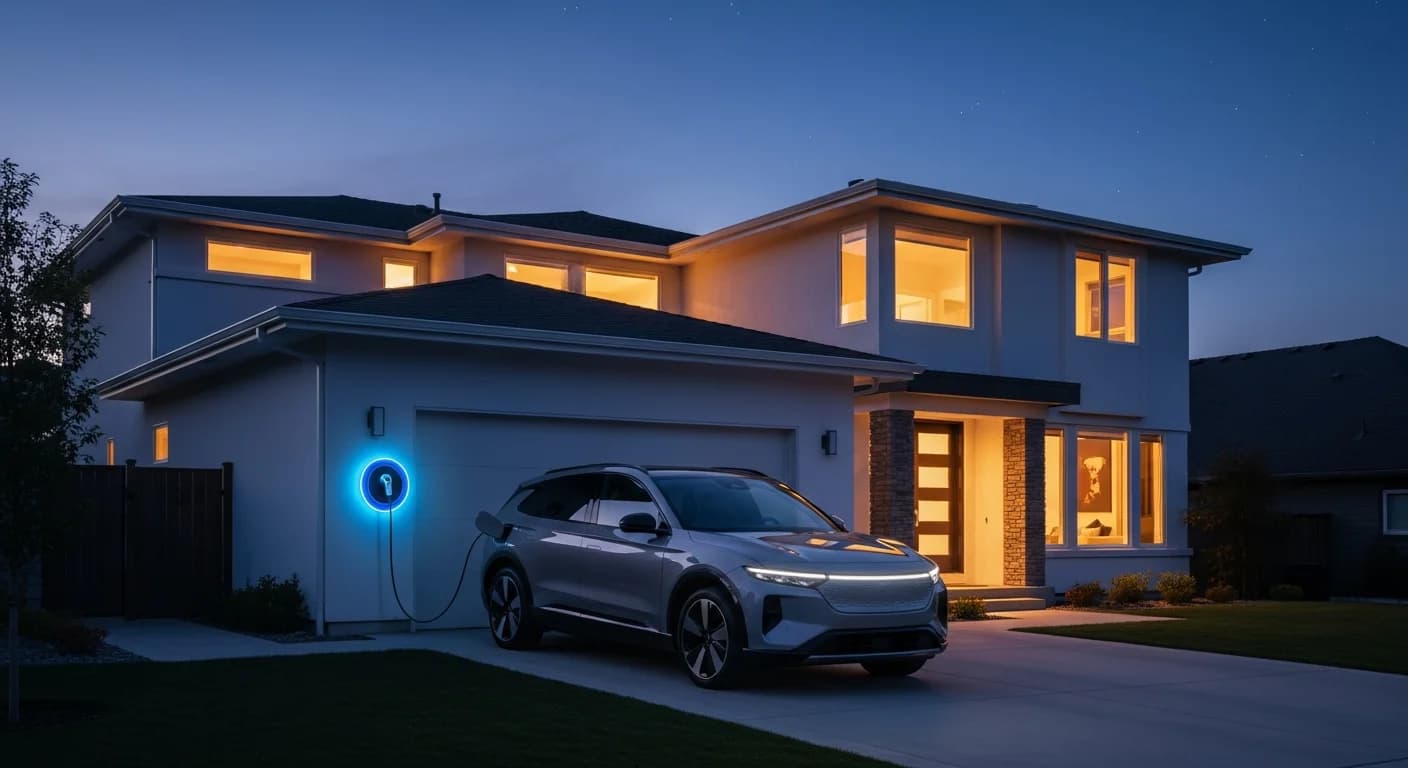
U.S. electricity customers averaged 11 hours without power in 2024, nearly double the prior decade’s average (EIA, 2025). If you drive an electric vehicle, you may already own the solution. The average EV battery holds 69.5 kWh of energy, enough to run a typical American home for about two days (Environment America, 2025).
But you can’t just plug your house into your car. You need the right vehicle, a bidirectional charger, and a proper installation. This guide answers whether your EV can power your house, which vehicles support it, how long the backup lasts, and what the whole setup costs.
For a deeper look at how this technology works, read our guide on how vehicle-to-home technology works.
Key Takeaways – About 14 EV models support V2H (vehicle-to-home) backup power in the U.S. as of 2026, led by Ford, GM, Hyundai, and Kia – The average EV battery (69.5 kWh) can power a typical home for roughly two days during an outage (Environment America, 2025) – Complete V2H equipment costs $4,000-$10,000 installed, about half the price of a dedicated home battery – Your EV must be home and plugged in when the outage hits. Pairing V2H with a small stationary battery solves this limitation
Can an EV Really Power Your House?
Yes, your EV can power your house during an outage if it supports bidirectional charging and you have the right equipment installed. Roughly 630,000 V2H-capable EVs are already on U.S. roads, and that number is climbing fast as automakers standardize the technology (Electrek, 2026). With a compatible vehicle, a bidirectional charger, and a transfer switch, your car’s battery can keep your lights, refrigerator, and HVAC running through a multi-day blackout.
The technology is called vehicle-to-home (V2H). It works by reversing the flow of electricity: instead of pulling power from the grid to charge your car, a bidirectional charger pulls stored energy from the car and feeds it into your home’s electrical panel through a transfer switch.
Don’t confuse V2H with V2L (vehicle-to-load). V2L is the 120V outlet on some EVs that can charge a phone or run a small appliance, which is useful for tailgating or camping but nowhere near powerful enough to keep your house running. V2H feeds AC power through your main breaker panel, covering full circuits like HVAC, the water heater, and your kitchen.
One safety point that matters: never try to “backfeed” power through a standard 240V outlet with a homemade cable. It’s dangerous to utility workers and violates electrical codes in every state.
From our installs: The most common question homeowners ask us is whether their car needs to be home during an outage. The answer is yes. If you drive to work and the power goes out while you’re away, V2H can’t help. We’ll cover the solution to that problem later in this article.
Which EVs Can Power Your Home in 2026?
About 14 of the roughly 70 EV models sold in the U.S. support bidirectional home backup as of 2026 (Inside EVs, 2025). GM has standardized V2H across its entire Ultium platform, making it the largest V2H fleet on American roads with 246,000+ capable vehicles sold in 2025 alone (GM Newsroom, 2026).
Here’s who supports V2H right now, organized by manufacturer:
GM (Ultium platform): Chevy Silverado EV (up to 200 kWh), Chevy Equinox EV, Chevy Blazer EV, Cadillac Lyriq, GMC Hummer EV, GMC Sierra EV. GM’s V2H Bundle pairs with all Ultium vehicles.
Ford: F-150 Lightning (98 or 131 kWh) with the Intelligent Backup Power system through Sunrun’s Home Integration System or Ford Charge Station Pro.
Hyundai/Kia: Ioniq 5 (77.4 kWh), Ioniq 6, Kia EV6, Kia EV9 (99.8 kWh). All use the 800V architecture that supports bidirectional charging.
Nissan: Leaf (40-62 kWh) and Ariya. Nissan pioneered V2H in Japan over a decade ago.
Tesla: The Cybertruck includes Powershare, delivering up to 11.5 kW for home backup. Tesla has announced broader V2H rollout across its lineup.
For the complete compatibility breakdown, see our full list of V2H-compatible vehicles in 2026.
How Long Can an EV Power Your House?
The Ford F-150 Lightning can power an average U.S. home for up to three days at normal usage, or up to 10 days if you limit consumption to essentials (Recharged, 2026). Your actual backup time depends on two variables: your EV’s battery size and how much electricity your home draws.
The math is simple. The average American home uses about 30 kWh per day. Divide your EV’s battery capacity by 30, and you get a rough estimate of backup days. A Chevy Silverado EV with its 200 kWh pack gives you roughly 6.7 days. A Hyundai Ioniq 5 at 77.4 kWh gets you about 2.6 days.
Those numbers assume you’re starting with a full charge and running the whole house at normal consumption levels. In practice, most V2H setups prioritize essential circuits: the refrigerator, lighting, Wi-Fi, a few outlets. Running only essentials drops your daily draw to 10-15 kWh, which doubles or triples your backup time.
A few things that eat through battery fast: central air conditioning (3-5 kW), electric water heaters (4.5 kW), and electric dryers (5 kW). If you’re in the middle of a summer heat wave, your EV backup won’t last as long as it would during a mild-weather outage.
For comparison, a single Tesla Powerwall 3 holds just 13.5 kWh. That’s roughly 12 hours of essential backup. Your EV holds 4 to 15 times more energy.
See If Your EV Qualifies for V2H
Eos installs V2X modules and home batteries. Get a free assessment to find the right backup setup for your home and vehicle.
What Equipment Do You Need for V2H?
A complete V2H system costs $4,000-$10,000 installed, roughly half the price of a dedicated home battery like the Tesla Powerwall 3 at $14,500-$18,000 (EnergySage, 2026). You need three components: a bidirectional charger, a transfer switch or energy gateway, and professional installation.
The bidirectional charger is the core piece. It converts DC power from your EV’s battery into AC household power and manages the flow in both directions. Popular options include:
- Ford Charge Station Pro: ~$3,895 hardware (pairs with F-150 Lightning)
- GM Energy V2H Bundle: ~$6,000-$8,000 (works with all Ultium EVs)
- Wallbox Quasar 2: ~$4,000-$6,000 (works with multiple brands)
- Tesla Powershare: ~$1,990 (Cybertruck only, currently)
The transfer switch ($800-$2,500) isolates your home from the grid during an outage. This is a safety requirement, not optional. It prevents your system from backfeeding electricity onto utility lines where workers may be making repairs.
Installation adds $1,000-$3,000 depending on your electrical panel, the charger location, and whether you need a panel upgrade.
From our installs: The most common surprise we see is panel upgrades. About a third of homes we evaluate need a 200-amp panel upgrade before V2H installation. If your home still has a 100-amp or 150-amp service panel, budget an extra $1,500-$3,000 for the upgrade.
What If Your Car Isn’t Home During an Outage?
The smartest solution is to pair V2H with a small stationary home battery so you’re covered even when the car is away. V2H’s single biggest limitation is that your EV must be home and plugged in when the power goes out. If you commute to work every day, your car is gone during a significant chunk of the week. Storms don’t check your schedule.
Think of it like a relay race: the home battery runs the first leg while your car is away, and the EV picks up the baton when you get home for the long haul. A 5-10 kWh stationary battery covers the first hours of any outage automatically. When you return and plug in, the EV takes over as the deep reserve for multi-day backup. The V2H market is growing at 24.3% annually, projected to reach $532.6 million by 2032 (Business Research Insights, 2025), and this hybrid approach is a big reason why.
This combination gives you always-on coverage (from the home battery) plus massive capacity (from your EV). It costs less than two Powerwalls, and it protects you in the one scenario where V2H alone fails.
Planning tips for V2H owners:
- Keep your EV above 50% state of charge when severe weather is forecast
- If you have two cars, designate one as the “backup car” that stays home during storms
- Set your bidirectional charger to maintain a minimum charge floor so you always have driving range
Eos installs V2X modules that bridge the gap between your EV and a stationary battery. Talk with our team to see if V2H plus a home battery is the right setup for your home.
Compare V2H with other backup options in our V2H vs Powerwall comparison and explore whole house generator alternatives.
Add a Home Battery to Complete Your Backup Setup
Pair your V2H system with a stationary battery for always-on coverage. See what it costs for your home.
Frequently Asked Questions
Is it safe to power my house with an EV?
Yes, when using proper V2H equipment installed by a licensed electrician. Bidirectional chargers meet UL safety standards and include built-in protections against overload, ground faults, and backfeeding. The transfer switch isolates your home from the grid, protecting utility workers. Never attempt to backfeed power through a standard outlet.
Does V2H damage my EV battery?
No. Modern bidirectional chargers manage charge cycles carefully, and V2H typically uses shallow discharge cycles that are gentler than fast charging. Most EV manufacturers warranty their batteries for 8-10 years or 100,000 miles regardless of V2H use. Battery degradation from V2H is minimal compared to normal driving.
How much does V2H cost in 2026?
A complete V2H setup runs $4,000-$10,000 installed (EnergySage, 2026). For comparison, a Tesla Powerwall 3 costs $14,500-$18,000 installed and stores only 13.5 kWh, while your EV likely holds 60-200 kWh.
Can I power my whole house or just some circuits?
Most V2H systems deliver 9-12 kW of continuous power, enough to run an entire home including HVAC. Your electrician will configure which circuits receive backup power based on your priorities. Essential-load setups (fridge, lights, Wi-Fi, a few outlets) stretch your EV’s battery two to three times longer than whole-home coverage.
What happens if the power goes out while I’m driving?
Your home has no V2H backup until you return and plug in. This is V2H’s primary limitation. The solution is to pair V2H with a small stationary home battery (5-10 kWh) that provides instant, always-on coverage for the gap. See our guide on battery backup systems for homes and businesses for options.
The Bottom Line
Your EV can absolutely power your house during an outage, but only if you have the right vehicle and equipment. About 14 EV models support V2H today, with more coming every year. The cost is $4,000-$10,000 installed, roughly half what a dedicated home battery costs.
The one catch is that your car needs to be home. For complete coverage, pair V2H with a small stationary battery so you’re protected around the clock.
Eos installs V2X modules alongside home batteries to give homeowners the best of both worlds. Get a free assessment to find out if your EV qualifies for V2H and what the right backup setup looks like for your home.