Best Surge Protector and Battery Backup for Your Home in 2026: What Actually Works
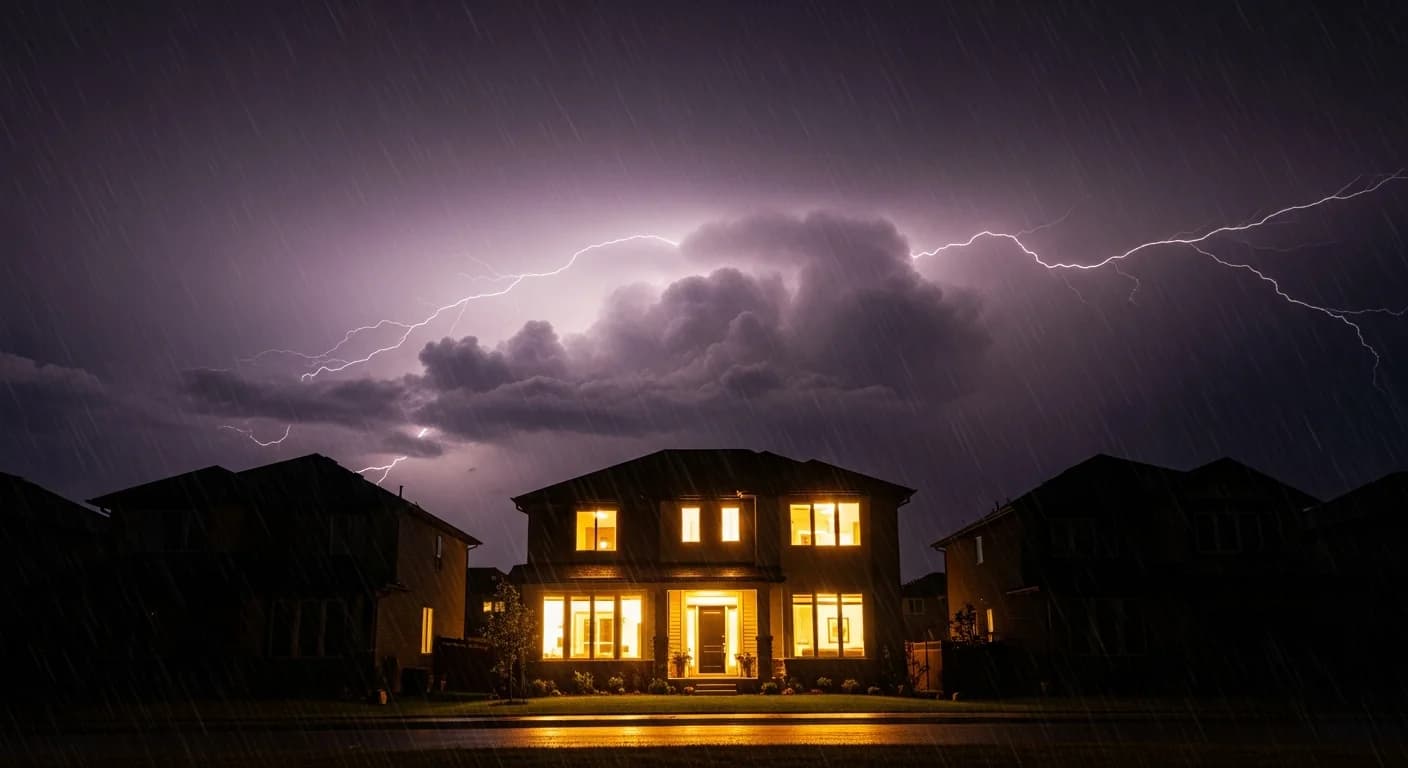
Best Surge Protector and Battery Backup for Your Home in 2026: What Actually Works
Nearly 28.3% of U.S. homeowners experienced at least one power outage in 2023 — and most of them reached for a surge protector as their first line of defense (U.S. Census Bureau, 2024). There’s a problem with that: surge protectors don’t produce backup power. They never have.
The gap between what most homeowners think they’re protected against and what their equipment actually covers is enormous. A surge protector absorbs voltage spikes. A small UPS buys maybe 10 minutes to save an open document. Neither keeps your refrigerator running, your HVAC on, or your home livable during an extended outage.
This guide explains what each protection tier actually does, where each one fails, and what a whole-home battery backup system delivers instead — including how V2X technology lets EV owners use their car battery as an extension of their home’s backup capacity.
Learn more about the complete residential battery backup solution.
Key Takeaways – Surge protectors offer zero backup power — they’re passive voltage spike blockers, nothing more – Small UPS units last ~10 minutes, enough to save a file, not to survive an outage – 28.3% of U.S. homeowners experienced an outage in 2023; the average duration in 2024 was 11 hours (EIA, 2025) – Whole-home battery systems power essential loads for 12–24+ hours and switch on in milliseconds – V2X modules let compatible EVs add 60+ kWh of additional backup capacity to any home system
What’s the Actual Difference Between a Surge Protector, a UPS, and Whole-Home Battery Backup?
The typical surge protector has a lifespan of 3–5 years before its metal oxide varistors (MOVs) quietly degrade — often with no warning indicator (LSP, 2024). More importantly, it was never designed to produce backup power during a blackout. There are three completely different tiers of electrical protection, and only one of them qualifies as true outage protection.
Surge protectors are passive devices. Their MOVs absorb excess voltage from spikes — lightning strikes, grid fluctuations, appliance startup surges. When the surge arrives, MOVs take the hit so your devices don’t. When the power goes off entirely, a surge protector is just a power strip. It provides nothing.
Small UPS units (uninterruptible power supplies) add a battery, giving you roughly 5–10 minutes at typical loads. That’s enough to save your work and shut down a computer cleanly. It’s not enough to run a refrigerator, keep the lights on, or get through a storm. Most units also have a less-known limitation: only 2–3 of their 6 outlets carry battery power. The rest are surge-only.
Whole-home battery backup systems are a different category entirely. They connect directly to your home’s electrical panel, hold kilowatt-hours (not minutes) of capacity, and power your home — or essential circuits, depending on size — for 12 hours to multiple days. They switch on automatically in milliseconds when an outage starts.
MOV degradation is also worth flagging separately: each spike a surge protector absorbs reduces its remaining capacity, and devices installed in storm-heavy regions like the Gulf Coast or Southeast may fail years before the labeled lifespan. There’s typically no indicator when this happens. Silent failure is the most dangerous kind.
See also: how battery backup systems work for homes and businesses.
Why Surge Protectors and Small UPS Units Fail During Real Outages
The numbers make the case directly. U.S. customers averaged 11 hours without power in 2024 — the highest in a decade, with hurricanes Beryl, Helene, and Milton accounting for 80% of those lost hours (EIA, 2025). Against an 11-hour outage, a device that lasts 10 minutes isn’t a backup plan. It’s false confidence in a plastic case.
What does 11 hours without power actually cost a household?
- Refrigerator contents stay safe for about 4 hours with the door closed. After that, food starts spoiling — replacing the average refrigerator runs around $200.
- Hotel stays run $150/night. A two-night summer outage when heat makes the home uninhabitable adds $300 before you’ve replaced a single meal.
- Pipe damage from a winter outage without heat can hit $10,000. A failed sump pump during heavy rain: $25,000 or more in basement flooding.
The U.S. economy absorbs an estimated $150 billion in annual losses from power outages (RMI, 2024). Most of that falls on households and businesses who had some protection — just not the right kind.
Worth noting: surge protectors in storm-heavy regions like the Gulf Coast or Southeast often fail years before their labeled lifespan. Each spike they absorb reduces remaining MOV capacity. There’s no warning light, no beep, nothing to signal the device stopped working. Homeowners who haven’t replaced their surge protectors in 3–5 years may already be unprotected without knowing it.
The residential backup power market is growing at 7.6% annually precisely because homeowners are learning this lesson after the fact (SkyQuest, 2025). The demand isn’t coming from tech enthusiasts — it’s coming from families who’ve lived through a multi-day outage and don’t intend to do it again.

Read more: battery backup systems for homes — what to expect during an outage.
What to Look for in a Whole-Home Battery Backup System
A whole-home battery backup system costs $8,000–$20,000 installed before incentives, with most homeowners landing between $10,000 and $14,000 for a properly sized system (EnergySage, 2025). That range makes specification decisions matter — undersizing by 5 kWh can be the difference between making it through a two-day storm and not.
Here’s what actually separates a solid system from an undersized one.
Capacity (kWh). This is the number that drives everything else. A 10 kWh system powers essential circuits — refrigerator, lights, Wi-Fi, phone charging, furnace fan — for roughly 10–12 hours. Add electric HVAC, a well pump, or an EV charger and you need 20–30 kWh for the same duration. Most installers recommend sizing up rather than down.
Inverter type. A hybrid inverter manages solar input and battery output from a single unit — cleaner installation, better efficiency. If you have solar or plan to add it, hybrid is almost always the right choice. If you’re battery-only for now, a standard battery inverter works fine and can be replaced later.
Professional installation. A whole-home battery connects to your electrical panel. This requires a licensed electrician, permits, and inspections. Installers who skip the permit step are cutting corners you’ll pay for — especially on insurance claims after an outage.
Financing. In-house financing converts a $10,000–$15,000 capital decision into a monthly line item. Monthly payments for a financed whole-home system often come out lower than a single extended-outage hotel stay and food replacement bill combined. The protection starts immediately; the payment spreads over years.
Monitoring and warranty. App-based monitoring lets you see charge level and current load in real time. A 10-year warranty on the battery cells is the current standard — shorter is a flag worth investigating before signing.
In installation after installation, homeowners consistently underestimate their actual load. Before sizing a system, walk through your home and list everything that would need to run during an outage — not just lights, but the refrigerator, any medical devices, communication gear, and whether you’d run HVAC. Then size for that list, not for a best-case scenario.

Not sure what size you need? Talk with our team to size your system.
Know Exactly What You’re Protected Against
Get a free home assessment — find out what a whole-home battery covers and what monthly payments would look like.
The V2X Advantage: Your Electric Vehicle as Emergency Backup Power
If you own an electric vehicle, you may already have a 60–100 kWh battery parked in your driveway — and most EV owners don’t know it’s available for home backup. In 2023, 42% of new EV buyers chose V2H-compatible vehicles. By 2024, that number rose to 53% (GlobeNewswire, 2024), and General Motors alone sold over 246,000 V2H-capable vehicles in 2025.
The majority of new EV purchases now include bidirectional capability. The gap is on the home side.
V2X (vehicle-to-everything) technology lets a compatible EV send power back into your home through a bidirectional charger. An optional V2X module — added at installation or retrofitted later — bridges the EV and the home’s inverter system. During normal operation, your car charges as usual. During an outage, the system automatically draws from the EV battery to supplement your home storage.
The math is compelling. A 60 kWh EV battery powering essential home loads at ~1 kW average draw lasts over 60 hours — nearly three full days without the grid. That’s more than five times the duration of the 2024 national average outage. See how vehicle-to-home backup compares head-to-head with the Tesla Powerwall.
Despite this, 42% of EV shoppers have never heard of vehicle-to-home technology (GlobeNewswire, 2024). According to Wood Mackenzie, global V2X installed capacity is expected to double in the near term as residential adoption expands (Wood Mackenzie, 2025). For EV owners, a V2X module may be the single highest-impact home upgrade available right now.
Explore the full residential solution including V2X.
How Much Does Whole-Home Battery Backup Cost — and Is It Actually Worth It?
The residential backup power market reached $13.85 billion in 2025 and is projected to grow to $24.88 billion by 2033 at a CAGR of 7.6% (SkyQuest, 2025). That growth isn’t driven by early adopters chasing gadgets — it’s driven by homeowners running the numbers after one bad outage.
Installed systems run $8,000–$20,000, depending on capacity and site complexity. Financed at standard rates over 7 years, that’s roughly $120–$300/month. Now compare that to what a single extended outage actually costs.
One outage involving pipe damage or basement flooding can cost more than the total financed payments on a whole-home battery system over its entire 10-year warranty period. Most homeowners don’t run that math until after the damage is done — and by then the window to act cheaply has already closed.
In-house financing is the key lever here. It converts what looks like a $12,000–$15,000 capital decision into a monthly line item — often smaller than a streaming bundle and a gym membership combined. Protection starts day one. The payment spreads across years.
See financing options on the residential solution page.
Stop guessing what you’re actually protected against. Get a free home assessment and see exactly what a whole-home battery backup system would cover for your property — and what monthly payments would look like with in-house financing. Schedule Your Free Assessment →
Ready to Upgrade from Surge Protectors?
Eos installs whole-home battery systems with in-house financing and same-week installation.
Frequently Asked Questions
Does a surge protector protect against power outages?
No. A surge protector blocks voltage spikes from the electrical grid but provides zero backup power when the grid fails entirely. During a blackout, it functions as a standard power strip. For actual outage protection you need a battery-backed system — a whole-home battery for comprehensive coverage, or a UPS for individual devices. The two types solve different problems and don’t replace each other.
How long can a whole-home battery backup power a house?
A 10 kWh system powers essential loads — refrigerator, lights, Wi-Fi, furnace fan — for roughly 10–12 hours. A 20 kWh system roughly doubles that. With solar recharging, even a 10 kWh battery can extend coverage indefinitely during daylight. The U.S. averaged 11 hours per outage event in 2024, meaning a properly sized system covers the typical outage with capacity to spare (EIA, 2025).
What is V2X and does my EV support it?
V2X (vehicle-to-everything) is bidirectional charging technology that lets a compatible EV send power back into your home during an outage. As of 2024, 53% of new EV buyers chose V2H-capable vehicles. Brands including GM, Ford, and Nissan have expanded their bidirectional lineups significantly in 2025–2026. To use it for home backup you also need a compatible home charger and a V2X-capable inverter — your installer can confirm compatibility for your specific vehicle.
See V2X compatibility details on our residential page.
Is whole-home battery backup worth it for homeowners?
For most homeowners in storm-prone regions, yes. The national average outage in 2024 was 11 hours, and individual household costs per event range from $200 in minor food spoilage to $25,000+ when pipes or flooding are involved (RMI, 2024). Financed systems run $120–$300/month. One significant outage event typically exceeds multiple years of payments. Homeowners with sump pumps, well pumps, medical equipment, or EV charging needs see the clearest immediate return.
Conclusion
Surge protectors do one thing: block voltage spikes. They don’t generate power, they don’t run your refrigerator, and they don’t keep you home during a storm. The gap between what most homeowners think they’re protected against and what their equipment actually covers is where the real losses happen.
A whole-home battery backup system closes that gap. It powers your home automatically, runs for hours or days on a single charge, and — with a V2X module — connects to your EV battery for extended capacity you may already own. When in-house financing is available, the monthly cost is typically less than one hotel night during the outage it would have prevented.
The 28.3% of homeowners who experienced an outage in 2023 already know this. The question is whether you learn it before or after the next one.
Ready to take the next step? Talk with our team about your home.