Battery Backup for Houston Print and Sign Shops: A Ruined Job Is Not Recoverable

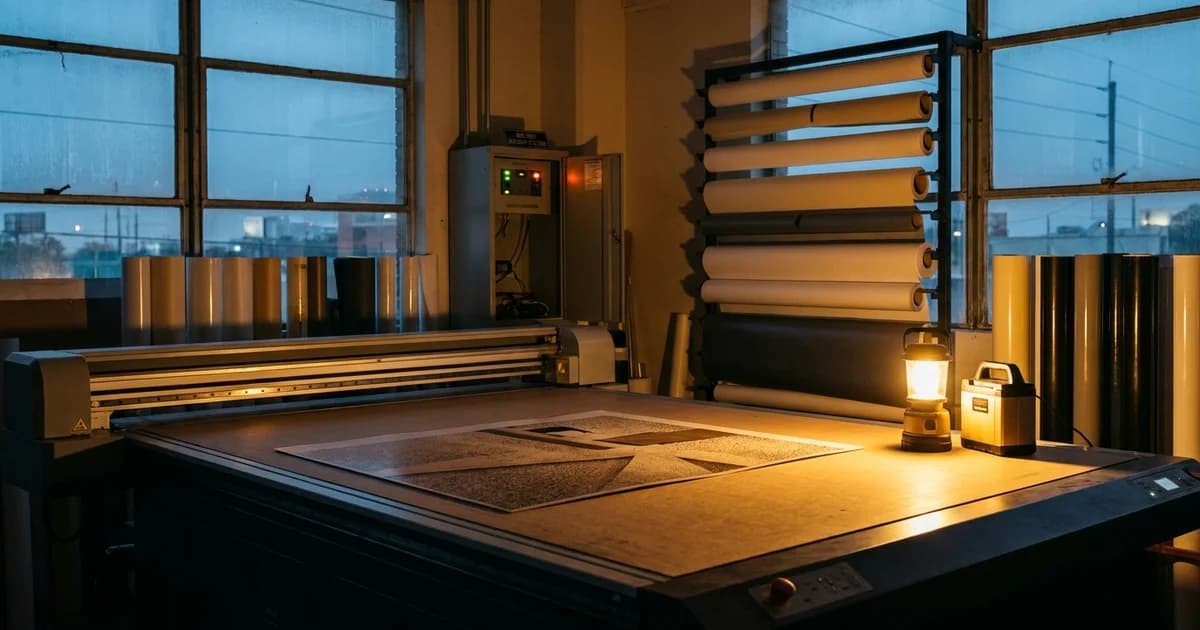
It is 2:14 on a Tuesday afternoon in July. A wrap panel is three quarters of the way through a pass on the flatbed. Then the lights go. That panel is scrap, the ink already laid down on it is scrap, and the install bay is still booked for Thursday.
That is what separates a print shop from every other small business on the block. They lose hours and earn them back. You lose material you already paid for. The shop described here is a composite, built from public benchmarks, standards documents, and Houston outage data. It is not a real customer. The loads, the failure modes, and the sizing ranges are real.
Key Takeaways
- An outage in a print shop destroys material instead of deferring revenue. The substrate, the ink on it, and the press time go together.
- Ultraviolet curing is chemistry, not a timer. Peer-reviewed work reports polymerization "is inhibited by air because the oxygen molecules scavenge the radical species" needed for crosslinking, so a pass that stops leaves an under-cured, tacky surface (PLOS ONE, 2015).
- Media is climate sensitive by specification: the standard conditioning atmosphere for paper and board is 23 C at 50 percent relative humidity (ISO 187:2022).
- U.S. customers averaged 11 hours without electricity in 2024, nearly nine of them from major events such as Hurricane Beryl (U.S. Energy Information Administration, 2025).
- One controller at 11.5 kW continuous and 17.1 kW surge covers the raster image processor, the file server, one production printer, and climate control. A full floor needs a multi-controller design.
Why does an outage cost a print shop more than most businesses?
Because a print shop converts material, and material caught halfway through conversion has no salvage value. In 2024, U.S. electricity customers averaged 11 hours of interruptions, nearly nine of those from major events such as Hurricane Beryl, and major events drove 80 percent of all interruption hours (U.S. Energy Information Administration, Today in Energy, 2025). A restaurant loses that day's covers. You lose the sheet, the ink, and the press time already spent on it.
[UNIQUE INSIGHT] So the priority order here is not the usual one. Protect the file and the job queue first. Protect the machine second. Protect production third.
What happens when a wide format or UV printer stops mid-pass?
The pass fails, it does not pause. On a roll-fed machine the media has to be re-registered, and re-registration on a partially printed roll rarely lands cleanly, so the printed section plus the lead-in becomes waste. On a flatbed, the sheet has ink on part of it and nothing on the rest.
The cure is the part owners find hardest to explain to a customer. Ultraviolet ink stays liquid until radiation triggers free-radical photopolymerization, and cutting the radiation does not hold the reaction in place. Peer-reviewed work records that the rate "is inhibited by air because the oxygen molecules scavenge the radical species" required for crosslinking, so a region that got an insufficient dose stays incompletely cured and highly tacky (Alvankarian and Yeop Majlis, PLOS ONE 10(3):e0119658, 2015). Soft ink is not a finished graphic, and running the lamp again does not repair that band.
Then there is the head. A service station caps the printhead between jobs, "sealing the nozzles from contamination and drying," because ink pigments dry out and block the nozzle apertures (USPTO Patent 6,497,471). A hard power loss can leave a head parked outside its cap. Whether that becomes a service call depends on the machine and the outage length.
The load nobody protects: the raster image processor and the file server
The smallest electrical load in the building holds every customer's artwork. The raster image processor turns files into machine instructions, and the server beside it holds source art, approved proofs, color profiles a shop spent a year tuning, and the tickets that say what is due Thursday.
A desktop uninterruptible power supply is the wrong tool for the duration. It buys minutes for a graceful shutdown, which is useless across a Beryl week. Our guide to
takes that runtime argument further.[PERSONAL EXPERIENCE] On Houston site surveys, owners name the big printer first and the workstation last, every time. The workstation is the one holding the queue.
Surge loads: routers, cutters, and shop air
Sign fabrication is where demand spikes. Routers, plotters, saws, vacuum tables, and air compressors are motor loads, and a motor does not draw its running current at the instant it starts. NEMA MG 1 classifies standard Design B induction motors by locked-rotor current, several times full-load current at startup. That is why a system carries headroom: 17.1 kW surge against 11.5 kW continuous absorbs a start like that without dropping the rest of the panel.
And the irreversibility point returns. A router that loses spindle power mid-cut does not stop politely. The bit is in the material, and that sheet of acrylic or composite panel is scrap.
Climate control is production equipment in a print shop
Media and adhesive vinyl are specified to a conditioned environment, so when the air handling stops, your stock drifts out of spec. The standard atmosphere for conditioning and testing pulp, paper, and board is 23 C at 50 percent relative humidity, with a tropical alternative of 27 C at 65 percent (ISO 187:2022). Sheets curl, registration drifts, and a stack that sat through a humid outage does not feed the way it did Friday.
During the Beryl restoration, National Weather Service heat indices ran 100 to 106 F (National Weather Service Houston, 2024). A shop with no air handling that week is not a storage environment for laminate or adhesive vinyl.
Ventilation is a legal interlock, not a comfort item. Where spray finishing happens, federal rules require electrical equipment to be interlocked with the ventilation so it cannot operate unless the fans run, and require ventilation to keep running after spraying long enough to clear vapors from drying coated articles (OSHA 29 CFR 1910.107; see also NFPA 33). One outage takes the booth and the exhaust clearing work already drying.
A composite Houston sign shop through the Beryl week
Picture a single-location shop in a leased Houston suite: a roll-fed printer, a flatbed with ultraviolet curing, a laminator, a plotter and a small router, a workstation and file server, a front counter, racked roll stock, six people. Composite again, not a real client.
Beryl made landfall on a Monday in July 2024 and knocked out roughly 2.2 million CenterPoint customers at peak (Houston Public Media, 2024), with more than a million still dark days later (Texas Tribune, 2024).
Inside: a wrap job dead on the flatbed, a trade show set half cut on the router, an install bay booked Thursday and an event happening Saturday whether or not the panels exist. Customers calling about jobs nobody can look up.
Here is the part unique to this vertical. The shop does not only lose the outage days. It loses the following week, because ruined jobs get remade at its own cost while that week's schedule is already full.
With one controller live, the artwork and the queue never went down, the flatbed finished the pass it was in, the suite stayed conditioned enough to keep stock usable, and Thursday's install happened. Capacity was reduced. Nothing was destroyed.
How much battery does a Houston print shop actually need?
One controller, rated 11.5 kW continuous with 17.1 kW surge, covers the irreplaceable layer: the raster image processor and file server, one production printer, climate control for the media room, the front counter, lighting, and security. Capacity is added in 9 kWh nominal blocks, 8.76 kWh usable each, sized to the production hours you want to hold.
Now the limit. A flatbed, a roll printer, a laminator, a router, and a compressor running together is a multi-controller design, and for a multi-day regional event the honest answer is a battery paired with a generator. Anyone promising whole-floor backup off one small system is selling a disappointment.
The design work happens at the panel, where an electrician separates the finish-the-job circuits from the full-floor circuits so the smaller system never sees the whole shop. Pricing is quoted per address after a site survey. Our
covers panel-level design in depth.Battery or generator for a leased print shop suite?
For a leased suite, a battery clears the three obstacles that kill most generator projects: no exterior slab or gas line the landlord has to approve, no exhaust and noise clearance beside the next tenant, and no fuel run during a regional outage.
Transfer time is what decides it in this vertical. A generator has a transfer gap, and a transfer gap is a stop. In a print shop the stop is the entire loss event, so a system that restores power ten seconds later has already let the panel be ruined and the head be parked. An instantaneous transfer is the only kind that saves the pass instead of shortening the recovery.
The counterpoint stands: for a full floor running everything at once through a multi-day event, a generator or a paired system fits better. On the money side,
is worth reading, with one caveat. Standard downtime math undercounts this vertical, because it prices lost hours and never lost material.Or call Eos at 833-989-3737 to talk through your setup with an installer.
Frequently asked questions
What happens if a large format printer loses power mid-print?
The pass fails rather than pauses. Re-registering a partially printed roll or flatbed sheet rarely lands cleanly, so the printed section and the lead-in become waste, along with the substrate and the ink already applied.
Can you resume an ultraviolet print job after an outage?
Not reliably. The cure is a photochemical reaction, and where radiation stopped, oxygen inhibition leaves an under-cured, tacky surface (PLOS ONE, 2015). Restarting the lamp does not repair the band that got a partial dose.
Does a power outage damage a printhead?
It creates exposure. Service stations cap printheads during non-use because ink pigments dry and block the nozzle apertures (USPTO Patent 6,497,471), and a hard power loss can leave a head parked outside its cap.
How much battery does a print shop need?
One controller at 11.5 kW continuous and 17.1 kW surge covers the raster image processor, the file server, one production printer, climate control, and the front counter. Capacity is added in 9 kWh nominal blocks, 8.76 kWh usable each.
Is a battery better than a generator for a leased sign shop?
For protecting the job in progress, yes, because a generator's transfer gap is itself the stop that ruins the pass. For running an entire floor through a multi-day event, a generator or a battery-and-generator pair is the honest answer.
The goal is to lose only time
To restate it once: the shop above is a composite, not a real business. The failure modes and the sizing ranges are real, and they repeat every storm season in Harris County.
Material loss is what makes your outage different from the restaurant's next door. A cure cannot be resumed where it stopped. The smallest load in the building holds every customer's artwork. One controller covers the irreplaceable layer honestly, and the full floor is a bigger conversation.
Nobody should try to run a production floor through a hurricane. The goal is narrower: when the lights come back, the only thing you lost was time.
General information for Houston print, sign, and graphics operators, reflecting Eos specifications as of August 2026. The shop described is a composite illustration, not a client, and no runtime or business outcome is promised. Confirm equipment loads, electrical code, and permitting with the appropriate professionals.